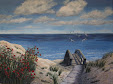
Showing posts with label Linda Blondheim. Show all posts

Friday, May 31, 2019

How to Create Depth in Landscape Paintings, Part II--Tips and Techniques

"Summer Reflections"
     Our previous post discussed some principles of atmospheric perspective. This time, a few tips about achieving it in a landscape painting and other techniques for creating the appearance of depth. You may be surprised by the degree to which careful planning and analysis can be involved in painting.

     One technique I learned from my painting mentor Linda Blondheim is the use of glazes. I think glazes are particularly useful in acrylic painting because acrylic hues are usually quite sharp and clear. Distant elements in a scene should look hazy, a bit "fuzzy", and have a pale, cool hue. 

     Although I try to begin with appropriate soft tones in the background, they often need to be pushed further back visually. Acrylic glazing liquid is useful for this. Depending on the size of the area that needs to be modified, mix a puddle of acrylic glazing liquid with just a touch of blue, purple, or even soft aqua paint. After mixing it well, use a soft brush to stroke it across the area that needs softening, blending out the edges a bit so as to avoid an obvious line. Don't worry if it looks too muted or cloudy; it will usually be fine when dry. Let the area dry well (this will take somewhat longer than normal acrylic paint drying time). You can repeat the process with another layer or two until you are satisfied with the result. 

     The far background of the painting " Summer Reflections" was treated this way, and the tree just to the left of the center was also pushed back, but less dramatically (just one layer was enough to help that tree recede). The painting I showed you last time, "Look to the Hills" was painted before I knew about glazes. I remember finding it difficult to handle the distant hills, probably scrubbing on bluish purple mixed with lots of titanium white to produce that hazy appearance of distance. 
A study of a marsh scene

     The relative size of objects in a scene also helps define distance. Your eye may be better than mine, but I have discovered that I sometimes tend to make far away objects larger on canvas than they should be. Since I work from reference photos, I sometimes actually measure something on the photo, then use a proportion (oh no! math!) to translate that to my canvas. For example, if the photo is 4" vertically, and my canvas is 16" vertically, a far line of trees that is about 1/4" tall on the photo would only be about 1" tall on the canvas if I wanted to keep precisely the same proportions. 

     Of course, I do not duplicate the reference photo and am not bound by precise numbers and proportions. The exercise of measuring simply serves as an aid and a suggestion as I work, which is open to change if the result doesn't look right. A study of a marsh (pictured here) which I painted early in my art journey was a combination of a little measuring and lots of free-styling. Artistic license is alive and well in my studio--alongside some analytic thinking.

Question of the day: Do you think that planning, analyzing, and measuring are compatible with creativity?


Saturday, April 15, 2017

"Falling Leaves" Hand-painted Silk Scarf

"Falling Leaves",  hand-painted silk scarf
     It's spring, but I recently completed a hand-painted silk scarf with an autumn theme and wanted to show it to you. "Falling Leaves" took several months because I was not happy with the way it was turning out and put it away for a time. Once the French silk dye is in the fabric, radical change is not possible--partial modification is the best one can do.

Musings on "failure" in an art project
     
     To be honest, the finished product is still not to my taste. However, I know that it could still be the perfect addition to the right outfit for the right person. 

Close up detail
Close up detail
     So, I refuse to count this scarf as a failure or even to be disappointed in it. For one thing, every art project is a learning experience, and sometimes what can feel like failure has more learning value than a "success". I am still quite new to French silk dye techniques and welcome any opportunity to learn and grow in the art. 

     A second reason comes from the wise words of my acrylic painting mentor, Linda Blondheim. Once, when she was advising me on improving a landscape painting, I had done all that we could think of, and we both still concluded that we didn't like the results. I told her I'd just gesso over it and reuse the canvas. "Oh no, Mary," she said. "This is not an intrinsically bad painting; it's just one you and I don't like a lot. Someone will love it; you wait and see." I've told this story before; that painting sold in a local shop long before others I like much better.

     Oh, in case you are wondering, here's why this scarf will never be a personal favorite (what a ridiculous sales pitch this is turning out to be! not a sales pitch at all--just sharing my thoughts): I had planned the leaf shapes and layout quite carefully and still like them. The background came last, working carefully around the leaves, which had been outlined in a gutta resist to prevent dye flow in or out of the shapes. For some reason, I thought using a couple of colors would look nice and increase the versatility of the scarf as an accessory. Maybe a good idea for some scarves, but for this design, it made for too much going on. In my opinion, that is; others may feel differently, as Linda has taught me to realize

Question of the day: When have you been disappointed in the results of a project only to discover that others like (or even love) the results?

Friday, October 30, 2015

Favorite Paintings--When to Keep, When to Sell

"Summer Reflections" 18" x 24" in acrylic
     Every painting is a valuable learning experience, but some emerge as personal favorites. (Note that each photo caption is a link to earlier blog posts about that painting if you are interested in more background on any piece.) 

     Since we have down-sized our home in retirement and already have some treasured wall art, we have limited space for new pieces. If none of my babies left home, they would pile up under the bed and beyond, even though I am a slow painter with limited output. So, it has been delightful for me to connect with people who value a particular piece enough to purchase it. I have also enjoyed giving paintings as gifts--something I do carefully and only when I know for certain the recipient likes the work. 
"Castaway Island Cedars" 9" x 12" in acrylic

     However, a few particular paintings would be difficult to part with. They are not necessarily my best work; in fact some represent a creative struggle with a composition that stubbornly refused to come together for a time. Others feel like markers of growth and may have flaws or elements I would do differently now. My wonderful mentor, Linda Blondheim, taught me to value them all--from the earliest, awkward efforts on--because they represent the best I could create at the time.


"Look to the Hills, I" 18" x 24" in acrylic
     In a recent post, I showed you a painting called, "Hanna Park Heron", which found a wonderful home, but which I miss at times. Today's works are (at least for now) definitely not for sale. 

     Other artists (including the real professionals) seem to have varied viewpoints on keeping versus selling artwork. I have heard some say that "everything is for sale" and that it's foolish to hang on to anything, while others treasure certain works in what is often called "the collection of the artist". Of course, I am a simple hobbyist (though a serious one) and am fortunate not to have to make a living through my art (which would be a pitiful living, indeed!). That leaves me freer to choose what and when to sell.

     Why these three? The first is from 2014 and just pleases me no end; I particularly like the clear focal point, feeling of depth, and optimistic mood. The second is from a walk in a favorite preserve and feels serene and very typical of North Florida. The third is an earlier work, inspired by our 2006 revisiting of a lovely retreat center in New York and the memorable time we spent there with precious friends.

Question of the day: What special objects are your "keepers"--whether or not you made them?


Thursday, December 20, 2012

Favorite Paintings Part II--Works from 2008 & 2009

     In this reflective end of the year time, we will look back today. Several months ago, I posted some of my personal favorites among older paintings and will continue that theme today. Since painting is relatively new in my life, the "oldies" don't go very far back. However, it feels as though I have learned  and grown significantly in the last 3 or 4 years and (although others may not notice a dramatic difference) can see improved elements in some more recent work. Of course, art works always have a mind of their own, so that unexpected results--for good or ill--can come along anytime. The process, the journey, and the sheer scary fun of trying are worth the ride no matter how various pieces turn out. I never fail to learn from every painting session.


     I won't repeat the background and reflections from the earlier favorites post. However, one insight from my mentor Linda Blondheim is worth recounting today. I once told her that a painting teacher had said to us students that she was sometimes ashamed of her early work and didn't like to think of the pieces people had bought back then still being on display. Linda agreed with me that the artist's feelings seemed sad and shared her own outlook. Of course, Linda has learned a great deal and grown as an artist over the years, but every time she has painted, she did the very best she could at the time. So, she is pleased if those works were appealing to buyers--or even if not--and truly values each of them. A healthy, motivating outlook, I think.


     The earliest of these three pieces is the 18" x 24" vertical creek view with the egret seen above. As the piece developed, I liked the fantasy feeling of the under painting in the streaky water and not-quite-realistic trees, so kept that aspect intact and called it "Creek Bend Fantasy". The second is the largest piece I have made so far, on a 22" x 28" canvas, called "Serenity"--also showing a creek bend where it pools. Both have garnered fans and favorable comments over several shows and in shops. The third painting, an 18" x 24" work called "Hanna Park Heron" sold at the very first Open Studio Reception in our home to friends who treasure it as a reminder both of many years of happy family outings in North Florida's Hanna Park and as a tribute to the majestic great blue heron who frequents the large pond behind their house. Descriptions of the process of creation for each piece and other details are in earlier posts; simply click on the links if interested.

     Thank you, dear readers, for your patience with my uneven posting schedule in recent months; I am recovering very well from hip replacement surgery and hope for more conversation with you in 2013. That partly depends on circumstances beyond my control; i.e., ME and my love for procrastination. I will do (some version of) my best :>). 

     May all of you enjoy a hopeful, peaceful Christmas and a joy-filled New Year.

Question of the day: Are you able to manage Linda Blondheim's positive, encouraging view of your past efforts? 

Friday, October 26, 2012

Newest Painting Is Complete--"River View at Kingsley Plantation"

     I felt a little rushed to complete this 18" x 24" acrylic on gallery-wrapped canvas in time to deliver it to Paddiwhack Gallery for a special exhibit. However, I am quite pleased with the result. "River View at Kingsley Plantation" utilized my cabbage palm painting photos and study, mentioned in the most recent previous post. It may not seem like a big deal to everyone, but creating the palm trunks and especially the palm canopy (and even the part of a canopy visible on the far right) required special study and careful work.

     Then, the first try after my studies produced a very nice canopy on the furthest palm away from the viewer (which appears in the middle of the three seen), but I painted much of it out and started again. That canopy had been very high on the canvas and was not seen in full (in other words, the viewer of the painting saw maybe the lower two-thirds of it at most). On e-critique advice from Linda Blondheim and on further reflection myself, I concluded that for good composition and better balance, that entire palm canopy needed to be lower so that it would be seen in full. Other changes from the main reference photo (seen below)--made to enhance the composition--included painting in a more interesting sky, adding a kite, which is one of Florida's gorgeous soaring shore birds, and simplifying the tall grasses.  My literal rendition of the bulkhead along the river at the Kingsley Plantation National Parks historic site bothered Linda. She would have preferred a softer, more organic, curving line, perhaps of the mud flats that line the river bank at low tide. I did consider her suggestion to replace the bulkhead, knowing that it would certainly work well. However, in the end, I stayed with the straight  bulkhead as it is, partly because viewers who have visited Kingsley Plantation have seen it there and partly because something about the sharper angles appealed to me as a change from some of the softer composition edges I have used in other pieces. 


     You can see other changes from the actual scene that I made in the painting. But, you can also see that this particular photo already represented a composition that appealed to me without major rearrangement. Compared to the times that I have used a reference photo that had appealing elements but was not composed well and required major revision in painting, beginning with a solid photo composition is much simpler and more satisfying.

Question of the day: Do you personally prefer fairly realistic--or even near photo-realistic paintings--or some other type such as impressionistic or abstract?

Thursday, October 18, 2012

Studying Cabbage Palms for Better Painting

In my newest painting, which I'll show you soon, three cabbage palms frame one side of the scene. They are seen fairly close up, so needed to be painted quite accurately. Painting a realistic cabbage palm tree proved more complicated than expected. After all, I thought, there were some decently rendered distant palms in some of my paintings, and I had good results with a tropical beach scene that had the island sort of palms near the viewer. Painting them close up was a whole new challenge, humbling, but very interesting.

Cabbage palms (technically the Sabal palmetto, Florida's state tree) are actually quite complex. The fronds in the canopy grow out on various levels as the tree grows taller. In nature, the lower fronds gradually brown, droop, and eventually drop off, sometimes cleanly and sometimes leaving spiky pieces of stem behind (as on the loosely trimmed palms in the photo above). At the national historic site scene I was working on, the browned lower fronds had been regularly trimmed away from the palms, leaving a mostly bright green "lollipop" shaped top. For visual interest, I had decided to add a few browned fronds hanging down, but did incorporate the fairly smooth trunk with no spikes sticking out, just as I saw it at the historic Kingsley Plantation. The plantation is one of our favorite places to visit or to bring out-of-town guests; if you wish, you can view previous Kingsley Plantation posts here.

As I worked to learn more about the cabbage palm, my mentor, Linda Blondheim, advised me and provided one of her own printed tutorials with detailed pointers on painting various species of palm trees. The tutorials may be available from Linda--here is a way to contact her. I also viewed dozens of palms on a perfectly timed weekend watching the dogs at our kids' beach town home while they were away. The yard of their home has gorgeous stands of palm trees, Then, just the shortest walk in their area provided many more palms to study and photograph--each with its own unique form and character. That weekend, I sketched a few palms and parts of palms to get a good feel for them and took dozens of photos, some showing a whole tree or stand of trees, others mid-range, and some intense close-ups for information about details. Back in the studio, the painting flowed much more successfully--will post the results soon.


By the way, please bear with me for a couple of months with less frequent posts. Mark is recovering well from recent rotator cuff repair surgery, and I go in next week for total right hip replacement. I plan to prepare a few posts the rest of this week (if all goes well) that can post automatically, but probably two posts a month will be my max for awhile.
Question of the day: Do you also find that one of the joys (and sometimes, frustrations) of creative pursuits is that each new project presents new challenges and opportunities to grow?

Saturday, September 29, 2012

"Sea Oats" Painting Revisions


     "Sea Oats", a 12" x 16" acrylic painting, is still a work in progress, but I think some current revisions have improved it. The newer version seen above now hangs on the studio wall for consideration. This piece will be part of a special exhibit I will have at Paddiwhack Gallery in Gainesville, Florida in less than a month. In spite of some on-going personal obstacles to getting maximum work done right now, I am determined to complete this painting and one larger piece in time to hang in Paddiwhack's honored front nook for a six week mini-show with other recent works. A previous post showed you the first exhibit I brought to this amazing store back in the spring of 2011.

     Some of you were very complimentary about the earlier version of "Sea Oats" I showed you awhile ago--seen below--but it wasn't quite satisfactory for me. It was too "pink" for my taste (others will differ on palette preferences, of course) and lacked punch. My mentor, Linda Blondheim, agreed, calling it a "pretty enough" picture, but also feeling that it was somewhat bland. 

     So, having added more tonal contrast, a more interesting sky, and more variation in the tones of the grasses and sea oats on the dune, I am happier with the piece. I have also reduced the power of the pink areas, substituting some quiet golden glow. Still am considering some minor adjustments, and may (or may not) change the placement of the birds (which will be sharpened a bit once their location is definite). Since I have signed up for one more week of Linda Blondheim's excellent e-critique, we will see what she thinks of this work once I have one other, larger piece ready for her assessment as well. She is a super teacher and guide and always understands that I may or may not include all her suggested revisions in the final form. As I have confessed to you before, I always have trouble knowing when a painting is finished (or finished enough, given that one could continue revising indefinitely--a process that eventually begins to detract from the vitality and impact of a work). So, Linda's assessment is also tremendously helpful in making that decision to sign a painting, give it a protective coat of medium, and consider it ready for prime time.
Question of the day: In any undertaking, do you agree that the assessment and revision process is almost as significant as the original concept for a good outcome?

Sunday, September 16, 2012

Favorite Paintings from 2007 and 2008

     Thinking back on the relatively few years I have been painting, I browsed the photo file, viewing earlier works, and spent some time feeling grateful for this rewarding pursuit. A few favorite early paintings stood out, although each and every piece has some interesting features, and each represents creative learning and growing experiences.

     About nine years ago, a week-long painting course at the John C. Campbell Folk School in North Carolina awakened a whole new pleasurable undertaking for me. I had expected to relax, stretch my mostly analytical mind beyond its comfort level, have fun making some messes, and come home refreshed. Well, with an excellent teacher, all my expectations were met--except one. The paintings were not total messes at all. Not that they were great art, but they were pleasing to me beyond anything I had ever thought possible.


     Since then, I have learned much more and refined my painting skills with occasional local classes, guidance from my painting mentor, Linda Blondheim, and lots of practice. Painting is a whole new, unexpected source of joy.

     So, as I looked back, I  found three photos to show you, each representing a particularly pleasing achievement for me. Each work has elements I would do differently today, but they were the best I could do at the time, and that's good enough. No need to be overly self-critical about them (or to whine to you about the short-comings I see in them now). 

     It's interesting how differently artists view their own earlier work. In one painting class, a very good teacher said that she sometimes cringed when she saw some of the paintings she had sold years ago. She was somewhat ashamed of those earlier works. That seems a pity; clearly they appealed to the buyers (and probably to others). Further, regardless of other peoples' opinions, they represent a stage in her creative journey which contributed to where she is now. Linda Blondheim's attitude strikes me as healthier and more self-affirming; she enjoys looking back and values every one of her paintings, convinced that each was the best she could do at the time.

     So, without apologies, here are three personal favorites from 2007 and 2008. For each, clicking on the link will pull up an earlier post describing their creation in more detail. "Look to the Hills", an 18" x 24" landscape, interprets a meaningful visit to a retreat center in Warwick, New York. The 12" x 16" marsh scene recalls a delightful day kayaking with my husband and one son (and later became an engagement gift for our son and his fiancee). The 9" x 12" "Magnolia on Purple" was based on photos of magnolia blossoms on some neighbors' trees. Each work brought frustration as I confronted its challenges, and each was a significant learning adventure. 

     Life's journey is always surprising--what if I had listened to my conviction that I had zero artistic ability?--what if I had never tried painting? By the way, I also value other less successful (or even totally bungled) ventures along my journey for the contribution they have made to the person I am today.
Question of the day: What surprising discovery have you made about your own abilities?

Thursday, July 19, 2012

The Encouragement of Past Achievements

     In the previous post, I mentioned having hit a fallow time in my painting. Browsing images of some of my past paintings was helpful--especially the works that were most difficult to complete. The dune bridge piece pictured here was very stubborn and resisted my efforts to produce a harmonious composition for some time. Looking at it now and recalling the many wrong turns I took in painting "Spring Breeze" reminded me of the wisdom of the saying "this too shall pass". I have felt reluctant to paint, unproductive, and just plain unable before. So, feeling that way should not be scary now and certainly is no excuse for hopelessness. 


     Linda Blondheim's e-critique service helped me rescue this piece from what seemed like an impossible mess. Some of the fixes she suggested did not work; others were ideal. Some of the adjustments I tried on my own were helpful; others were disastrous. But, with persistence, the sort of painting I envisioned creating finally emerged. In the visual arts, some revisions can't be evaluated until you see them in relation to everything else in the composition. Fortunately,  acrylic paints permit painting out unsatisfactory areas and covering them with new shapes, colors, and forms. I would be lost without the possibility of "do-overs".


     The main problem with what you might call the "first draft" was a lack of balance, I think. Keeping the viewer returning to a central focal point gives a work its power, and the wildflowers competed with the foot bridge for awhile. Also, being too literal about the slope of the dunes I had photographed for reference left me with too little variation in the line of the dunes. Since the horizon is inescapably straight, I needed to exaggerate the height of the left side dune and add more undulations to the dune outline (without overdoing it) as a contrast to that straight line. One trick I used to "try on" various dune lines was to cut a paper outline and tape it over the piece--then a different outline, etc., until it looked about right. 


     So, looking back on creative challenges I have faced and coped with in the past helped me get past the funky time and get back to work. "Spring Breeze" and other works remind me of the inevitable ups and downs of the creative process. This is not the first time I have felt as though I have forgotten how to paint, nor will it be the last time. All I need to remember is that the frustration has always been a temporary speed bump and that with faith and patience, the joy of creating will return.
Question of the day: Can you recall a troublesome season you experienced that you were able to work through in time? Can you draw strength from those memories to help you face new challenges?

Tuesday, July 10, 2012

Handling A Fallow Time for Creativity

     A few weeks ago, I showed you this photo from our trip to Maryland and commented that the clouds to the north at this Chesapeake Bay park were a dramatic contrast to the clear sky to the south at the very same moment, shown in another photo on that post. Recently, my creative skies have been on the cloudy side. Not totally bleak, mind you; there had been plenty of beauty in life just as there is in this scene. However, the creative process--my painting in particular--had gone somewhat stale.


     During the last couple of weeks, I have not felt like painting, and when I forced myself to the easel, the results were not satisfying. In addition, instead of being relaxing and absorbing, the painting process felt tense and unproductive. I gained renewed admiration and respect for professional painters, writers, and many others who create for a living and do not have the option of taking a break from the process as I did. Their self-discipline is inspiring--and difficult to emulate.


     When farmers let fields lie fallow for a season, the soil can renew and the new crop planted afterwards is healthier and produces better. It is definitely too early to tell if my (relatively brief) fallow creative season will lead to anything remotely similar. The good news is that the lull is apparently past for now, and painting is fun again. I am working on several pieces that I will show Linda Blondheim soon via photo images for her illuminating e-critique response. Whatever blocked the creative painting process resulted in unsatisfactory efforts for a time, but now it feels as though I have pushed through those particular difficult areas and am moving forward. 


     Possible responses to fallow periods include spending time away from the activity, as I did, or trying an oblique approach to the work. I could have shifted to goal-free sketching or tried a series of brushwork or other basic exercises to loosen up and move on. That might have been better, but for some reason seemed too much "like work". I am fortunate and thankful that giving myself a break from painting helped me return with joy. It did require getting behind myself and pushing at first, but the fuzzy feeling has passed and the clouds are parting.
Question of the day: How have you coped with the inevitable enthusiasm gaps in your work or hobby activities?


Friday, June 22, 2012

New Salt Marsh Painting--"Castaway Island Palms"

     The first of two 9" x 12" paintings I am working on from my exploration of Castaway Island Preserve might be finished. At least, it is very near finished and is ready to show you. The small palm hammock in the mid-distance across the salt marsh drew me to the scene. Paintings always take on a life of their own, and this one somehow became a bit darker and softer than my original vision, which seems fine. It hangs in my studio where I'll contemplate it occasionally to decide whether or not to make any further adjustments.


     I have been fortunate to have had the advice of two excellent painters on this piece. I began the work in Roger Bansemer's helpful two-day workshop, described in a previous post, and brought it home maybe 2/3 finished. A companion piece, also from a Castaway Island scene, got a rough start there, too--at least in its basic layout--and is now on my easel to be re-engaged.


     Linda Blondheim, my dear friend and mentor--and best painting teacher I have ever studied with--has also advised me as I worked to complete this piece. Given that she lives and works in Gainesville, Florida, a good 75 miles away from Jacksonville, our time together is limited. However, she offers an e-critique service which is extremely well-done. Periodically, I send her images of works in progress and ask questions about them. Her responses are encouraging, insightful, and precise, guiding the process without imposing her own style. She is that rare art teacher whose guidance helps students achieve their own vision to the best of their ability.


     The palette for this painting and its eventual companion piece is: ultramarine blue, cerulean blue, Indian yellow, cadmium yellow light, cadmium red, Payne's grey, buff, and white. This is the first time I have used Indian yellow, an orangy, yet not overly bright blend and enjoyed learning something of its mixing potential. Following Roger Bansemer's practice, I toned the canvas with a rub of burnt sienna before beginning. Once that is rubbed partly off, the resulting background is a mid-tone, which can help the painter judge tonal relationships as she adds first the major dark areas and then the lightest lights, and builds from there. In a departure from my usual technique, I let some of this undertone show through rather than completely covering it with full-strength paint. Handling the light in the scene was tricky, given a day that had been partly cloudy with a somewhat directionless glow and very subtle shadowing. Our weather has been unusually dry here in North Florida until recently; the marsh is undoubtedly much greener and thicker than when I last visited Castaway Island Park. I am reasonably pleased with the way this painting captures the light and mood of the day I was there.
Question of the day: Wouldn't life be sadder and poorer without compatible teachers and mentors?


Saturday, February 4, 2012

Techniques for Painting Shadows in Landscapes

Today, let's consider shadows in landscape paintings once more, this time considering a few "how-to" techniques. (Scroll down a bit for earlier posts on this topic.) Of course, since painting is very individual and variable, I realize that my techniques and methods are only one way to approach this important element in a scene. I would love to hear from other artists who approach shadow painting differently--as well as from readers who might "see" them differently. I think shadows are fascinating to consider.
"Wooded Path" is adapted from some photos I took on the extensive grounds of the Kingsley Plantation, which I have written about in several earlier posts. This historic site is nestled in an immense preserve area just north of Jacksonville, Florida. The Timucuan preserve includes salt marshes, wooded areas, and Florida prairie, as well as other land and water habitats. The 16" x 20" acrylic painting on gallery-wrap canvas shows a bend in a path as it leads deeper into the woods. Unfortunately, I was not able to get a good, true photo of this piece (don't know why that happens sometimes). The photo of the final version, seen below an earlier view and a detail of the foreground, looks misty in the mid-ground, whereas the actual painting is clear. The work-in-progress took a better photo--hope you can see some value in the improvements in the final version in spite of the poor photo.
At first, the path was too uniformly dark and mid-dark in tone, so in the work-in-progress photo above, you see that I have lightened whole areas, especially just before the bend. Then I added some shadow areas gradually, being careful not to overdo either the amount of shadow area on the path or the darkness of the tones.
Linda Blondheim, in one of her excellent workshops, helped me see that the foreground shadow of the tree trunk was too dark as it moved away from the tree. Real life shadows tend to be darkest at their "source" (right next to the object casting the shadow) and then partially fade along the length of the shadow. Actually, I knew that, but had not been successful in my attempts to vary the shadow. It never looked right. Linda advised that I pull in other path tones and colors from the sides of the shadow edge as it moved away from the tree. To my eye, that worked like a charm, much better than my earlier tries at just gradually lightening the color I used for the shadow as it extended out.
One other change, made before Linda's workshop, was to revise the curve of the path in the foreground. Although not related to shadows, I thought you might like to see that revision, too. In the earlier version, it seemed like the perspective was off, like the path sort of spilled into the viewer's lap. The detail photo shows my sketched lines for revision, which led to an improvement in the composition, I think .
Question of the day: Do you look at shadows differently after hearing about the challenges involved in painting them?

Tuesday, September 20, 2011

Open Studio Class--A Creative Community

On Saturday, I again traveled over to Gainesville, Florida, for Linda Blondheim's Open Studio Class. For this class, we each bring our own works in progress (especially those that seem not to be progressing :>) to Linda's retail loft studio above the Paddiwhack shop. We work at tables or bring an easel and enjoy ample opportunity to ask for advice and direction as we plan or paint. Linda is an ideal art teacher; she respects each student's vision and style (never trying to push us to paint her way), yet offering keen insights and helpful suggestions to help us do our best work. I wish she were nearer, as the drive takes me over an hour and a half each way--but it's all well worth it whenever I can make the trip.
Six of us came to paint this time, so we had plenty of kind encouragement and the inspiration of participating in a creative community for a couple of hours. At her Art Notes blog, designed as a kind of on-line journal describing her work and thoughts, Linda has posted a photo of this delightful group with the pieces we worked on. In the photos here, you see several of us at work with Linda's guidance. In the background, you can see the amazing paintings Linda shows in her Paddiwhack loft. I include a photo (not the best shot, I fear) of my 16" x 20" woodland path "work in progress". The path itself needs the most work. Once that is in better form, I will spruce up other areas, especially the intended focal point in the top right quadrant, with a double trunk tree and some red-orange wildflowers catching the sunlight. Hopefully, I will have the final version to show you fairly soon, although I alternate working on this piece with several smaller paintings that are on a deadline, so it will take some time.
Question of the day: Under what circumstances do you prefer working alone on a project, and when do you prefer a creative community?

Thursday, September 8, 2011

Painting Process--My Easel Set-up

Today, you see a typical set-up at my easel. For most paintings, I place an old piece of heavy poster board against the easel behind the canvas so that I can tape things to it for reference. Nearly all my landscape pieces are studio paintings based on actual scenes, so the main reference photos go up on the board first. Below, you see one of the marsh reference photos I am using for these small paintings. The other item you see in this easel photo is a sheet of paper with a couple of quick sketches and other notes. Many of you know that I am a planner, rather than painting completely spontaneously. However, the amount of advance planning varies for different paintings. This is a relatively simple example for a pair of 5" x 7" salt marsh paintings, currently in progress.
In the photo of the sheet of paper, you see that I have done minimal sketching for these pieces. Given their rocky progress to this point, I may have done better to prepare more detailed value studies, planning the balance of lights and darks--but I didn't this time. I also did less in the way of color studies than I might do for larger works, but I did explore some of the possible gold and buff mixes for the dry winter grasses. Notice (learned this the hard way) that I recorded the tube colors used for each mix and also wrote down the colors used for sky and water (though without a sample patch) and the list of tube colors for this particular limited palette. Some artists probably can do with less written down, but I often am working on several pieces at the same time, so one may be set aside for awhile. It definitely helps to have notes about color blends used when I return to a work in progress after some time has passed.
Linda Blondheim, my painting mentor, suggested this blog post topic when I journeyed over to Gainesville, Florida on Saturday for one of her Open Studio Classes. I am thrilled that she is offering this class again; she had stopped for a number of months, and I missed the guidance she offers painters with any work they bring to the gathering. When Linda saw this set-up, she felt that others might like a peek at my typical messy work board. You can find earlier posts on similar topics by entering "painting process" in the blog search box, top left of this blog. The June 28, 2010 post in particular shows the planning materials and easel set-up for a study of a shore bird--somewhat like this board. And, as always, you can click on a photo to enlarge it and see more detail.
Question of the day: What triggers, tools, or processes aid you in creative endeavors (whether "artistic " projects or creative problem solving and everyday living)?

Sunday, June 5, 2011

New Marketing Flyer for Gainesville, Florida Exhibit of Paintings

I am very pleased with the look of my new marketing flyer, prepared for the exhibit of my paintings at Paddiwhack in Gainesville, Florida. I think you can enlarge it by double-clicking on the image. A few posts ago, I showed you the grouping of paintings there and the Artist's Statement written for that show (it is framed and standing near the paintings). Both these publicity pieces will be useful in other contexts as well; I did not want to go to the time and expense of preparing and printing them just for this six week event.
I am grateful to painting mentor Linda Blondheim for excellent advice, generously shared, as I wrote and prepared these materials and to Lori Taylor of Trends Home Decor for layout assistance and low-cost printing for both pieces.
Whenever I visit other artists' shows, I pick up any well-done publicity pieces that are available. For one thing, I enjoy visiting their blogs and web sites and sometimes strike up an email correspondence with some artists, so like to have their contact information. The other reason I keep these materials on file is that they are helpful when I need to prepare my own publicity materials. Of course, I do not copy what another artist has to say. But, as you know, if you have tried to write any publicity piece from scratch, it can be very difficult. For me, it is doubly difficult to write about myself and my work--even though I enjoy sharing the works and their stories. I just feel blocked and shy about it. Viewing and reading the materials of others helps me get started.
So, I hope that others among you might find the ideas, layout, or other features in this flyer useful. Do not plagarize please :>), but feel free to use this or the artist's statement from the earlier post as a springboard for your own publicity materials. As I am inspired by all of you and your creativity (and I don't mean only the practicing "artists" among you, but all the bloggers who share thoughts and visuals), I hope that you find something stimulating or fun in this post.
Question of the day: Do you also find preparing publicity materials--or any necessary writing you are called to do--difficult, especially getting the process started?

Monday, January 31, 2011

Exploring--Unique Shop and Linda Blondheim's Painting Loft

On Friday, Mark and I drove inland to Gainesville, Florida, home of the University of Florida and of Paddiwhack Gallery, a unique treasure trove of art, furniture and accessories for the home as well as jewelry, wearable fabric art, and so much more. Our primary reason for the drive was to visit Linda Blondheim, my dear friend and painting teacher and mentor, in her new loft overlooking this large gallery/shop. Linda greets clients and friends there four afternoons a week in a warm, homey space full of her gorgeous central north Florida landscape paintings. Linda brewed us excellent coffee, offered us comfy chairs, and we enjoyed a long chat about a variety of topics. After awhile, Mark brought up our cooler with a nice bottle of Chardonnay. He had also found rolls from an excellent bakery in the same shopping area and mixed nuts from the Fresh Market next door to Paddiwhack.
What a lovely afternoon! If you are ever near Gainesville, don't miss the experience of spending time with Linda, who manages to combine the best of southern hospitality and a welcoming down-to-earth warmth with a lively mind and a sincere interest in her visitors. Two of the photos show Linda's loft (one with the artist herself seated at a table); the third photo is a small glimpse of Paddiwhack Gallery showing a nook in the front of this large, goodie-packed shop.
Come May and June, I will be the featured artist with paintings in this nook, which is just to the right of the front door as people enter. Of course, I am excited and honored to have this opportunity. Since I had not seen the shop before, you can imagine my delight in getting a look at the space where my work will hang and an opportunity to meet the owner and his knowledgeable staff. They answered my questions and offered advice that will help me prepare my exhibit.
Question of the day: What would make a perfect day's outing for you?

Tuesday, October 5, 2010

Learning and Growing--Painting Process for a Study of a Cypress Swamp

This work-in-progress is an 8" x 10" study using reference photos (I have posted two of them) from our visit to Babcock Wilderness Adventures, near Punta Gorda, Florida, on the Gulf Coast. I am considering what to paint on a 30" x 40" canvas waiting in the closet, which is larger than anything I have attempted so far. So, I am planning a few studies to try out some possibilities.
I first made full-page black and white copies of a couple of my photos to help me see the layout clearly. I love color so much that I have trouble seeing the "values" in a potential composition. "Value" refers to the relative lightness or darkness of objects, as if on a grey scale, and interesting value variation is a crucial element in good composition. Failing to consider value relationships can lead to a bland result, even if colors are varied and pleasing. I decided to make the sky and some of the background just a half-tone darker than they look in the photo so that the sunlight on the cypress trunks would draw the eye as the lightest areas in the piece. The reflections in the water also needed to be darker for the contrast and sense of mystery I hoped to achieve.
The actual scene has a cluttered appearance that is fascinating in nature, but not necessarily good in a painting. So, I decided to concentrate on the powerful cypress trunks themselves, to have some semi-abstracted vegetation on the far bank, and to leave most of the rest out. That one diagonal line in the photo is appealing, but just stole the whole show in my preliminary sketches (even though it was not intended to be a focal point), so I regretfully left that out, too.
I'll say more about the palette colors and later composition decisions when I post the final version--it is nearly done. Today, I wanted to show you the way I revised the scene before painting. Given that I was leaving out so much, the piece needed (in my opinion) a few more cypress trees. So, I played "cut and paste" with the photocopies until I had a pleasing arrangement of five trees, receding to the far bank. A rough line drawing helped in assessing placement.
Linda Blondheim provided very useful advice, as I was using her e-critique services during the early stages of this study. After getting the piece to the stage in the photo above, I had put it away while I completed a larger work and now am ready to finish it. Linda's question, "What do you intend as the focal point?" had me experimenting with a few possible finishing details. Soon, I will show you the result.
Question of the day: I love to hear about other people's thinking processes--in any context, whether is has to do with art or not. Do you find that interesting, too?

Tuesday, September 14, 2010

Learning and Growing--Painting Process on Dune and Beach Piece, "Spring Breeze"

Today's post is designed for readers interested in my landscape painting process and in composition design in particular. The photos above show earlier stages of "Spring Breeze", with the final version at the top. The lower left photo is quite early, with some elements, like the sky and footbridge, more developed and others, like the wildflowers, just barely indicated. It was a real challenge to get the balance and focal point to work well on this piece. My painting mentor Linda Blondheim provided invaluable advice during a couple of months of using her e-critique services. With her guidance, I gradually added more curve to the path--even the second version of the path in the photo on the right changed further later on. The evolution of the path illustrates how landscape artists sometimes need to adjust features in the actual scene for a more pleasing composition. The first version reproduces the way the path actually looked in my reference photo, but adding curves and more variation provided a much more graceful lead into the scene. In a departure from my usual process, I painted the footbridge in a fairly detailed form early on because I was strongly drawn to the sharp shadows cast by the railing. Since that area was my intended focal point, I worked to render the bridge in correct perspective from the beginning.
I have no idea how often I painted out and revised the wildflowers on the left side. Although they are a major element, I wanted them to balance, but not compete with, the footbridge and its interesting shadow pattern. An important step in solving the overly even seesaw look of the foreground was to make the left side dune higher. At one point, I cut some scrap paper into a much higher dune shape, taped it (with masking tape) to the canvas, and emailed that image to Linda. She agreed that a higher dune made the composition more interesting than having so many elements on roughly the same level, but suggested going a bit lower than the line of my cut-out. However, I hesitated before revising the dune so radically because Jacksonville Beach dunes are not that steep. We landscape painters vary, I think, in the degree to which we are willing to change the actual scene when we work from nature or reference photos. For several days, this work-in-progress stood on the fireplace mantel for consideration while I worked on other paintings. The need for a greater variation in line won out over realism. Also, since steeper dunes grace some nearby beaches, the change was not completely out of line.
If some of you are interested, I will talk about the process of painting the sky and clouds in "Spring Breeze"in a future post. It can be difficult to achieve a semi-transparent, wispy effect with acrylic paints, so sharing our methods could be fun.
Question of the day: More of a reflection than a question this time: For me, achieving an interesting balance of compositional elements in a painting, with both dynamic tension and restful features, seems like a metaphor for a set of life skills we all need. What do you think?