Showing posts with label Atlantic Ocean. Show all posts

Saturday, September 29, 2012

"Sea Oats" Painting Revisions


     "Sea Oats", a 12" x 16" acrylic painting, is still a work in progress, but I think some current revisions have improved it. The newer version seen above now hangs on the studio wall for consideration. This piece will be part of a special exhibit I will have at Paddiwhack Gallery in Gainesville, Florida in less than a month. In spite of some on-going personal obstacles to getting maximum work done right now, I am determined to complete this painting and one larger piece in time to hang in Paddiwhack's honored front nook for a six week mini-show with other recent works. A previous post showed you the first exhibit I brought to this amazing store back in the spring of 2011.

     Some of you were very complimentary about the earlier version of "Sea Oats" I showed you awhile ago--seen below--but it wasn't quite satisfactory for me. It was too "pink" for my taste (others will differ on palette preferences, of course) and lacked punch. My mentor, Linda Blondheim, agreed, calling it a "pretty enough" picture, but also feeling that it was somewhat bland. 

     So, having added more tonal contrast, a more interesting sky, and more variation in the tones of the grasses and sea oats on the dune, I am happier with the piece. I have also reduced the power of the pink areas, substituting some quiet golden glow. Still am considering some minor adjustments, and may (or may not) change the placement of the birds (which will be sharpened a bit once their location is definite). Since I have signed up for one more week of Linda Blondheim's excellent e-critique, we will see what she thinks of this work once I have one other, larger piece ready for her assessment as well. She is a super teacher and guide and always understands that I may or may not include all her suggested revisions in the final form. As I have confessed to you before, I always have trouble knowing when a painting is finished (or finished enough, given that one could continue revising indefinitely--a process that eventually begins to detract from the vitality and impact of a work). So, Linda's assessment is also tremendously helpful in making that decision to sign a painting, give it a protective coat of medium, and consider it ready for prime time.
Question of the day: In any undertaking, do you agree that the assessment and revision process is almost as significant as the original concept for a good outcome?

Wednesday, July 25, 2012

Witnessing a Miracle of Nature

     Mark and I (and Magnolia the Magnificent, our Shih-tzu) were privileged to witness a miracle of nature this past weekend--newly hatched baby sea turtles scurrying to the ocean. Since I seldom go to the beach without a camera, usually for taking painting reference photos, I was able to snap a few pictures, including my size seven, medium foot in some to show how small these babies are. After a few photos, I was happier to simply watch in awe as the turtles scampered by.


     Sea turtles often hatch at night, when it is safer from most predators, but these emerged before 8 p.m. We are thankful they did, because being present was a once-in-a-lifetime thrill. Onlookers waved birds away as dozens--perhaps almost 100--little turtles headed straight for the ocean. They were quite fast, and overcame most obstacles. Even a footprint in the sand can create a mound more like a huge dune for these little ones, but they steadfastly kept on going--over, around, whatever it took. If they flipped over, they waved their legs awhile, but usually needed to extend their long necks and flip themselves right side up with their heads. Although we are not supposed to touch them, some onlookers couldn't resist "helping" the turtles who seemed to be in trouble. It is particularly amazing that they knew which way to go from their nest well above the high tide line because it was still light enough out that their usual guidance system of going toward to lightest area (at night, the glow of the water) would have been weak.

      If you would like to know more about these amazing animals, now a protected species given the steep drop in their numbers, here is one interesting web site. I am awed and thankful to have been present to see in person what we had only watched on TV before. That Saturday evening is now in my memory bank along with other remarkable scenes I can call to mind when I need a lift--or anytime I begin to recall the multitude of experiences of nature I am thankful for.
Question of the day: What unique, remarkable experiences of nature live in your thankfulness memory bank?

Wednesday, February 29, 2012

Work in Progress--Dune, Ocean, and Sea Oats Painting

This North Florida dune painting has been difficult for me to assess and complete. The reference photos were taken in dim conditions, so I am trying to recreate the brighter glow of some late afternoons at the beach just from my memory and from more recent walks on our Atlantic Ocean beaches. However, none of the days I have gone recently have had the atmospheric and light conditions I remember from a certain summer day. Late day photos I have taken in other locations along the shore have been some help, but haven't solved all the problems.
As many of us who make any sort of thing (art work, cake, cabinet, poem, garden, scrapbook, tin whistle, song, quilt, . . . ) know, some creations are more satisfying than others. I always struggle with each painting, but some really please me when they are finished. Others, less so. I have learned from experience that a piece I do not like as well as others may still appeal to someone else. In a previous post, I described how a painting delighted a client of the Trends Home Decor shop (although I did not mention that I had never liked that piece much and once considered painting something else over it!). She ignored all the other pieces I had in the shop and bought my least favorite. Viva la difference, n'est pas?
So, here's the thing. I have this particular work in progress (a 12" x 16" acrylic painting on gallery wrapped canvas) hanging on the wall and feel strongly that it needs further revision. I also know that it will probably never be a favorite among my creations, so have to resist overworking it and ruining any good qualities it might have. Interestingly, when I photographed it, looking at the photo gave me a bit of distance, and the piece didn't seem quite so bad.
The more distant beach line still needs work. It has been very hard to get the right perspective, to show how the dune slopes down onto the beach in the near right corner compared to the glimpse of the shoreline farther away, past the edge of the dune. I also may have made the sky too blue and bright for a late afternoon, although it sometimes looks this way, and I really don't want to grey it down much. Finally, this stretch of dune had a much thicker stand of sea oats, which would be an unattractive visual mess if exactly duplicated on canvas. I'd like to add a few more stalks, smaller and less prominent than those featured here, but don't want to overdo it.
Any suggestions you might have would be very welcome. Please don't just flatter the piece (you readers are all so sweet and kind); it does need some revision. What do you think?
Question of the day: How critical are you of your own creations and production? To what extent does your self-criticism work in your favor, and when does it hinder you?

Friday, February 17, 2012

Refreshing Day Trip to Crescent Beach, Florida

Several weeks ago, on a pleasant North Florida winter day, Mark and I took a day trip to Crescent Beach, Florida. This distinctive area is southeast of Jacksonville (where we live), an off-shore island south of St. Augustine and north of Daytona. Although North Florida beaches on the Atlantic Ocean share similarities, each has its own particular look as well as variations in vegetation, bird life, and animal population.
The Matanzas Inlet adds to the interest we had in the area; it is one of the few inlets around which is not protected by jetties and thus gradually moves with the currents and tides. The Matanzas Inlet leads from the Atlantic Ocean to the inland waterway, which runs on the inland side of a string of off-shore islands along North Florida. Of course, the inland waterway runs all the way along the Atlantic Coast, but varies from place to place in whether it follows rivers near the ocean or other available waterways. In one of the photos, you can see the large pond-like area into which the inlet flows and across the water, (if your eyes are sharp; it is by no means a close-up) the Fort Matanzas National Monument, built by the Spanish. More information about the Fort here. In the photo that shows the ocean on the left and dunes on the right (looking south), you may be able to discern the inlet by a narrow fog layer extending in toward land, with homes on the far side. Our friends who fish say that the inlet is prime fishing territory for many species of fish. One friend, who hand weaves casting nets in the tradition of her Cherokee ancestors, particularly likes casting for mullet here. She watches dolphins feeding near shore in the ocean for clues to the running of the mullet. Sometimes a group of dolphins actually cooperate in fishing, as some of them "herd" hundreds of mullet toward other dolphins so that they can surround them and feed.
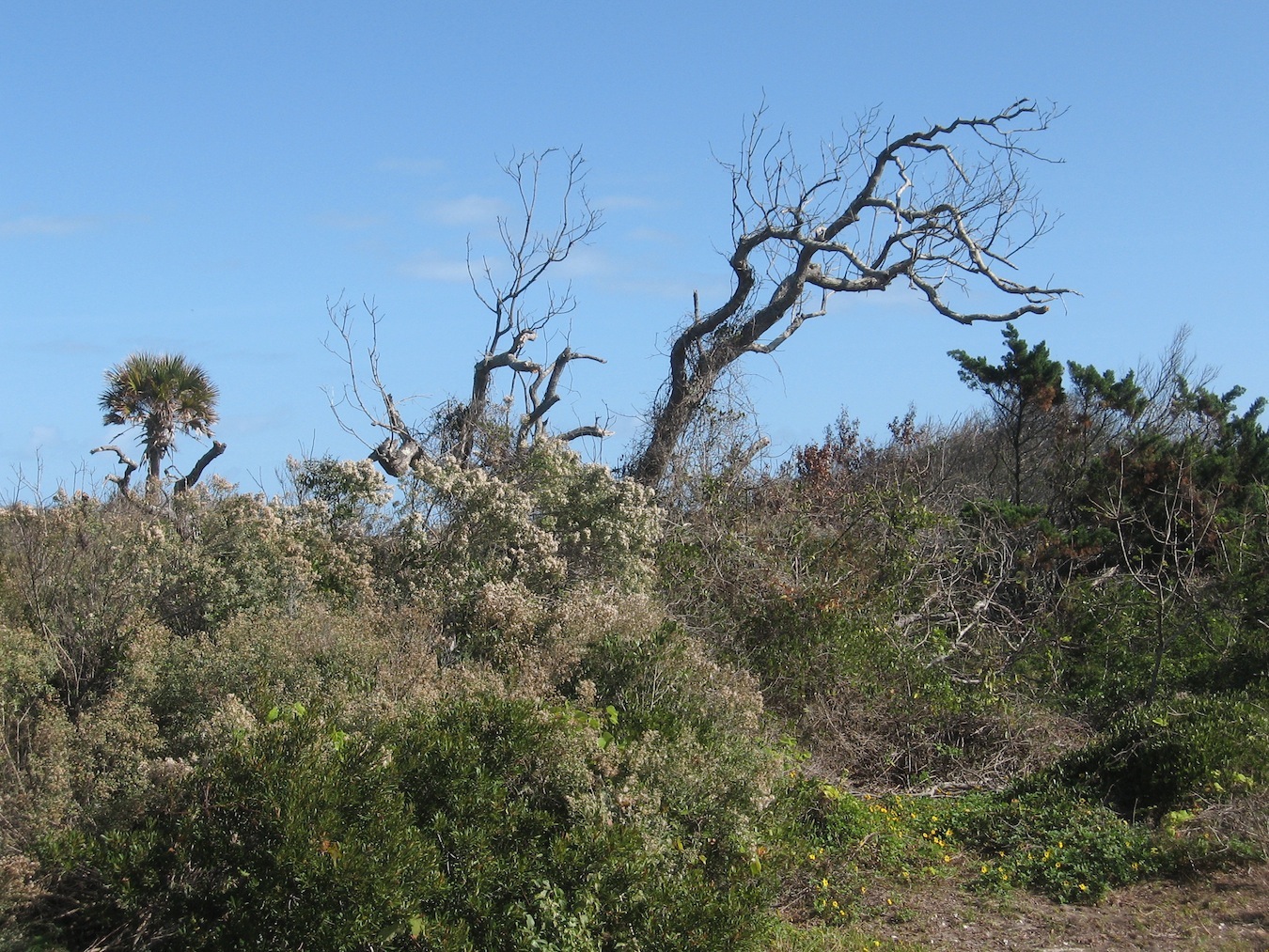
Our day was delightful. In the photos, you can see the beach and ocean, fairly heavy with haze that day, the boardwalk protecting the dunes and their vegetation, the inlet, and--a real treat for us--a gopher tortoise, one of several who had just come out of their underground den. (Correction: I can't believe I typed "turtle" and then didn't notice for a few days; this is a true, solely land-dwelling tortoise, not a turtle at all). We are indebted to a couple of tourists coming along the walkway as we were headed in from the beach who alerted us to their sighting of these shy, elusive animals. Sadly, their numbers are declining, a great loss due to their pivotal importance in a whole mini-ecosystem. As my Audubon Field Guide to Florida says, " [their] methodically constructed tunnels are . . . not only home to the declining Gopher Frog and Eastern race of Indigo Snake, but 300 other species of vertebrates use or rely on the burrows for shelter or food." If you look carefully in the photo with a dead-looking small tree at the top, you can see the large opening to the gopher turtle burrow at the lower right. As always, you can click on any photo to enlarge it.
One important aspect of our "creative everyday life" is exploring our rich and varied local area whenever we can. Those of you who are regular readers have seen other posts about our adventures in Coastal North Florida.
Question of the day: Do you agree with us that some of the best travel experiences can be found near home for curious, creative day trippers and explorers?

Wednesday, January 18, 2012

Beach Scenes Are Enhanced by Shadows

Now that we have returned from a refreshing week away, I return to the shadow theme with a few examples of beach scenes.
Reflecting about the importance of shadows in painting (and in any visual experience or art form), I realized how crucial shadows have been in some of my recent beach scenes. Views of the ocean or other large bodies of water and expanses of shoreline can be fairly bare and lacking in obvious shadows. Although such scenes can serve as excellent subjects for serene, minimalist art works, including an object or objects, either natural or built on a beach or dune, creates opportunities for drama in contrast of the lights hitting the objects and the darks of shadow areas.
Particularly at the ocean here in Northeast coastal Florida, the sunlight can be very intense, casting strong, deep shadows. Here are three examples. Each of them has appeared in a previous post or two; clicking on the links will provide more information about them.
In the smallest, 6" x 12" painting, "Away from the Crowd", a bright red beach chair contrasts with the softer natural hues and draws the eye. But try to imagine the exact same scene on an overcast, misty day--or with the sun directly overhead so that the shadow would not extend out. The scene would still be nice, but some movement and interest would be lost. Further, notice the subtle dimensionality in the clouds due to the warmer, brighter light on the sunny side.
In the 12" x 16" vertical, "Dune Shadows", I was most interested in the patterns of the fence and its shadows on the rolling surface of the dune. Again, it seems that the scene would be more static and less interesting without the clear shadow design.
Finally, the 18" x 24" "Spring Breeze" demonstrates the extent to which a bright day at the ocean creates contrasting darks and lights. If the sun were straight overhead, the sand would be more monotonal; the foot bridge would be plainer, and the clouds would again be flatter-looking. Even the sky would have less color variation and less apparent depth.
Question of the day: Do you find yourself drawn to scenes with strong light and shadow contrasts or to quieter views with subtler contrast?

Saturday, April 3, 2010

Learning--Reference Photos for New Landscape Painting Projects

Each of these photos is slated to serve as a reference for a new coastal North Florida landscape painting. The sandpiper feeding in the foam spun by Atlantic Ocean waves is started on a 9" x 12" canvas board. So far, the major change from the photo is to swap positions of the bird and seaweed debris--didn't want our feathered friend skittering right out of the painting :>). The major challenge of this piece will be to render a pleasing, faithful impression of the sea foam and the wet shimmer on the sand. Even in the photo, that ridge of foam looks a bit unreal--so stay tuned for how my wrestling with it all turns out. It will be great for my learning process to work on this scene.
I think I mentioned the other photo a few posts ago when we had some fun conversation (thank you, thank you, commenters!!!) about a dune scene that left the viewer no clear way to cross over to the beach. This scene shows one of many dune-preserving boardwalks on Jacksonville Beach, the only permitted way to cross our precious dunes in order to protect them and the life forms they support.
Right now, I have just begun to sketch possible compositions for the new dune scene. The photo cuts the composition almost in half vertically--not acceptable. Secondly, I am not happy with the way the foot bridge competes for attention with the white fence. So, I have been juggling the elements in thumbnail sketches in a way to feature the foot bridge, the intended focal point. Once the plan for the composition is ready, I will consider the palette--will punch up the color and contrast some, but still keep it natural and a bit soft. Lots to think about for this one. It's time for me to paint something new in an 18" x 24" size (or possibly even larger). Dune Crossing may be the one.
Question of the day: If you are an artist or have a creative hobby, what is your planning process? Are you more intuitive and inclined to pursue that flash of inspiration spontaneously; do you have a meticulous planning or preparation process; or are you somewhere in between?

Monday, March 22, 2010

Learning--North Florida Beach Painting, Final Version

Here is a better photo of the 16" X 12" dune and beach scene from a reference photo taken on a calm day at Jacksonville Beach in coastal North Florida. A few posts ago, I described the painting process and the revisions in this piece from a combination of my own ideas and the expert advice I received from my mentor Linda Blondheim's e-critique service. An added hint of low waves breaking just over the sight line of the dip in the dunes is one small change not in this photo. Since I forgot to take another picture before I added the final coat of satin finish medium to the painting, I am posting this photo. It is much more difficult to get an accurate photo after the medium is on, given slight reflective areas under any normal lighting conditions. Dune Shadows is now signed, sealed and ready for sale.
I loved getting your comments on the previous post. My favorite comments reflected a preference for a previous version with more of an opening in the dune grasses. Even though that is a gentle criticism of the final version, I didn't mind at all. The fact that some of you were disappointed that there was no longer an obvious way down to the beach struck me as a very positive reflection on the painting. What I hear in those comments is that viewers are actually putting themselves "into the picture", and I am delighted by that. Besides, no one is supposed to cross over the dunes as they are protected, both for the sake of the natural vegetation and critters living there and to help prevent erosion (not that a mental crossing when viewing a painting hurts anything).
I have a nice set of photos of a wooden walkway nearby, one of many crossings up and down the miles of gorgeous beach on our city's off-shore island. When I figure out what angle I'd like and how best to compose the scene, I'll start on a painting just for all y'all who want to run into a painting and onto that beach. Thank you for giving me the idea for a new work.
Question of the day: Isn't feedback wonderful? I love hearing reactions to my work, even thoughtful negative ones (in moderation :>) as I continue my lifelong learning journey.

Thursday, February 25, 2010

Learning and Growing--Critique Service Results on Dune Painting

On February 1, when I posted this 12" x 16" painting as a work in progress (the small photo), it was ready for comments from my painting mentor, Linda Blondheim. You can scroll down to that post for more information about Linda's teaching services and a link to her website. I had signed up for her e-critique service for the month of February and have found it immensely valuable in the development of five paintings. I was aware of several changes this piece needed, and Linda suggested other modifications--most of which I included in the revision. By the way, I photographed the earlier version in much brighter light, so please don't think that the whole painting is darker now. If you'd like to see more detail, you can click on the photos to enlarge them.
The work seems about finished to me, but you will notice that it is not yet signed. That means it will rest for awhile so that I can live with it and decide if any further tweaking is desirable. As I have mentioned before, knowing when to stop revising is both crucial and difficult in any art form. The piece is based on reference photos from a June visit to Jacksonville Beach, Florida, looking out at the Atlantic Ocean over the dunes. All along Jacksonville's offshore islands, the dunes are protected so that natural vegetation and critters can thrive; beach visitors may cross to the beach only on boardwalks.
For those of you who are interested, here are the main details of the revision. Probably the most noticeable change is the stronger, darker fence. Since it is the focal point, it needed more drama in size and tonal value. Even those of you who paint may not guess what gave me the most trouble in this piece--it's the top half of the dune on the right. In the earlier version, the tall grasses drew attention to themselves and distracted both from the fence and from the bright wildflowers that I considered a secondary focal area. As Linda and I considered various possible fixes, I first painted the grass out completely but did not like the look of the dune completely bare either. My final solution was to cover more of that dune with grasses, carefully keeping them soft, nearly uniform, and neutral in tone so that they would blend with the dune and not pull attention away from more important areas. Other changes in tonal balance (degrees of dark and light) on the horizon line, on the sunlit left dune top, and in the foreground increased the interest and drama of the scene. The ocean is deliberately kept as a quiet area, somewhere for the viewer's eye to rest, as one looks out toward an interesting, but not overly dramatic, sky. The painting now captures my impression of that lovely June day.
Question of the day: In your creative projects, do you enjoy the ups and downs of the process, or do you feel impatient for completion?

Sunday, January 17, 2010

Learning--Perspective Study--Jacksonville Pier Painting

Some paintings grow from an effort to learn or practice a particular skill. A few years ago, I worked on this piece primarily to practice handling perspective, trying to show the Jacksonville Pier extending into the distance. It was also an early attempt to capture ocean waves--not a simple task, either. Although it took considerable time and work, this is, in essence, a study--or a study plus some development. The painting itself is approximately 11" X 17", an acrylic on heavy acid-free art paper. Although it began as a study, it seemed worth having professionally mounted and matted when it was finished and now has an overall size of 18" X 24", which will fit a standard frame.
Given my math background and tendency to over-analyze some things, I tried to reason out the representation of depth in proper perspective on a flat surface. However, working carefully with several photos of the pier and struggling until the view looked right to me yielded a better result than all that meticulous figuring had. Interestingly, an exact scaling up of the pier and its pilings from photos to painting did not quite "look right", and I had to tinker with the sizing and spacing to achieve a realistic representation (at least, one that looked realistic to me). I am tempted to philosophize on appearances vs. reality or some silly thing, but will spare you that.
Question of the day: Is it just me, or is struggling to master something difficult more fun and rewarding than doing the things that come easily?

Saturday, December 26, 2009

Learning--Winter Beach Painting--Patterns in the Sand

Not too long ago, I posted an entry about winter walks on the beach. This painting, Tide Pool Patterns, evolved from photos on a winter walk several years ago. That day, the Atlantic was in a rare indigo mood (the water color is never exactly the same from day to day, changing sometimes subtly, sometimes quite dramatically), and the waves were crashing very white. The receding tide had left shallow pools and interesting patterns and ridges in the sand. I think the earlier hours had been fairly windy, because the beach was more stirred up than sometimes. The view was interesting to me almost in an abstract sense, and I hoped to create a very simple, somewhat empty (if that's the right word) scene where the tonal contrasts, some strong, some subtle, and the abstract design would be the focus.
As in many paintings, this one did not look right for quite awhile. When I painted the wavy patterns in the sand as they actually appeared, it did not work on the canvas because they slanted so sharply that they gave the impression of going steeply downhill. Not wanting to lose the texture and diagonal interest and yet needing a more realistic look, I fought the angles and patterns for several painting sessions until the sand appeared flatter. In the foreground, I sprinkled salt on the wet paint to create some sparkly dimension on a few of the ridges of sand. Even clicking on the detail photo probably doesn't show you that texture, but it's kind of nice. I feel fairly pleased with the final result, which I hope conveys a feeling of peace contrasted with the energy of the background waves.
Question of the day: Isn't it interesting what makes for visual interest and how central a part different kinds of contrasts play in what is pleasing to the eye?

Saturday, December 12, 2009

Exploring--Our North Florida Winter Beach Plus Bidding Update

I wish you all a very joy-filled holiday season. Although we try to keep our Christmas season low key and focused on what really matters, it is still a fairly busy time. Because of that, our little Shih-Tzu, Maggie, and I have not been to the beach in the last few weeks. Missing the wide sweep of sand with timeless waves rolling in, I decided to post a few Jacksonville Beach photos with today's greetings.
These are early winter shots, taken on two different November days, quite late in the day. The sun setting behind homes and buildings casts long shadows on the sand. The beach in one photo is littered with broken shells, kelp and other marine vegetation, tossed up by wind-driven waves at high tide on a stormy day. Looking up the beach, you may be able to see the Jacksonville Beach Pier in the distance.
Now, a month later, fewer people would be wading in the cooling water, and the only swimmers would be visitors from Canada or Minnesota or someplace like that. They've come al the way to Florida for the warm weather, and by golly, they're going to jump in that ocean even though both the air and North Florida's Atlantic waters are chilly.
OK, I've talked myself into it. Instead of missing the beach, I promise myself to walk there sometime this week, even for a short visit. It will be good for my peace of mind and spiritual center.
Question of the day: If this is a busy time for you, what quiet, centering moments do you plan to include in the next few weeks?
Bidding for the 9" x 12" original painting, Purple Iris Solitaire, remains at zero, so it looks like a low bid will take it. Deadline for bidding is noon on Monday, December 14. Bidding starts at $12; a bid of $20 or more will win you free shipping in the US and $5 off international shipping. Scroll down for more details and a photo of the painting.

Sunday, September 27, 2009

Exploring & Growing--The Refreshment of a Different Point of View

When our sons were Sesame Street age, I sometimes watched that wonderful show with them. One delightful piece I still remember featured video of a variety of creatures and a catchy song, each chorus ending with the claim, "It all depends on where you put your eyes." The camera gave us glimpses of the world as it may look to a giraffe, for example, contrasted with the way it may look to many other critters with eyes at radically different levels.
Strangely, that song has popped up in my mind several times in recent days. What's that about? Is my subconscious trying to tell me something about my perspectives, goals, or viewpoint? If it is, I will do my best to listen and learn from it.
I have posted in the past about our love for walks on the beach. We are grateful to live near the mighty Atlantic Ocean and enjoy the many moods of the waves and weather there. Somehow, our little Shih-tzu, Magnolia, who is too short to see much out the car windows, always knows when we are crossing the bridge over the intracoastal waterway. Her excitement builds as we drive on the offshore island side of the bridge where the pavement is wavy and gives us a mini-roller coaster ride. We both anticipate our beach time with joy.
However, I also love the distinctive and varied salt marshes in the Jacksonville area and enjoy contemplating the stretch of golden, green and/or brown (depending on the season) marsh grasses visible from the bridge. When the tide is low, more water birds are poking around among the mussel beds and crab holes; when it is high, more fishing boats congregate.
One fine day on our way home from the beach, I decided to explore the neighborhood closest to the marsh on the mainland side and made a sharp right turn just off the bridge. When I could see through to the marsh between yards, fences, and old trees, I had a whole new perspective on the bridge, marsh, and intracoastal waterway. The photo above is one view this lovely area provided.
So, as the Sesame Street song continues to invade my reflections, I recalled this experience, which struck me as a metaphor for the richness available in life--depending on where I put my eyes. Don't have anything profound to say about that just now, but I'll keep on looking and listening.
Question of the day: Where are your eyes these days? Have you recently found a new perspective, are you hopeful for a change in viewpoint, or is your outlook just right for this time in life?