Showing posts with label learning. Show all posts

Saturday, April 13, 2013

Painting Class #2 with Anthony Whiting

     The homework exercise for the second painting class with Anthony Whiting was to paint a bowl of fruit. He had suggested we could pull down a reference photo from the internet, but I couldn't find one with the kind of lighting I wanted. So, did it the hard way--set up a bowl of fruit and took some photos. The image to the right shows my finished painting exercise in acrylic paint on 8 1/2" x 11" heavy paper in a bound sketchbook.

     Before painting the fruit, we were to make an outline sketch of the 8 - 12 major shapes in the image, then a 5 value sketch to plan the placement of the lights and darks, and finally some color samples to choose the paint hues we would use. You can see the preliminary exercises page here. I tried my grey scale markers for the value sketch and used 5 of them, from a very light grey to a very dark grey. The markers helped with decisions about placement of values, but did not allow for the kind of subtler shading a pencil sketch can provide. Instead of individual color swatches, I made a couple of choppy stroke blended patches (as in the first class's homework; see previous post). I used a limited primary color palette with only 3 tube colors altogether plus titanium white--alizarin crimson, cadmium yellow medium, and cobalt blue--which created a wide range of color blend possibilities. Limiting the color palette also makes for a pleasing underlying harmony.

     Anthony Whiting's teaching and homework assignments are providing me with new techniques and leading me to real growth. The subjects, brush stroke technique, choppy blending method--and more--are a change for me. And a challenge. Some of what we do for the class is well outside my comfort zone, or, in other words, at the perfect learning edge.

Question of the day: Where is the learning edge in your life currently?


Friday, March 29, 2013

Painting Class #1 with Anthony Whiting

     Looking for inspiration and motivation as well as instruction, I recently started a series of painting classes with Anthony Whiting, a noted Jacksonville artist. The class has been everything I had hoped it would be and is helping me get past a "stuck" feeling in my own work. Since I  never took high school or college  art classes, there are gaps in my knowledge, technique, and ability to create what I have inside. So, I started by attending two of Anthony Whiting's  beginning painting classes--fun and very helpful. Today, you see a color blending exercise from the first class and the completed homework assignment. Soon, I will post the work from the other beginning class I attended. Next week, I will transition into his intermediate class, six two-hour classes for students with some acrylic painting experience.

     The initial two-hour class covered a number of basics listed on a handout. Then, after a demonstration of what Anthony called a "painterly" way to transition from one color to another, we all tried the technique.

     The two color patches show the result of first mixing a range of tones on the palette from white and pale yellow, through greens, to pure blue, then transitioning from white to blue on a sample in choppy, patchy strokes. You can click on the photo to see detail more clearly. Anthony stressed avoiding a smooth blend--instead letting the strokes show. The result is a lively color transition, which achieves a "painterly" blending in the viewer's eyes. Titanium white, cadmium yellow medium, and ultramarine blue are the only tube colors used--all the greens are mixes of yellow, blue, and sometimes white.


     Given my usual smoother blends and more realistic style, this exercise encouraged me to take a looser, less perfectionistic approach, and I really liked learning it. Our homework was to paint a pear using similar choppy strokes, which was more difficult for me than anticipated--a great learning experience. I used the same two colors plus white for the pear, adding burnt sienna for the background and to make grey tones for the shadow and stem by mixing it with the ultramarine blue. You see the sketchbook page at the left and a close-up of the pear above.

     Even though stepping outside my comfort zone is uncomfortable, I always enjoy doing so in a stimulating learning experience. Anthony Whiting is an excellent teacher, effectively encouraging each of us to experiment and learn. This series of classes is exactly what I have been looking for.
Question of the day: Are you also drawn to learning experiences? Do you prefer to try something totally new or to refine your existing skills and talents?

Thursday, January 31, 2013

A Favorite Book About Painting--and Life

     The Simple Secret to Better Painting by Greg Albert inspires and teaches me something every time I pick it up. This book comes home from the public library once every few months so that I can find a new idea in it--or remind myself of ideas that are easy to forget.


     Greg Albert's "simple secret" is the wonderful lesson of variety within balance, which I find a metaphor for an important secret to a meaningful life as well as to painting in ways that (hopefully) delight viewers. I hope he would not mind me mentioning his simple secret, which he calls the one central rule for design: "Never make any two intervals the same." Trust me that there is so much valuable information contained in the way Greg Albert spells out applications for this rule that I cannot and will not "give away" his secret in this brief blog post. If you have any interest in the visual arts or in any facet of design, this book is worth reading and rereading. I think its possible applications go way beyond painting alone.

     Mr. Albert uses painting examples to expand his simple rule to intervals of distance, shape, tonal value, color, and more--no sort of interval should be the same, he maintains. This advice is helpful at all stages of a creative process. Here's an example. One of my recurring painting mistakes is to trend too much toward mid-tone values, rather than to include at least small areas of more intense dark and very light values. I have no idea why that happens (an excess of caution, maybe?), but during the revision process, the value range often needs extending. Mr. Albert's rule is a reminder to include a broader value range as well as to make sure that the areas (or "intervals") of dark, light, and mid-tone should not be similar in overall size. A previous post about a painting called "Sea Oats" shows one example of revision that included adding some very light clouds and brightening light areas on a dune as well as deepening just a few very dark highlights.

     Another painting that required some added variety was "Hanna Park Heron" (sorry the colors here are not as intense as in the actual painting) , shown here beside the original reference photo (more about this painting was posted earlier also). Notice how the reference photo's background vegetation naturally repeats types of plants (shapes), colors, and sizes--not ideal for artistic composition. Then, notice the additions of the two light grey dead trees to change that sameness and to provide strong verticals across from the large palm trunk. You will be able to spot other changes from the reference photo and to consider my possible reasons for them.


Question of the day: Are you mostly a hands-on learner, or do you (like me) rely on well-illustrated books to learn and grow?

Tuesday, September 14, 2010

Learning and Growing--Painting Process on Dune and Beach Piece, "Spring Breeze"

Today's post is designed for readers interested in my landscape painting process and in composition design in particular. The photos above show earlier stages of "Spring Breeze", with the final version at the top. The lower left photo is quite early, with some elements, like the sky and footbridge, more developed and others, like the wildflowers, just barely indicated. It was a real challenge to get the balance and focal point to work well on this piece. My painting mentor Linda Blondheim provided invaluable advice during a couple of months of using her e-critique services. With her guidance, I gradually added more curve to the path--even the second version of the path in the photo on the right changed further later on. The evolution of the path illustrates how landscape artists sometimes need to adjust features in the actual scene for a more pleasing composition. The first version reproduces the way the path actually looked in my reference photo, but adding curves and more variation provided a much more graceful lead into the scene. In a departure from my usual process, I painted the footbridge in a fairly detailed form early on because I was strongly drawn to the sharp shadows cast by the railing. Since that area was my intended focal point, I worked to render the bridge in correct perspective from the beginning.
I have no idea how often I painted out and revised the wildflowers on the left side. Although they are a major element, I wanted them to balance, but not compete with, the footbridge and its interesting shadow pattern. An important step in solving the overly even seesaw look of the foreground was to make the left side dune higher. At one point, I cut some scrap paper into a much higher dune shape, taped it (with masking tape) to the canvas, and emailed that image to Linda. She agreed that a higher dune made the composition more interesting than having so many elements on roughly the same level, but suggested going a bit lower than the line of my cut-out. However, I hesitated before revising the dune so radically because Jacksonville Beach dunes are not that steep. We landscape painters vary, I think, in the degree to which we are willing to change the actual scene when we work from nature or reference photos. For several days, this work-in-progress stood on the fireplace mantel for consideration while I worked on other paintings. The need for a greater variation in line won out over realism. Also, since steeper dunes grace some nearby beaches, the change was not completely out of line.
If some of you are interested, I will talk about the process of painting the sky and clouds in "Spring Breeze"in a future post. It can be difficult to achieve a semi-transparent, wispy effect with acrylic paints, so sharing our methods could be fun.
Question of the day: More of a reflection than a question this time: For me, achieving an interesting balance of compositional elements in a painting, with both dynamic tension and restful features, seems like a metaphor for a set of life skills we all need. What do you think?

Thursday, February 25, 2010

Learning and Growing--Critique Service Results on Dune Painting

On February 1, when I posted this 12" x 16" painting as a work in progress (the small photo), it was ready for comments from my painting mentor, Linda Blondheim. You can scroll down to that post for more information about Linda's teaching services and a link to her website. I had signed up for her e-critique service for the month of February and have found it immensely valuable in the development of five paintings. I was aware of several changes this piece needed, and Linda suggested other modifications--most of which I included in the revision. By the way, I photographed the earlier version in much brighter light, so please don't think that the whole painting is darker now. If you'd like to see more detail, you can click on the photos to enlarge them.
The work seems about finished to me, but you will notice that it is not yet signed. That means it will rest for awhile so that I can live with it and decide if any further tweaking is desirable. As I have mentioned before, knowing when to stop revising is both crucial and difficult in any art form. The piece is based on reference photos from a June visit to Jacksonville Beach, Florida, looking out at the Atlantic Ocean over the dunes. All along Jacksonville's offshore islands, the dunes are protected so that natural vegetation and critters can thrive; beach visitors may cross to the beach only on boardwalks.
For those of you who are interested, here are the main details of the revision. Probably the most noticeable change is the stronger, darker fence. Since it is the focal point, it needed more drama in size and tonal value. Even those of you who paint may not guess what gave me the most trouble in this piece--it's the top half of the dune on the right. In the earlier version, the tall grasses drew attention to themselves and distracted both from the fence and from the bright wildflowers that I considered a secondary focal area. As Linda and I considered various possible fixes, I first painted the grass out completely but did not like the look of the dune completely bare either. My final solution was to cover more of that dune with grasses, carefully keeping them soft, nearly uniform, and neutral in tone so that they would blend with the dune and not pull attention away from more important areas. Other changes in tonal balance (degrees of dark and light) on the horizon line, on the sunlit left dune top, and in the foreground increased the interest and drama of the scene. The ocean is deliberately kept as a quiet area, somewhere for the viewer's eye to rest, as one looks out toward an interesting, but not overly dramatic, sky. The painting now captures my impression of that lovely June day.
Question of the day: In your creative projects, do you enjoy the ups and downs of the process, or do you feel impatient for completion?

Monday, February 1, 2010

Learning and Growing--Signing on for a Critique Service & a Work in Progress

I have just begun working with an exceptional painter, teacher, and mentor, Linda Blondheim, via her e-critique service. The photo shows one of the works in progress I sent to her for suggestions. I know which parts of this painting I feel need to change and what I still plan to do with it--it will be fascinating to hear her reflections. Hopefully, in a couple of weeks or less, I will be posting the finished version for you to see.
I have taken several classes and workshops from Linda in her charming studio, out in the countryside near Gainesville, Florida. Every time, I came away encouraged, energized, and bursting with new skills and insights to apply to my painting. Although she is too busy to offer such classes right now, she still teaches via the Internet. One of these days, I will take one of her e-classes, but her e-critique service fits my schedule and needs better this winter and spring. Each week, I will e-mail Linda images of a few pieces I am working on along with particular questions I have about them. She will then analyze and critique them, returning not just her verbal commentary, but scanned images of the works with alternate possibilities sketched in. Then, I can get back to work. Linda is respectful and understanding when I decide not to follow a suggestion, but most of the time, her pointers are right on target and help guide my process in a direction that feels right for me. If you would like information about her many services and products for artists, click on "artist resources" on her web site.
One of the teaching qualities I appreciate most in Linda is her sensitivity to each student's own style and vision. Some art teachers seem to think that all the students should precisely imitate their style and technique, sometimes even their subject matter. That approach may be helpful to some students, but drives me right out the door. Of course, I know that I have a lot to learn, and I humbly work to improve and grow with every session at the easel. However, the best sort of teacher for me is one who guides and encourages me to develop freely in my own unique creative direction.
Question of the day: What inspirational teacher or learning experience stands out for you?

Sunday, January 17, 2010

Learning--Perspective Study--Jacksonville Pier Painting

Some paintings grow from an effort to learn or practice a particular skill. A few years ago, I worked on this piece primarily to practice handling perspective, trying to show the Jacksonville Pier extending into the distance. It was also an early attempt to capture ocean waves--not a simple task, either. Although it took considerable time and work, this is, in essence, a study--or a study plus some development. The painting itself is approximately 11" X 17", an acrylic on heavy acid-free art paper. Although it began as a study, it seemed worth having professionally mounted and matted when it was finished and now has an overall size of 18" X 24", which will fit a standard frame.
Given my math background and tendency to over-analyze some things, I tried to reason out the representation of depth in proper perspective on a flat surface. However, working carefully with several photos of the pier and struggling until the view looked right to me yielded a better result than all that meticulous figuring had. Interestingly, an exact scaling up of the pier and its pilings from photos to painting did not quite "look right", and I had to tinker with the sizing and spacing to achieve a realistic representation (at least, one that looked realistic to me). I am tempted to philosophize on appearances vs. reality or some silly thing, but will spare you that.
Question of the day: Is it just me, or is struggling to master something difficult more fun and rewarding than doing the things that come easily?

Tuesday, January 12, 2010

Learning and Growing--I Now Have a Facebook Page

Today, I only have time for a quick post to say that I now have a Facebook page. I have been slow to try this technology, but have wanted to begin to connect with friends and family via social networking. Today I took the plunge and have enjoyed the experience so far--mostly--as this old dog slowly learns a new trick.
I hope that my blogging friends will check in. Try the Facebook "badge" on this blog, and please let me know if it is working or not.
The best "head shot" I could find for my profile is posted here for your amusement. I cropped it out of a photo a couple of years old from a fun getaway to Myrtle Beach, SC with my sister. Browsing my IPhoto library showed me what happens when I am usually the person taking the photos--nothin' much of myself there.
I will soon post some photos from our son's wedding on Facebook, so there will be a few more sightings of this dancing fool.
Question of the day: In your opinion, what are the benefits and pitfalls of using Facebook?

Wednesday, October 14, 2009

Learning & Growing--Choosing Paintings to Show

As I prepare for the Open Studio Reception I mentioned in the last post, one task is to decide what paintings to show and offer for sale. Advice from other artists is proving very helpful, especially from those who will give me a clear, honest assessment of the pieces I am considering. We don't like all our own creations equally, of course, but cannot predict how other people might see them. Some that disappointed me in some way strike my "jury" as having merit and might prove to be another person's cup of tea. I find that I am ready (more so than even several months ago) to part with most of my "better" pieces, knowing that I will go on to create more. So, the timing is right for a show. UPDATE: I have now added an index to all blog posts about planning and holding an art reception. Access it here.

Today's painting, on an 14" X 18" canvas board, is a romanticized version of a scene near our home which I pass on one of my favorite walking routes. A broken-down, abandoned shed surrounded by rusted metal debris stands on the curve of a two-track dirt drive leading far back into a wooded area. Perhaps there was a house on this lot once although there is no evidence of a foundation, just half-ruined utility connections. It's on a back road shared by a mix of small "Old Florida" homes, newer construction replacing tear-downs, and older mobile homes, so might once have boasted a double-wide. Now natural vegetation and overgrown plantings are gradually taking over, but the place still somehow breathes with the spirit of people who once used tools stored in this shed. It invites the imagination to spin a story of those who called this spot home.
After studying, sketching and photographing the scene a couple of years ago, I came up with this painting, called Long Gone. It took on a life of its own, as creations often do, and I was led away from the initial subdued, realistic palette to make it sing with color. In spite of the air of abandonment, this has always struck me as a happy place, so that's what flowed from my brush. The result has a sort of storybook quality rather than realistically representing the actual location. This painting made the cut for the Open Studio Reception and hopefully will make an interesting contrast to other pieces with more limited palettes and greater realism.
Question of the day: In your own creative pursuits, how often does the process take on a life of its own? How comfortable are you with those experiences--do you like to maintain some control or do you enjoy being carried away and surprised?

Sunday, September 27, 2009

Exploring & Growing--The Refreshment of a Different Point of View

When our sons were Sesame Street age, I sometimes watched that wonderful show with them. One delightful piece I still remember featured video of a variety of creatures and a catchy song, each chorus ending with the claim, "It all depends on where you put your eyes." The camera gave us glimpses of the world as it may look to a giraffe, for example, contrasted with the way it may look to many other critters with eyes at radically different levels.
Strangely, that song has popped up in my mind several times in recent days. What's that about? Is my subconscious trying to tell me something about my perspectives, goals, or viewpoint? If it is, I will do my best to listen and learn from it.
I have posted in the past about our love for walks on the beach. We are grateful to live near the mighty Atlantic Ocean and enjoy the many moods of the waves and weather there. Somehow, our little Shih-tzu, Magnolia, who is too short to see much out the car windows, always knows when we are crossing the bridge over the intracoastal waterway. Her excitement builds as we drive on the offshore island side of the bridge where the pavement is wavy and gives us a mini-roller coaster ride. We both anticipate our beach time with joy.
However, I also love the distinctive and varied salt marshes in the Jacksonville area and enjoy contemplating the stretch of golden, green and/or brown (depending on the season) marsh grasses visible from the bridge. When the tide is low, more water birds are poking around among the mussel beds and crab holes; when it is high, more fishing boats congregate.
One fine day on our way home from the beach, I decided to explore the neighborhood closest to the marsh on the mainland side and made a sharp right turn just off the bridge. When I could see through to the marsh between yards, fences, and old trees, I had a whole new perspective on the bridge, marsh, and intracoastal waterway. The photo above is one view this lovely area provided.
So, as the Sesame Street song continues to invade my reflections, I recalled this experience, which struck me as a metaphor for the richness available in life--depending on where I put my eyes. Don't have anything profound to say about that just now, but I'll keep on looking and listening.
Question of the day: Where are your eyes these days? Have you recently found a new perspective, are you hopeful for a change in viewpoint, or is your outlook just right for this time in life?

Wednesday, September 23, 2009

Learning & Growing--Art Classes & Cypress Swamp Painting

I recently showed you a painting of an iris, adapted from a reference photo taken by someone else and wrote about some of the difficulties I encountered. Well, I have done it before. Today's painting, of a cypress swamp (or marsh), is also adapted from someone else's photo, this one from a nature magazine. I am sorry that I cannot credit the photographer (even though my rendering is quite different from the photo). Since this painting was mostly completed in a painting class using reference material the instructor provided, I no longer have information on the photo or the magazine. Given the strong dark tones and bright contrast in this painting, I hope that it looks something like the real thing on your monitor (it is a bit too yellow on mine).
My landscape painting mentor and friend, Linda Blondheim, is an excellent teacher, both tough and sensitive. She listens to her students' expression of what they would like to achieve in a painting and (if that vision is achievable) helps them get there--a rare teaching gift. Looking at this cypress swamp piece reminds me of the enriching day and growth as an artist I experienced in a design and composition workshop with her a few years ago. By the way, all the best artists I know are self-described learners and are continually pushing themselves to grow and to achieve new directions and goals.
I was privileged to study with Linda again recently at a full day workshop learning about using values well in the landscape ("values" in art refer to the whole range of darks to mid-tones to lights). I know that this is one area in which I need improvement--I get so taken up with the brilliance or the subtlety of colors in nature that it is difficult for me to judge values sometimes or to balance them in an interesting way in a composition. Among other topics, she introduced the Notan system for making values "sing" in our work. It was especially meaningful to work with her earlier this month because her schedule requires her to stop in-person teaching for a time, and I am thrilled I could be in her final workshop (for now--all her students hope that she will return to teaching in the future).
For anyone who would like painting instruction from Linda, she is continuing on-line teaching, both individual and class instruction, and her e-classes are excellent. In fact, her next class unit will be an expanded version of the one-day values workshop I experienced. For more information, go to HER WEBSITE and click on "artist resources" at the top.
Even if you are not looking for painting classes, her remarkable paintings and fascinating articles about her beloved North Florida, its history, farms, ranches, wetlands, and preserves are well worth a visit to that website (click on the link above). If you think all of Florida looks like Miami or the Gulf Coast, you will be amazed to see the paintings her lifetime of exploring has inspired.
Now, about the above painting, an acrylic on a 9" X 12" canvas panel from a workshop with Linda a few years ago. Like many of my accounts of the painting process, the story of this piece is a tale of mistakes along the way and hurdles overcome. The basic composition, under-painting, and some of the finishing were complete by the time I left the workshop. Under Linda's guidance, it was looking fairly good then. Linda had scanned a good quality copy of the magazine photo for me to bring home as i completed the scene, but I had difficulty getting it to look real. Finally, an insight struck as I studied the copy of the photo for the millionth time. The photographer either had used flash or had other additional lighting on the stumpy cypress knees in the foreground so that there was a combination of natural back lighting and dramatic light falling on the foreground. Although that made for a striking photograph, trying similar tones in my painting made the scene look phony. Softer, mid to dark tones in the foreground made a real improvement.
Question of the day: What is your current growing, learning edge?

Saturday, September 19, 2009

Exploring & Learning--Our Magical Public Libraries & Reference Books for Artists

For weeks, I have been meaning to write about the delights of exploring public libraries. From the time my mother first took me to Muskegon, Michigan's castle-like Victorian library as a small child, libraries have held a fairy tale magic for me. Since the last post featured books and since I recently found a terrific series of photo reference books for artists, now is the perfect time for this subject.
I am an absolute library junkie and did my best to raise our sons to share that obsession. It seems particularly timely in a difficult economy to remember the remarkable resources available free of charge in public libraries. As much as I love books, I purchase relatively few--in particular, very few novels. They are free at the library; I read each one only once--why would I buy them? The library is also my favorite source for current non-fiction (often works I have heard about on public radio) like the latest nutrition book, exercise DVD, financial advice, business trends, and other works that I want to look at, but don't need to purchase. Most libraries offer wonderful additional services, such as children's story hours, student and adult programs, free computer use, and a variety of media (beyond books) available to borrow.
Admittedly, we do purchase books, too. We have kept a number of worthwhile books from our years of study and from my adventures teaching philosophy and math. I also like having reference books handy, so our shelves hold atlases (up-dated periodically), travel books, books about words and writing, nature field guides and bird books, books about architecture, home repair, sewing, knitting, music, history, and many other topics. Other long-time friends include poetry, quality art reproduction collections, and thought-provoking, spiritually meaningful books.
Of course, I also own some books that inspire and assist my painting. For example, when my own reference photos don't provide quite enough detail for accurately painting birds in a landscape, my various bird books provide rich detail about that particular species--everything from characteristic textures of feathers and subtleties of coloring to unique patterns of flight and characteristic posture when standing or perching.
Still, the world is full of wonderful books we don't own that the library can provide. The pages above were scanned from a series of books by photographer Gary Greene, who generously and explicitly invites artists to photocopy or scan and then adapt images from his books (as long as they do not try to profit from an exact copy). As always, you can click on the images above to enlarge them in order to appreciate the remarkable detail in Greene's photos. His beautiful books spark my creative process even when I don't use any of the specific images for a painting. Our library system has a number of his works, and I am currently waiting for one to come in on a transfer from another branch. The above pages appear in Artist's Photo Reference, Reflections, Textures & Backgrounds. The volume I am waiting for showcases boats and marine scenes. When it comes in, you can bet that along with it, I'll carry home an armload of additional, irresistible finds from my magical library.
Question of the day: Are you a public library junkie? What are your favorite recent library discoveries?

Wednesday, September 16, 2009

Learning & Savoring--Inspiring Photo Books

I mentioned an accomplished photographer-friend, David Young, in my last post. Today, I'll show you some of the photos from one of his books, Prayer Photos, and say a few words about his books. If you would like to know more about them, you can email Dave at dsyoung@peoplepc.com. He has some copies of two of his books available for only $5, a substantial discount off the cover price. If you read my blog regularly, you know that I normally do not include anything even resembling advertising, but decided to make an exception for some exceptional books at a super price.
Prayer Photos is a high-quality, soft-cover book with a photo on each right-hand page and an appropriate free verse prayer poem by David Young on the left. The poems explore a variety of moods and human experiences, are non-sectarian, and would be meaningful to any spiritual person. The photos above are two examples of his sensitive, intriguing images.
I highly recommend this book as well as another he has available, called Coloring the Wind, with several one-page essays about peace, justice, and other topics, many short free verse poems, and more of David's beautiful photos, mostly of people, taken on his extensive travels to many cultures. He possesses an uncanny ability to capture a depth of character and meaning in a photo of an elderly Latina's face, of children at play around the world, of varied family groups, and more.
Question of the day: What powerful images have touched you recently?

Sunday, September 13, 2009

Learning & Growing--Purple Iris Floral Painting

About a month ago, I showed you a magnolia floral painting I had worked on as a change of pace from my usual landscapes (scroll down to August 11 or enter "magnolia" in the search box above to see it again). This purple iris painting is an older work, one of my first close-up florals. Among other things, I learned the value of perseverance from this project.
I can't remember anymore how long this painting was a "work in progress," or how many times I was tempted to scrap the project due to to the fact that some of the changes I tried made it worse instead of better. Works in progress are supposed to progress, aren't they? This one definitely gave me trouble.
Probably one issue with the painting was that I used someone else's photo. A friend (thank you, David Young) who is known for his breathtaking photos of people from around the world, sent me a packet of varied photos several years ago. I was inspired to try to paint this iris from one of his photos with a few adaptations to fit my own vision for the image.
Although I am quite pleased with the final result, I felt hampered along the way by the fact that I had not seen, touched, and smelled the flower myself. A wiser artist than I was would have at least sought out live purple irises somewhere to observe, sketch, and photograph. I will do that in the future. I know some artists can create excellent paintings strictly from photos of places, people, or natural things they have never seen in person. I am humbled by their skill. For me, I have learned that nothing can replace being there. In addition to various technical problems I had to iron out for this painting, it was difficult for me to bring the blossom alive on canvas--we had never actually met. The result--and sort of a solution--was to paint an image that is more stylized than natural.
Venturing outside my comfort zone can be a thrill. But when an effort to do or to learn something new seems too unpleasant or too hard, I try to remember this painting experience. Of course, some attempts fail. No shame there, I believe--the shame would be avoiding the new for fear of failure. But in the thick of any difficult struggle with a new venture, I recall the BATTLE OF THE IRIS and persevere. After all, I think this image turned out all right. In any case, I learned and grew as a person and as an artist from this project.
Question of the day: Have you battled any irises lately? What growth or learning resulted?
Tuesday, September 1, 2009

Learning--Blogging and Landscape Painting

Thank you for your positive response to the last post. Today, I am posting a related article, also a repeat of a post from this past May. I hope you enjoy it and promise something brand new next time.

Did you learn something new today? Whether simple facts or complex new abilities, new learnings enrich life, keep us mentally and emotionally young, and just plain add fun to our creative everyday lives. I am a compulsive learner on many levels and love to gain new insights and skills. Some of my most rewarding learnings have followed attempts to understand or do something I assumed I would not do well. Taking that risk is stimulating, sometimes humbling, and always enlivening (at least in the long run), no matter what the result is.

This blog is one example of a personal learning adventure. As a minimally computer-literate person, I faced a steep learning curve in order to begin posting. Those of you who are computer-adept would have found my approach hilarious, involving everything from perusing library books to asking friends to viewing on-line video how-tos. Numerous notes and lists later, I took the heart-pounding dive off the . . . well, so far, what I have done is probably analogous to slicing into the pool from the edge; this is hardly the high dive of blogging. However, it represents an achievement for me, both in learning the basics of blogging and in publishing the thoughts and adventures of an introverted self for y'all readers.
I wonder: If blogging had been simple for me, would it have been as rewarding as it is now? In time, I hope to advance to more variety in format and to including appropriate links for interested readers, and more! (Note: I have learned to insert clickable links since I wrote this--progress!) It's a shame you can't all watch over my shoulder to chuckle (in the nicest possible way, of course) at my ongoing efforts in techno-communication. Truthfully, the process is not always fun for me, but my small triumphs are satisfying--and, hopefully, are also beneficial flexing for my maturing brain.
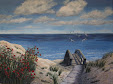
Oh, about the photo above, you ask? A few years ago, I took a wonderful painting course. Awkwardly wielding an artist's brush for the first time since elementary school, I discovered a whole new source of creative expression and satisfaction. With zero expectation that I would produce anything even worth keeping, I was astonished to like some of the paintings I made in the class. Now, that's a sign of a world-class teacher! I'll describe that learning adventure in future posts. In the meantime, you can view an effort from about a year ago--my response to exploring Big Talbot Island (see a recent post about that unique beach below).
Question of the day: What new learning adventure intrigues you? What fears keep you on the side of that pool? Why not give it a try?

Sunday, May 10, 2009

Learning and Savoring--International Space Station

Whenever it's possible, I stand outside at night and watch the International Space Station silently move across the Florida sky. I cannot remember who first told me about the orbit information on NASA's educational website, but I owe that person a debt of gratitude. Since I can personally remember the very first rockets and satellites to soar triumphantly beyond our atmosphere as well as the heart-stopping disasters and near-disasters in space exploration, I retain some of the original awe I felt watching news coverage of those firsts. I don't expect that I will ever consider space exploration routine or uninteresting. 
As a child, I loved watching the night sky, contemplating the ever-changing moon, and learning the names of constellations and stars. Now, walking our dog late each evening, I am still that child, looking up in amazement.
Last night, the space station glided magnificently above us here in Jacksonville (and above many others, of course). It was visible for over 4 minutes, reaching the highest point in the sky of any time I have watched (maximum, 80 degrees above the horizon--in other words, almost straight up), traveling from our southwest to northeast. The recently installed additional solar panels render it brighter and larger-looking than ever. I do not know the entire range of its changing orbit, but I do know that it is visible at times from many different states and countries on earth. The link to click for viewing opportunities where you live is at the end of this post.
The photo above comes from the NASA website and was taken looking down at the Colorado River snaking almost vertically down the center of the photo toward the Grand Canyon gorge at the lower right. Didn't find a good photo looking down on Florida, but this one will do to illustrate a thought that fascinates me as I look up--that someone in the space station might be looking down at the same time. It is difficult to articulate the sense of human connection in spite of distance which I feel at that thought. 
I hope that if you are intrigued, you will take a look at the website and perhaps be privileged to view these explorers for yourself one clear night.
For information, follow the prompts on the left side of  THIS PAGE
at NASA's site, beginning with "Go to country".
Question of the night: What do you think and feel as you look up into the night sky, just as people have looked up for thousands of years before us?

Friday, May 1, 2009

Learning--Blogging and Landscape Painting

Did you learn something new today? Whether simple facts or complex new abilities, new learnings enrich life, keep us mentally and emotionally young, and just plain add fun to our creative everyday lives. I am a compulsive learner on many levels and love to gain new insights and skills. Some of my most rewarding learnings have followed attempts to understand or do something I assumed I would not do well. Taking that risk is stimulating, sometimes humbling, and always enlivening (at least in the long run), no matter what the result is.
This blog is one example of a personal learning adventure. As a minimally computer-literate person, I faced a steep learning curve in order to begin posting. Those of you who are computer-adept would have found my approach hilarious, involving everything from perusing library books to asking friends to viewing on-line video how-tos. Numerous notes and lists later, I took the heart-pounding dive off the .  .  .  well, so far, what I have done is probably analogous to slicing into the pool from the edge; this is hardly the high dive of blogging. However, it represents an achievement for me, both in learning the basics of blogging and in publishing the thoughts and adventures of an introverted self for y'all readers. 
I wonder: If blogging had been simple for me, would it have been as rewarding as it is now? In time, I hope to advance to more variety in format and to including appropriate links for interested readers, and more! It's a shame you can't all watch over my shoulder to chuckle (in the nicest possible way, of course) at my ongoing efforts in techno-communication. Truthfully, the process is not always fun for me, but my small triumphs are satisfying--and, hopefully, are also beneficial flexing for my maturing brain. 
Oh, about the photo above, you ask? A few years ago, I took a wonderful painting course. Awkwardly wielding an artist's brush for the first time since elementary school, I discovered a whole new source of creative expression and satisfaction. With zero expectation that I would produce anything even worth keeping, I was astonished to like some of the paintings I made in the class. Now, that's a sign of a world-class teacher! I'll describe that learning adventure in future posts. In the meantime, you can view an effort from about a year ago--my response to exploring Big Talbot Island (see a recent post about that unique beach below).
Question of the day: What new learning adventure intrigues you? What fears keep you on the side of that pool? Why not  give it a try?