Showing posts with label creative process. Show all posts

Sunday, December 23, 2018

"Spring Breeze"--Ocean Beach Painting is a Christmas Gift

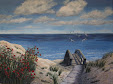
     "Spring Breeze", an 18" x 24" acrylic painting on gallery-wrapped canvas, has now been adopted. My sister and her husband had a spot in their new Maryland  home that they hoped I could fill with an Atlantic Ocean beach painting. I was thrilled to send them images of 5 available pieces in various sizes and palettes (some in shops and one still in our home). They chose "Spring Breeze", a scene at Jacksonville Beach, Florida about 14 miles from our home. The difficulties involved in satisfactorily completing this piece have made it more precious to me, and I'm thrilled that they will enjoy it and that it will stay in the family.

     I am delighted when family members or special friends accept the gift of a painting (or a hand-painted silk scarf--see earlier post about that). Although I would not take a chance on presenting someone with a painting they may not have chosen for themselves or which may not fit in their home, it is a true joy to give a painting away when I know the recipients like and want it.

     I hope you and yours have a meaningful and merry holiday season and that the joy of giving remains central in your lives. All of you who are faithful readers of this blog are a gift to me. Thank you for providing me the opportunity to share photos and thoughts with you, and a special shout-out to those of you who kindly share your own thoughts in response.

Question of the day: What is a gift you have received that seemed particularly precious or meaningful?

Saturday, December 13, 2014

Blog Hop, Part II--My Creative Process

A great blue heron, seen at  Jacksonville's Hanna Park
Somewhere in Michigan (a scene from memories)

     Thanks again to Mary Paquet for the invitation to contribute to the blog hop project by responding to four questions. I continue here with the two last questions (see my previous post for Part I). And don't miss Jo Castillo's post on Monday, Dec. 15; I "tagged" her to be next in the blog hop and know that you will enjoy her lively creative sense and fine art works.

3) Why do I create what I do?

     I have always enjoyed sewing, knitting, and crocheting, but did not believe I had any talent for the visual arts I so admired. My love for color and for the beauty of the natural world kept tugging me toward giving landscape work a try.
Castaway Preserve Cedar
Castaway Preserve Palms

     Finally, about 11 years ago, I signed up for a week-long class in acrylic painting at the John C. Campbell Folk School in North Carolina--expecting to enjoy playing with color and making creative messes, then to toss them and return home renewed and relaxed. Well, with an excellent teacher and time to practice and learn, I painted pieces that I really liked. No tossing occurred, and I was hooked! Now, with more workshops and lots more practice behind me, some pieces even sell. More importantly, I find continued delight in creating acrylic landscapes and learning more all the time. Another Folk School class this year started me in silk painting as well--a fluid, often unpredictable medium that gives me additional pleasure. Creating art is a whole new world for me and a rewarding pursuit in semi-retirement.
Jacksonville Beach
Jacksonville Beach

4) How does my creative process work?

     While considering this question, I used the little search box at the top of my blog and entered "painting process". Oh, my--I have written many posts that include discussion of the creative process in general and of the particular processes involved in individual paintings or silk scarves.
An early work--A favorite retreat near Warwick, NY

Silk scarf (using resist)
Silk scarf (natural blending--no resist)
     So, what are the common threads in varying processes for individual pieces? For processes in making the silk scarves, please see recent posts on that topic.
     
     Nearly all landscape paintings begin with a photo or a cluster of reference photos. Since I am endlessly fascinated with coastal North Florida scenes and want to convey the beauty and serenity I find in exploring out-of-the-way places in this area, I study angles of light, color (how to capture the incredible range of greens?!), and take notes to accompany the photos I take from various angles and distances.

     In the studio, the next considerations are composition (including tonal balance--the lights and darks) and color palette. In our area, good composition almost always involves leaving out some of the lush growth and sometimes other elements. Sketching--very roughly--a few possible versions of a scene, sometimes moving the point of view or focal point, helps me decide on a final version. Here are some previous posts that discuss composition.

     Choosing a limited number of colors helps both in unifying a painting and still gives an incredible range of possible hues. I don't try to match the actual scene so much as try to capture a feeling while staying in a realistic color range. Sometimes I go for low contrast and cool serenity, sometimes warmer, lively vistas. Again, here are some previous posts with more about color and palette for interested readers.

      Revision is the other most crucial piece of my process. The beauty of acrylics (especially for a learner like me) is that they dry quickly and cover well. I can paint over an area that does not please me, take out a superfluous bush, or whatever. Sometimes before a major change, I try it out by cutting a shape out of construction paper that approximates the change, tape it to the canvas, and squint to judge the effect on the composition.

     When wrestling with a piece that is not cooperating, it helps to remind myself that any work is a valuable learning experience (taking myself too seriously is fatal). At times, I put a painting away for a time and work on something else. A fresh look later on often yields a solution.

Question of the day: Do you enjoy hearing about the creative process or watching artists work? Or would you rather simply experience the art for yourself with no background or explanation given?

Saturday, April 13, 2013

Painting Class #2 with Anthony Whiting

     The homework exercise for the second painting class with Anthony Whiting was to paint a bowl of fruit. He had suggested we could pull down a reference photo from the internet, but I couldn't find one with the kind of lighting I wanted. So, did it the hard way--set up a bowl of fruit and took some photos. The image to the right shows my finished painting exercise in acrylic paint on 8 1/2" x 11" heavy paper in a bound sketchbook.

     Before painting the fruit, we were to make an outline sketch of the 8 - 12 major shapes in the image, then a 5 value sketch to plan the placement of the lights and darks, and finally some color samples to choose the paint hues we would use. You can see the preliminary exercises page here. I tried my grey scale markers for the value sketch and used 5 of them, from a very light grey to a very dark grey. The markers helped with decisions about placement of values, but did not allow for the kind of subtler shading a pencil sketch can provide. Instead of individual color swatches, I made a couple of choppy stroke blended patches (as in the first class's homework; see previous post). I used a limited primary color palette with only 3 tube colors altogether plus titanium white--alizarin crimson, cadmium yellow medium, and cobalt blue--which created a wide range of color blend possibilities. Limiting the color palette also makes for a pleasing underlying harmony.

     Anthony Whiting's teaching and homework assignments are providing me with new techniques and leading me to real growth. The subjects, brush stroke technique, choppy blending method--and more--are a change for me. And a challenge. Some of what we do for the class is well outside my comfort zone, or, in other words, at the perfect learning edge.

Question of the day: Where is the learning edge in your life currently?


Thursday, December 20, 2012

Favorite Paintings Part II--Works from 2008 & 2009

     In this reflective end of the year time, we will look back today. Several months ago, I posted some of my personal favorites among older paintings and will continue that theme today. Since painting is relatively new in my life, the "oldies" don't go very far back. However, it feels as though I have learned  and grown significantly in the last 3 or 4 years and (although others may not notice a dramatic difference) can see improved elements in some more recent work. Of course, art works always have a mind of their own, so that unexpected results--for good or ill--can come along anytime. The process, the journey, and the sheer scary fun of trying are worth the ride no matter how various pieces turn out. I never fail to learn from every painting session.


     I won't repeat the background and reflections from the earlier favorites post. However, one insight from my mentor Linda Blondheim is worth recounting today. I once told her that a painting teacher had said to us students that she was sometimes ashamed of her early work and didn't like to think of the pieces people had bought back then still being on display. Linda agreed with me that the artist's feelings seemed sad and shared her own outlook. Of course, Linda has learned a great deal and grown as an artist over the years, but every time she has painted, she did the very best she could at the time. So, she is pleased if those works were appealing to buyers--or even if not--and truly values each of them. A healthy, motivating outlook, I think.


     The earliest of these three pieces is the 18" x 24" vertical creek view with the egret seen above. As the piece developed, I liked the fantasy feeling of the under painting in the streaky water and not-quite-realistic trees, so kept that aspect intact and called it "Creek Bend Fantasy". The second is the largest piece I have made so far, on a 22" x 28" canvas, called "Serenity"--also showing a creek bend where it pools. Both have garnered fans and favorable comments over several shows and in shops. The third painting, an 18" x 24" work called "Hanna Park Heron" sold at the very first Open Studio Reception in our home to friends who treasure it as a reminder both of many years of happy family outings in North Florida's Hanna Park and as a tribute to the majestic great blue heron who frequents the large pond behind their house. Descriptions of the process of creation for each piece and other details are in earlier posts; simply click on the links if interested.

     Thank you, dear readers, for your patience with my uneven posting schedule in recent months; I am recovering very well from hip replacement surgery and hope for more conversation with you in 2013. That partly depends on circumstances beyond my control; i.e., ME and my love for procrastination. I will do (some version of) my best :>). 

     May all of you enjoy a hopeful, peaceful Christmas and a joy-filled New Year.

Question of the day: Are you able to manage Linda Blondheim's positive, encouraging view of your past efforts? 

Sunday, September 16, 2012

Favorite Paintings from 2007 and 2008

     Thinking back on the relatively few years I have been painting, I browsed the photo file, viewing earlier works, and spent some time feeling grateful for this rewarding pursuit. A few favorite early paintings stood out, although each and every piece has some interesting features, and each represents creative learning and growing experiences.

     About nine years ago, a week-long painting course at the John C. Campbell Folk School in North Carolina awakened a whole new pleasurable undertaking for me. I had expected to relax, stretch my mostly analytical mind beyond its comfort level, have fun making some messes, and come home refreshed. Well, with an excellent teacher, all my expectations were met--except one. The paintings were not total messes at all. Not that they were great art, but they were pleasing to me beyond anything I had ever thought possible.


     Since then, I have learned much more and refined my painting skills with occasional local classes, guidance from my painting mentor, Linda Blondheim, and lots of practice. Painting is a whole new, unexpected source of joy.

     So, as I looked back, I  found three photos to show you, each representing a particularly pleasing achievement for me. Each work has elements I would do differently today, but they were the best I could do at the time, and that's good enough. No need to be overly self-critical about them (or to whine to you about the short-comings I see in them now). 

     It's interesting how differently artists view their own earlier work. In one painting class, a very good teacher said that she sometimes cringed when she saw some of the paintings she had sold years ago. She was somewhat ashamed of those earlier works. That seems a pity; clearly they appealed to the buyers (and probably to others). Further, regardless of other peoples' opinions, they represent a stage in her creative journey which contributed to where she is now. Linda Blondheim's attitude strikes me as healthier and more self-affirming; she enjoys looking back and values every one of her paintings, convinced that each was the best she could do at the time.

     So, without apologies, here are three personal favorites from 2007 and 2008. For each, clicking on the link will pull up an earlier post describing their creation in more detail. "Look to the Hills", an 18" x 24" landscape, interprets a meaningful visit to a retreat center in Warwick, New York. The 12" x 16" marsh scene recalls a delightful day kayaking with my husband and one son (and later became an engagement gift for our son and his fiancee). The 9" x 12" "Magnolia on Purple" was based on photos of magnolia blossoms on some neighbors' trees. Each work brought frustration as I confronted its challenges, and each was a significant learning adventure. 

     Life's journey is always surprising--what if I had listened to my conviction that I had zero artistic ability?--what if I had never tried painting? By the way, I also value other less successful (or even totally bungled) ventures along my journey for the contribution they have made to the person I am today.
Question of the day: What surprising discovery have you made about your own abilities?

Thursday, July 19, 2012

The Encouragement of Past Achievements

     In the previous post, I mentioned having hit a fallow time in my painting. Browsing images of some of my past paintings was helpful--especially the works that were most difficult to complete. The dune bridge piece pictured here was very stubborn and resisted my efforts to produce a harmonious composition for some time. Looking at it now and recalling the many wrong turns I took in painting "Spring Breeze" reminded me of the wisdom of the saying "this too shall pass". I have felt reluctant to paint, unproductive, and just plain unable before. So, feeling that way should not be scary now and certainly is no excuse for hopelessness. 


     Linda Blondheim's e-critique service helped me rescue this piece from what seemed like an impossible mess. Some of the fixes she suggested did not work; others were ideal. Some of the adjustments I tried on my own were helpful; others were disastrous. But, with persistence, the sort of painting I envisioned creating finally emerged. In the visual arts, some revisions can't be evaluated until you see them in relation to everything else in the composition. Fortunately,  acrylic paints permit painting out unsatisfactory areas and covering them with new shapes, colors, and forms. I would be lost without the possibility of "do-overs".


     The main problem with what you might call the "first draft" was a lack of balance, I think. Keeping the viewer returning to a central focal point gives a work its power, and the wildflowers competed with the foot bridge for awhile. Also, being too literal about the slope of the dunes I had photographed for reference left me with too little variation in the line of the dunes. Since the horizon is inescapably straight, I needed to exaggerate the height of the left side dune and add more undulations to the dune outline (without overdoing it) as a contrast to that straight line. One trick I used to "try on" various dune lines was to cut a paper outline and tape it over the piece--then a different outline, etc., until it looked about right. 


     So, looking back on creative challenges I have faced and coped with in the past helped me get past the funky time and get back to work. "Spring Breeze" and other works remind me of the inevitable ups and downs of the creative process. This is not the first time I have felt as though I have forgotten how to paint, nor will it be the last time. All I need to remember is that the frustration has always been a temporary speed bump and that with faith and patience, the joy of creating will return.
Question of the day: Can you recall a troublesome season you experienced that you were able to work through in time? Can you draw strength from those memories to help you face new challenges?

Wednesday, February 29, 2012

Work in Progress--Dune, Ocean, and Sea Oats Painting

This North Florida dune painting has been difficult for me to assess and complete. The reference photos were taken in dim conditions, so I am trying to recreate the brighter glow of some late afternoons at the beach just from my memory and from more recent walks on our Atlantic Ocean beaches. However, none of the days I have gone recently have had the atmospheric and light conditions I remember from a certain summer day. Late day photos I have taken in other locations along the shore have been some help, but haven't solved all the problems.
As many of us who make any sort of thing (art work, cake, cabinet, poem, garden, scrapbook, tin whistle, song, quilt, . . . ) know, some creations are more satisfying than others. I always struggle with each painting, but some really please me when they are finished. Others, less so. I have learned from experience that a piece I do not like as well as others may still appeal to someone else. In a previous post, I described how a painting delighted a client of the Trends Home Decor shop (although I did not mention that I had never liked that piece much and once considered painting something else over it!). She ignored all the other pieces I had in the shop and bought my least favorite. Viva la difference, n'est pas?
So, here's the thing. I have this particular work in progress (a 12" x 16" acrylic painting on gallery wrapped canvas) hanging on the wall and feel strongly that it needs further revision. I also know that it will probably never be a favorite among my creations, so have to resist overworking it and ruining any good qualities it might have. Interestingly, when I photographed it, looking at the photo gave me a bit of distance, and the piece didn't seem quite so bad.
The more distant beach line still needs work. It has been very hard to get the right perspective, to show how the dune slopes down onto the beach in the near right corner compared to the glimpse of the shoreline farther away, past the edge of the dune. I also may have made the sky too blue and bright for a late afternoon, although it sometimes looks this way, and I really don't want to grey it down much. Finally, this stretch of dune had a much thicker stand of sea oats, which would be an unattractive visual mess if exactly duplicated on canvas. I'd like to add a few more stalks, smaller and less prominent than those featured here, but don't want to overdo it.
Any suggestions you might have would be very welcome. Please don't just flatter the piece (you readers are all so sweet and kind); it does need some revision. What do you think?
Question of the day: How critical are you of your own creations and production? To what extent does your self-criticism work in your favor, and when does it hinder you?

Monday, June 13, 2011

Creativity, Spontaneity, and Planning--Starting a Beach Painting

My regular readers (bless you, one and all!) know that I am a planner. Too a fault! Even in my creative endeavors, I plan. Previous posts have described my usual painting process (if you are interested, enter "painting process" as a search term in the box in the upper left corner of this blog). However, I know planning and taking care with things can be overdone--especially in projects like making a painting. You will chuckle to hear that this week, I am "working on spontaneity".
Since the flurry of finishing paintings for the exhibit at Paddiwhack, I have been working on a vertical piece showing a curving path. It has been moving ahead very slowly, and recently seemed as though the adjustments I made to try to improve it were making things worse. Some paintings are just very stubborn, even though they looked like a great idea in planning and sketching. The best response is sometimes to put it away for awhile and to begin a new piece.
This time, I decided to plunge into the new piece with minimal planning, no sketches, and no tonal studies. It seemed that I had become too careful, too picky over details--and, stuck. What appealed was to start a smallish piece in unusual proportions (12" x 6") with a fairly low horizon focusing on an interesting sky. With a few reference photos and four paint colors (so far), I forced myself to quickly lay in the first coat for the piece in about 20 minutes. It was fun!
Here are a couple of the reference photos--including one of our Shih-Tzu, Magnolia (aka Maggie) tearing down Jacksonville Beach--one of her favorite spots. The block-in of the painting is rough, but seems like a good start. The sky is a mix of cerulean blue and white near the horizon and ultramarine blue and white further up; the ocean uses the same colors, plus a bit of Paynes grey near the horizon. All blues are tempered with a bit of Cadmium red light to neutralize them (tube colors sometimes look phony in landscapes). The beach under-layer is mostly Cad red light and white. This will be adjusted, as our sand is actually somewhat grey-beige, but I want a warm tone present in both the sand and the clouds (which are yet to come).
Question of the day: Am I the only nut who sometimes needs to "work at spontaneity"? How do you overcome creative blocks?

Wednesday, October 21, 2009

Learning and Growing--Landscape Painting, Part II

Part II of a pair of posts "back by popular demand" (see previous post for an explanation) appears today.
This painting, based on the photo in my previous post, emerged slowly. As I worked, my priorities for focus and scope changed in ways I would not have predicted. I will spare you a long description of all the twists and turns of the creative process, but will mention some of the insights and adjustments I made along the way.
First, I assembled all the reference photos taken at this bend in Little Pottsburg Creek--wider panoramas and close-up details as well as the main photo. I recalled the mild, still air, the musky, but not unpleasant, smell of the flat, muddy bank, and the colors that had danced in the sunlight and softened in shadow. I decided to incorporate some elements from other photos and to use a horizontal layout showing a greater expanse of water and some tall grasses in the foreground.
My first instinct was that the soft reddish grasses on the right would be my focal point. My husband viewed some of my thumbnail sketches along the way and was drawn instead to the taller grasses in the left foreground. Being torn among various interesting elements, I painted an adequate, but unfocused scene--too much competition for attention. My subsequent efforts to improve the composition and balance were unsuccessful, and I set the canvas aside for awhile to rest my mind by working on a small floral piece.
My painting mentor, Linda Blondheim (see her web site for beautiful paintings), suggested that she found the reddish grasses interesting as a texture contrast to the rocks I had indicated (but not featured) in the foreground. That was the trigger I needed to complete the painting--featuring an area of varied textures. Without fully realizing it, I had been captivated by the multiple textures in the scene as well, from the placid water to the jagged rocks and both soft and sharp-edged grasses. The texture contrasts on the right side of the painting, from foreground to mid-ground became the focal point, while other areas became less detailed in order to let them recede in importance. There's that matter of balance again, which keeps emerging as a theme in recent posts.
Another artist would have painted quite a different rendering. Your answer to the last post's question regarding what you would feature in this scene might be radically different as well--and wonderful in its own way. I have often heard that one must be able to truly see in order to paint. Along my creative journey, the opposite has more often been the case for me--that painting is a vehicle to enhanced seeing of what is around me. Every painting in process is a growing and learning experience to treasure.
Question of the day: What pursuit or activity is your growing edge?

Saturday, October 17, 2009

Learning and Growing--Landscape Painting, Part I

Occasionally, I will repeat a post or two that were well-received for the sake of my newer readers. I know that few of you will go back to read all previous postings. Also, frankly, this is a crazy busy time for me, and this helps me keep on my twice a week posting schedule. Today's entry is the first of two about this scene on Little Pottsburg Creek. Please excuse me, fellow bloggers if I am not able to visit and comment on all of your wonderful blogs as often as I would like for the next few weeks. I'll be back full-force before too long.

Landscape painting is a balancing act and requires priority setting and focus. I have written about balancing life goals and projects before, and have realized that a similar balancing process goes into the decisions involved in painting.
Few, if any, painters copy what they see in exact detail. We must discern what aspects of a particular scene drew us in and feature them. Other aspects need to recede in importance or even be left out. Sometimes an element needs to be moved or added for the sake of the composition. However, such changes require restraint. If a weathered barn is surrounded by purple wildflowers except for a trash pile in my sight line, filling that area with similar or compatible plants or a glimpse of bare earth is an acceptable adjustment to enhance the overall scene. However, it wouldn't make sense to paint a profusion of tropical passion flowers or cacti instead. The integrity of the location matters. Now I know that some lovely landscape paintings are completely "made up" by the painter from some combination of memories and a desire to create a scene that looks a particular way. I have done that myself, with fairly good results.
However, the "made up" places, at least when I paint them, do not resonate with the same depth as those based on an actual location. If I have truly been there, have seen, heard, tasted, smelled and touched the natural elements, I believe the truth of that experience shows in the art work. Yet, I do not paint simply what I see with my eyes or experience with my other physical senses. The painting arises out of my personal response to a natural place.
Holding the real and the "ideal" mental vision in tension to produce an interesting painting of an observed scene is infinitely rewarding. Sometimes this is quite difficult and requires extensive adjustment along the way--at other times, the process flows more easily. Wrestling with the balance of light and dark tones, with the way colors appear under variations in natural light, and with the arrangement of shapes and elements is a deeply moving, uniquely personal, creative experience.
The scene in the photo above is near our home. It's no place special--definitely not on anyone's sight-seeing itinerary--just a wide bend in Little Pottsburg Creek. Chunks of old concrete jostle the rocks and mussel beds in the muddy shallows, and trash lies half-submerged in the water. Still, something in the scene drew my attention. So I carefully recorded details mentally, snapped a few photos, and went home to figure out what the appeal was. If I tried to capture the feeling I had experienced in this everyday North Florida location, what would I paint? The result was an excellent learning exercise for me, which I will show you in my next post.
Question of the day: If you painted, drew, or more carefully photographed this creek bend, what would you feature?

Tuesday, August 11, 2009

Learning & Growing--Magnolia Floral Painting

After several posts about cooking, which I call my other art form, I have another painting to show you. Since childhood, I have been nurtured by the beauty and variety of natural scenes. So landscapes, many with some water in view, are my first love in painting, and creating them is deeply satisfying to me. However, I  also paint florals and enjoy the different challenges they pose as a change of pace.
The magnolia painting shown here, which is a 9" X 12" acrylic piece on canvas board, evolved over a period of time. The vaguely Asian arrangement of the branch, buds, open blossom, and leaves emerged early in my sketching and changed little. Similarly, the splotchy purple background came early. Other aspects of the piece required more thought--and even some serious wrestling and reworking.
In general, I prefer creamy, buttery whites to purer cool whites. So my first blossoms reflected that preference--and simply looked wrong. Although hints of butter tones remain, I adjusted most of the whites to crisper, cooler tones, touched with blues, purples, and hints of pink. The improvement was dramatic (in my opinion). The open blossom and bud really "popped" and acquired more depth; the yellow ochre tones in the magnolia's center gained drama with the increased contrast; and the entire piece gained a new glow. 
The other aspect that required considerable reworking was the "lay" of the lower and side petals of the open blossom. Since I had taken most of my reference photos looking down at magnolias on low branches of a neighbor's tree, I had to modify their size, shape and angles for my intended side view. I often encounter challenges like this in adapting photo information because I am continually snapping photos for possible painting subjects or details without knowing how I might use them in a future painting. Unfortunately, I put the partially completed piece away for awhile while I completed some larger landscapes. As a result, magnolias were no longer flowering here in North Florida as I struggled to correct the perspective. If I could have studied real blooms, my task would have been simpler. Oddly, I couldn't even find artificial magnolia blossoms to purchase out of season, or posing them could have helped.
I am pleased with the result of my reworking and hope you enjoy seeing this painting. Working on an occasional floral refreshes me to return to landscape painting with new energy. And all painting efforts--including wildly unsuccessful ones--provide valuable growth in my skills, vision, and insight.
Question of the day: What creative endeavor enriches your days and gives you pleasure, even when the creative process is difficult--or perhaps at times, precisely because it is difficult?

Sunday, July 26, 2009

Exploring and Learning--Landscape Painting--Hanna Park Heron

Last post, I showed you a reference photo for a possible painting--a quick, drive-by snapshot of a great blue heron at Hanna Park Lake here in Jacksonville, Florida. As I studied that photo and others taken that day of the heron, the lake, and the surrounding trees, I knew that I could base a painting on them. But, just how should I compose the scene?
In the June 17 post, I described the creative process involved in a different painting and my difficulties choosing the focal area for the piece. Unlike that project, this painting had an unmistakable focal point. In spite of the appeal of dark, shimmering water, tall palm trunks, and jungle-like vegetation, the heron clearly draws the eye of the viewer. I felt certain, in fact, that the heron itself knew that he (or possibly she) had no competition for the starring role in this little tableau.
In preliminary sketches, the main issues I worked on concerned how to arrange the elements--how much yellowed grass in the foreground? where to place the major horizontal elements? how much vegetation area in comparison to the water? And of course, just where to place the heron? In the photo, it is too near the center and is looking out of the scene--clearly unsatisfactory. Some of the other elements could stay more or less as they were in the photo.
The major change from the photo to the painting may not be immediately obvious. I decided to move the sun. The relatively short time we spent at the lake that day gave me no choice about the lighting, and I took photos with a bright overhead sun. However, I wanted more dramatic shadows in the painting and moved the sun, first to a point low in the sky behind the background trees and palmettos. Then, halfway through the painting, I moved it again--higher in the sky to the viewer's right. 
What fun! There is such power in creative projects--I can move the sun itself. However, the fact that I changed the light source as I worked caused a fair amount of readjustment in the painting along the way, as you artist readers can well imagine. Luckily, working in acrylics allows me to paint over nearly anything, which saves me and my paintings every time. Such changes are more difficult or even impossible in some other media. 
You will notice other differences from the reference photo. The background vegetation gradually took on a life of its own and became a sort of jungle fantasy instead of a literal rendering of what I had seen. Also, I realized late in the process that the varied greens in the background, despite touches of blue, yellow, and rusty browns, needed to be broken up by some other color. Given that there were winter-bare branches and dead trees nearby, I felt free to add a few fallen branches and to import a pair of dead trees from another scene. They might look familiar to my regular readers--do you remember the post about an outing with my good friend Dee that yielded the reference photo for these trees? They help the overall composition in more than one way, I think, as they also echo the grey tones of the heron and add one other distinct vertical. 
This work-in-progress is not yet signed although I feel quite satisfied with it. The final version may be slightly revised, but I like it as it is and may leave it unchanged. On my computer screen, the colors do not appear nearly as deep as they are in the painting, especially the dark tones--I hope you can get a sense of the way it actually looks. 
Question of the day: When you pursue a creative endeavor, do you normally begin with a clear vision of the final outcome and then create that? Or do your creations change along the way? Are you comfortable and flexible if your original vision changes as you work?

Wednesday, June 17, 2009

Growing--Landscape Painting Part II

This painting, based on the photo in my previous post, emerged slowly. My priorities for focus and scope changed as I worked in ways I would not have predicted. I will spare you a long description of all the twists and turns of the creative process, but will mention some of the insights and adjustments I made along the way.
First, I assembled all the reference photos taken at the bend in Little Pottsburg Creek--wider panoramas and close-up details as well as the main photo. I recalled the mild, still air, the musky, but not unpleasant, smell of the flat, muddy bank, and the colors that had danced in the sunlight and softened in shadow. I decided to incorporate some elements from other photos and to use a horizontal layout showing a greater expanse of water and some tall grasses in the foreground.
My first instinct was that the soft reddish grasses on the right would be my focal point. My husband viewed some of my thumbnail sketches along the way and was drawn instead to the taller grasses in the left foreground. Being torn among various interesting elements, I painted an adequate, but unfocused scene--too much competition for attention. My subsequent efforts to improve the composition and balance were unsuccessful, and I set the canvas aside for awhile to rest my mind by working on a small floral piece.
My painting mentor, Linda Blondheim (see her web site for beautiful paintings), suggested that she found the reddish grasses interesting as a texture contrast to the rocks I had indicated (but not featured) in the foreground. That was the trigger I needed to complete the painting--featuring an area of varied textures. Without fully realizing it, I had been captivated by the multiple textures in the scene as well, from the placid water to the jagged rocks and both soft and sharp-edged grasses. The texture contrasts on the right side of the painting, from foreground to mid-ground became the focal point, while other areas became less detailed in order to let them recede in importance. There's that matter of balance again, which keeps emerging as a theme in recent posts.
Another artist would have painted quite a different rendering. Your answer to the last post's question regarding what you would feature in this scene might be radically different as well--and wonderful in its own way. I have often heard that one must be able to truly see in order to paint. Along my creative journey, the opposite has more often been the case for me--that painting is a vehicle to enhanced seeing of what is around me. Every painting in process is a growing and learning experience to treasure.
Question of the day: What pursuit or activity is your growing edge?