Showing posts sorted by relevance for query e-critique service. Sort by date Show all posts

Monday, February 1, 2010

Learning and Growing--Signing on for a Critique Service & a Work in Progress

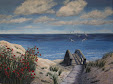
I have just begun working with an exceptional painter, teacher, and mentor, Linda Blondheim, via her e-critique service. The photo shows one of the works in progress I sent to her for suggestions. I know which parts of this painting I feel need to change and what I still plan to do with it--it will be fascinating to hear her reflections. Hopefully, in a couple of weeks or less, I will be posting the finished version for you to see.
I have taken several classes and workshops from Linda in her charming studio, out in the countryside near Gainesville, Florida. Every time, I came away encouraged, energized, and bursting with new skills and insights to apply to my painting. Although she is too busy to offer such classes right now, she still teaches via the Internet. One of these days, I will take one of her e-classes, but her e-critique service fits my schedule and needs better this winter and spring. Each week, I will e-mail Linda images of a few pieces I am working on along with particular questions I have about them. She will then analyze and critique them, returning not just her verbal commentary, but scanned images of the works with alternate possibilities sketched in. Then, I can get back to work. Linda is respectful and understanding when I decide not to follow a suggestion, but most of the time, her pointers are right on target and help guide my process in a direction that feels right for me. If you would like information about her many services and products for artists, click on "artist resources" on her web site.
One of the teaching qualities I appreciate most in Linda is her sensitivity to each student's own style and vision. Some art teachers seem to think that all the students should precisely imitate their style and technique, sometimes even their subject matter. That approach may be helpful to some students, but drives me right out the door. Of course, I know that I have a lot to learn, and I humbly work to improve and grow with every session at the easel. However, the best sort of teacher for me is one who guides and encourages me to develop freely in my own unique creative direction.
Question of the day: What inspirational teacher or learning experience stands out for you?

Thursday, February 25, 2010

Learning and Growing--Critique Service Results on Dune Painting

On February 1, when I posted this 12" x 16" painting as a work in progress (the small photo), it was ready for comments from my painting mentor, Linda Blondheim. You can scroll down to that post for more information about Linda's teaching services and a link to her website. I had signed up for her e-critique service for the month of February and have found it immensely valuable in the development of five paintings. I was aware of several changes this piece needed, and Linda suggested other modifications--most of which I included in the revision. By the way, I photographed the earlier version in much brighter light, so please don't think that the whole painting is darker now. If you'd like to see more detail, you can click on the photos to enlarge them.
The work seems about finished to me, but you will notice that it is not yet signed. That means it will rest for awhile so that I can live with it and decide if any further tweaking is desirable. As I have mentioned before, knowing when to stop revising is both crucial and difficult in any art form. The piece is based on reference photos from a June visit to Jacksonville Beach, Florida, looking out at the Atlantic Ocean over the dunes. All along Jacksonville's offshore islands, the dunes are protected so that natural vegetation and critters can thrive; beach visitors may cross to the beach only on boardwalks.
For those of you who are interested, here are the main details of the revision. Probably the most noticeable change is the stronger, darker fence. Since it is the focal point, it needed more drama in size and tonal value. Even those of you who paint may not guess what gave me the most trouble in this piece--it's the top half of the dune on the right. In the earlier version, the tall grasses drew attention to themselves and distracted both from the fence and from the bright wildflowers that I considered a secondary focal area. As Linda and I considered various possible fixes, I first painted the grass out completely but did not like the look of the dune completely bare either. My final solution was to cover more of that dune with grasses, carefully keeping them soft, nearly uniform, and neutral in tone so that they would blend with the dune and not pull attention away from more important areas. Other changes in tonal balance (degrees of dark and light) on the horizon line, on the sunlit left dune top, and in the foreground increased the interest and drama of the scene. The ocean is deliberately kept as a quiet area, somewhere for the viewer's eye to rest, as one looks out toward an interesting, but not overly dramatic, sky. The painting now captures my impression of that lovely June day.
Question of the day: In your creative projects, do you enjoy the ups and downs of the process, or do you feel impatient for completion?

Tuesday, October 12, 2010

Learning and Growing--Cypress Swamp Work in Progress

I just got back to this cypress swamp piece today after working on a new, larger landscape painting for awhile. I had mentioned in my last post that I was using Linda Blondheim's e-critique service in the early stages of this 8" x 10" study. She was complimentary of the overall composition at the point I showed you last time, but asked, "What do you plan as the focal point?" Even though I was liking it in that form, with the simple pattern of cypress trunks against a soft background, it did need something more to draw the viewer's eye. The reference photos (seen in the previous post), as you may recall, came from our visit to Babcock Wilderness Adventures, a tour of extensive, varied preserve areas near Punta Gorda, on Florida's Gulf Coast.
I experimented, just lightly sketching one or more egrets or other wading birds in various spots in the scene, but they seemed "too much" somehow. I liked the simplicity and relative emptiness of the piece and wanted just a hint of something more. But what? Walking past the pond in our neighborhood just as a frog, turtle (or some critter) put a nose up gave me an interesting idea. Perhaps I could suggest the rich underwater life in this swamp without showing any particular creature by painting in some ripples to suggest that a frog, fish, or maybe even a gator had broken the surface of the otherwise still water. So, here is a start in that direction, which I hope will add a subtle hint of life.
I will continue to texture the nearest cypress trunk to the ripples (right foreground). Now that a subtle center of interest will be there, I will reinforce that with more contrast and texture and will tone down the trunk in the left foreground just a bit to avoid competing. There is also more work to do (as you can see) in developing and filling in the background and in completing the water and reflections. This one is developing slowly, given its relatively small size, but I am completely enjoying the process and am in no hurry. Given that I may paint the scene in a larger format later, I believe that taking care with composition and values now will be well worth it. Even if this is the only version ever, it is providing a pleasant creative journey.
Question of the day: Do you suppose that the tranquility of the cypress swamp I am representing has influenced my mood and pace in this work? The process has not caused any frustration--unlike some other slow-to-fruition works. Thank you, Florida Wilderness.

Thursday, July 19, 2012

The Encouragement of Past Achievements

     In the previous post, I mentioned having hit a fallow time in my painting. Browsing images of some of my past paintings was helpful--especially the works that were most difficult to complete. The dune bridge piece pictured here was very stubborn and resisted my efforts to produce a harmonious composition for some time. Looking at it now and recalling the many wrong turns I took in painting "Spring Breeze" reminded me of the wisdom of the saying "this too shall pass". I have felt reluctant to paint, unproductive, and just plain unable before. So, feeling that way should not be scary now and certainly is no excuse for hopelessness. 


     Linda Blondheim's e-critique service helped me rescue this piece from what seemed like an impossible mess. Some of the fixes she suggested did not work; others were ideal. Some of the adjustments I tried on my own were helpful; others were disastrous. But, with persistence, the sort of painting I envisioned creating finally emerged. In the visual arts, some revisions can't be evaluated until you see them in relation to everything else in the composition. Fortunately,  acrylic paints permit painting out unsatisfactory areas and covering them with new shapes, colors, and forms. I would be lost without the possibility of "do-overs".


     The main problem with what you might call the "first draft" was a lack of balance, I think. Keeping the viewer returning to a central focal point gives a work its power, and the wildflowers competed with the foot bridge for awhile. Also, being too literal about the slope of the dunes I had photographed for reference left me with too little variation in the line of the dunes. Since the horizon is inescapably straight, I needed to exaggerate the height of the left side dune and add more undulations to the dune outline (without overdoing it) as a contrast to that straight line. One trick I used to "try on" various dune lines was to cut a paper outline and tape it over the piece--then a different outline, etc., until it looked about right. 


     So, looking back on creative challenges I have faced and coped with in the past helped me get past the funky time and get back to work. "Spring Breeze" and other works remind me of the inevitable ups and downs of the creative process. This is not the first time I have felt as though I have forgotten how to paint, nor will it be the last time. All I need to remember is that the frustration has always been a temporary speed bump and that with faith and patience, the joy of creating will return.
Question of the day: Can you recall a troublesome season you experienced that you were able to work through in time? Can you draw strength from those memories to help you face new challenges?

Monday, March 22, 2010

Learning--North Florida Beach Painting, Final Version

Here is a better photo of the 16" X 12" dune and beach scene from a reference photo taken on a calm day at Jacksonville Beach in coastal North Florida. A few posts ago, I described the painting process and the revisions in this piece from a combination of my own ideas and the expert advice I received from my mentor Linda Blondheim's e-critique service. An added hint of low waves breaking just over the sight line of the dip in the dunes is one small change not in this photo. Since I forgot to take another picture before I added the final coat of satin finish medium to the painting, I am posting this photo. It is much more difficult to get an accurate photo after the medium is on, given slight reflective areas under any normal lighting conditions. Dune Shadows is now signed, sealed and ready for sale.
I loved getting your comments on the previous post. My favorite comments reflected a preference for a previous version with more of an opening in the dune grasses. Even though that is a gentle criticism of the final version, I didn't mind at all. The fact that some of you were disappointed that there was no longer an obvious way down to the beach struck me as a very positive reflection on the painting. What I hear in those comments is that viewers are actually putting themselves "into the picture", and I am delighted by that. Besides, no one is supposed to cross over the dunes as they are protected, both for the sake of the natural vegetation and critters living there and to help prevent erosion (not that a mental crossing when viewing a painting hurts anything).
I have a nice set of photos of a wooden walkway nearby, one of many crossings up and down the miles of gorgeous beach on our city's off-shore island. When I figure out what angle I'd like and how best to compose the scene, I'll start on a painting just for all y'all who want to run into a painting and onto that beach. Thank you for giving me the idea for a new work.
Question of the day: Isn't feedback wonderful? I love hearing reactions to my work, even thoughtful negative ones (in moderation :>) as I continue my lifelong learning journey.

Friday, June 22, 2012

New Salt Marsh Painting--"Castaway Island Palms"

     The first of two 9" x 12" paintings I am working on from my exploration of Castaway Island Preserve might be finished. At least, it is very near finished and is ready to show you. The small palm hammock in the mid-distance across the salt marsh drew me to the scene. Paintings always take on a life of their own, and this one somehow became a bit darker and softer than my original vision, which seems fine. It hangs in my studio where I'll contemplate it occasionally to decide whether or not to make any further adjustments.


     I have been fortunate to have had the advice of two excellent painters on this piece. I began the work in Roger Bansemer's helpful two-day workshop, described in a previous post, and brought it home maybe 2/3 finished. A companion piece, also from a Castaway Island scene, got a rough start there, too--at least in its basic layout--and is now on my easel to be re-engaged.


     Linda Blondheim, my dear friend and mentor--and best painting teacher I have ever studied with--has also advised me as I worked to complete this piece. Given that she lives and works in Gainesville, Florida, a good 75 miles away from Jacksonville, our time together is limited. However, she offers an e-critique service which is extremely well-done. Periodically, I send her images of works in progress and ask questions about them. Her responses are encouraging, insightful, and precise, guiding the process without imposing her own style. She is that rare art teacher whose guidance helps students achieve their own vision to the best of their ability.


     The palette for this painting and its eventual companion piece is: ultramarine blue, cerulean blue, Indian yellow, cadmium yellow light, cadmium red, Payne's grey, buff, and white. This is the first time I have used Indian yellow, an orangy, yet not overly bright blend and enjoyed learning something of its mixing potential. Following Roger Bansemer's practice, I toned the canvas with a rub of burnt sienna before beginning. Once that is rubbed partly off, the resulting background is a mid-tone, which can help the painter judge tonal relationships as she adds first the major dark areas and then the lightest lights, and builds from there. In a departure from my usual technique, I let some of this undertone show through rather than completely covering it with full-strength paint. Handling the light in the scene was tricky, given a day that had been partly cloudy with a somewhat directionless glow and very subtle shadowing. Our weather has been unusually dry here in North Florida until recently; the marsh is undoubtedly much greener and thicker than when I last visited Castaway Island Park. I am reasonably pleased with the way this painting captures the light and mood of the day I was there.
Question of the day: Wouldn't life be sadder and poorer without compatible teachers and mentors?


Saturday, June 12, 2010

Learning and Growing--Painting of a Salt Marsh

This painting, on 12" x 16" gallery wrapped canvas, has been a long time coming. I have felt stuck and put it away a few times. As I worked on it in May, it reached "near completion". Yet, I was uncertain about the best solution to a couple of issues. The foreground grasses were problematical, sometimes seeming too bland; then a change would overdo the variation in tone and color. Bland wasn't good, but I did not want the foreground to distract from the egrets (intended to be a focal point) or from allowing the viewer's eye to move about the scene. You may want to enlarge this image to get a better view of the egrets and other details.
Knowing that I would be working with my painting mentor Linda Blondheim again in June, I waited for her advice. I mentioned her e-critique service for painters in two February posts, the last time we worked together. Between her suggestions and some experimenting on my part, the piece is now in a good place. There will still be minor color adjustments with transparent glazes on the lightest grass tips and perhaps on the tree mass furthest forward on the right. These will be subtle enough that they will not show much in a photo. So, I decided to go ahead and show it to all y'all.
Although the reference photo was taken one January, that was a mild winter (unlike this year!), and the salt marsh did not look completely winter-like yet. Also, some of the color changes I made to pump up the visual interest of several areas slanted the scene toward a late autumn in look. We have hiked the wooded and marshland trails in Fort Caroline National Monument several times, both on our own and with family members visiting from other parts of the country. Every trail turn reveals new natural beauty in this park, part of an immense preserve spanning thousands of acres near the mouth of the St. Johns River here in Jacksonville, Florida.
Question of the day: Isn't it interesting how some creations seem to come together in a flash (not only for painters, but for all creative individuals), and others unfold slowly?