Showing posts with label salt marshes. Show all posts

Saturday, August 4, 2012

A Second New Salt Marsh Painting--"Castaway Island Cedars"

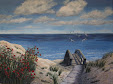
     "Castaway Island Cedars" is the second of two paintings begun at a painting workshop with painter/teacher Roger Bansemer. I described the painting process for "Castaway Island Palms" a few posts ago when it was finished. Both are 9" x 12" acrylic works on gallery-wrapped canvas using reference photos and notes from my outing to Castaway Island Preserve on the intracoastal waterway here in Jacksonville, Florida. Each scene shows characteristic North Florida native trees and other vegetation growing in or near salt marsh areas, scenes like those that greeted the first Europeans to step on the shore of what is now Florida.


     With apologies for the slightly washed out look of the palms photo, here is the other painting. As always, you can click on the images to enlarge the view.


     I used the same limited palette for these two scenes so that they could hang harmoniously as companion pieces, but made certain each could also work alone. This palette includes: cerulean blue, ultramarine blue, Payne's grey, cadmium yellow light, Indian yellow, cadmium red light, white, and buff, with some burnt umber in a few of the mixes. As described in the "Castaway Island Palms" post, this is my first experience using Indian yellow, a warm, slightly orangey hue. It's very nice. I rubbed each canvas with an uneven burnt sienna mid-tone before painting, which provides a warm undertone unifying the entire work as well as a base from which it was easy to judge the tones (relative darks and lights) of the rest of the painting. Beginning with what I planned as the darkest darks, then moving to lights and mid-range tones, I laid in the rough shapes of the composition, then gradually worked in greater detail. "Castaway Island Cedars" came together more quickly (or in my case, less slowly :>) than the palms piece.


     For each of these paintings, I had excellent reference photos, including those that showed more detail of the red cedar branches and needle clusters, or other crucial detail areas. Several times in the workshop, Roger Bansemer stressed the importance of starting with well-composed reference photos with adequate tonal variation. Sounds obvious, maybe, but I have begun with so-so photos more than once in the past and then struggled to compensate for a poor composition or monotonal appearance. There is a point beyond which I am not good at "making it up"--especially in trying to add something to the given scene that is not actually there. Some aspects of a scene are fairly simple to adjust. Given the lush, varied vegetation here in coastal North Florida, I inevitably need to leave things out to make a pleasing composition, which is simpler than adding elements. The horizon (which is often near the horizontal center of photos) can be moved easily to avoid cutting the composition in half (much less pleasing to the eye than placing it a third of the way from the top or bottom--or at another less symmetrical level). Beyond that, the fact that these works both came from good, solid reference photos helped me complete them with less stress and difficulty than sometimes.
Question of the day: In visual art (including photography), how often do you think about or notice the placement of various features of the overall composition? Do you know why you are particularly drawn to certain compositions?  

Friday, June 22, 2012

New Salt Marsh Painting--"Castaway Island Palms"

     The first of two 9" x 12" paintings I am working on from my exploration of Castaway Island Preserve might be finished. At least, it is very near finished and is ready to show you. The small palm hammock in the mid-distance across the salt marsh drew me to the scene. Paintings always take on a life of their own, and this one somehow became a bit darker and softer than my original vision, which seems fine. It hangs in my studio where I'll contemplate it occasionally to decide whether or not to make any further adjustments.


     I have been fortunate to have had the advice of two excellent painters on this piece. I began the work in Roger Bansemer's helpful two-day workshop, described in a previous post, and brought it home maybe 2/3 finished. A companion piece, also from a Castaway Island scene, got a rough start there, too--at least in its basic layout--and is now on my easel to be re-engaged.


     Linda Blondheim, my dear friend and mentor--and best painting teacher I have ever studied with--has also advised me as I worked to complete this piece. Given that she lives and works in Gainesville, Florida, a good 75 miles away from Jacksonville, our time together is limited. However, she offers an e-critique service which is extremely well-done. Periodically, I send her images of works in progress and ask questions about them. Her responses are encouraging, insightful, and precise, guiding the process without imposing her own style. She is that rare art teacher whose guidance helps students achieve their own vision to the best of their ability.


     The palette for this painting and its eventual companion piece is: ultramarine blue, cerulean blue, Indian yellow, cadmium yellow light, cadmium red, Payne's grey, buff, and white. This is the first time I have used Indian yellow, an orangy, yet not overly bright blend and enjoyed learning something of its mixing potential. Following Roger Bansemer's practice, I toned the canvas with a rub of burnt sienna before beginning. Once that is rubbed partly off, the resulting background is a mid-tone, which can help the painter judge tonal relationships as she adds first the major dark areas and then the lightest lights, and builds from there. In a departure from my usual technique, I let some of this undertone show through rather than completely covering it with full-strength paint. Handling the light in the scene was tricky, given a day that had been partly cloudy with a somewhat directionless glow and very subtle shadowing. Our weather has been unusually dry here in North Florida until recently; the marsh is undoubtedly much greener and thicker than when I last visited Castaway Island Park. I am reasonably pleased with the way this painting captures the light and mood of the day I was there.
Question of the day: Wouldn't life be sadder and poorer without compatible teachers and mentors?


Friday, May 11, 2012

Castaway Island Preserve--Another Amazing Jacksonville, Florida Park

Looking for some new reference photos for landscape painting, I recently visited the Castaway Island Preserve and found it fascinating. My photos don't fully capture its charms, I fear, but have given me much raw material for paintings. Sometimes all I need is good background information (a unique tree, a winding channel in the salt marsh, a particular bird) to meld into a composition that represents the area without copying any particular spot exactly. Although I had neglected to check the tidal schedule for the day, I was in luck to be there when the high tide was just receding. Thus, the marsh was quite wet, and birds, crabs, and other critters were active.
This wonderful small preserve includes both woodland and salt marsh ecosystems with views out to the intracoastal waterway, which runs between our off-shore beach island and the North Florida mainland in this area. We are parched for rain, unfortunately, and have some wildfires in the area. The day I explored Castaway Island, smoke hung in the air--sad to see and smell. However, I did the photo documentation I could under these conditions and have a nice packet of about 4 dozen prints to carry along with other photos to a painting workshop I will be taking this weekend. I hope to start two 9" x 12" canvases at the workshop.
In one photo, you see the dock at the end of the park area, where a woman had put a something on a line into the water (crabbing perhaps?). The intracoastal waterway is in the smoky background with a sailboat and a powerboat passing each other, going in opposite directions. Another photo shows the beginning of the path to Castaway Island (a short bridge crossing a channel in the marsh is the only clue that one is has crossed to an island). On the island part of the preserve, there are about 12 informative big boards along the main path, each one describing the life of one of the preserve's "survivor" species--other than that, the area is quite untouched. Two other photos show the wetlands, grasses, etc.--one includes a great blue heron fishing (actually blue-grey in color) which will take sharp eyes to see, even if you click on the photos to enlarge them.
For this visit, I took the paths through the salt marsh; the park provides extensive boardwalks over the wettest areas, helping to protect the natural habitat as well as making exploration convenient for the visitor. Another time, I'll explore the wooded areas further from the intracoastal. We are fortunate indeed in the Jacksonville, Florida area to enjoy a rich variety of habitats and to have many thousands of acres in these areas protected in preserves and parks.
Question of the day: Isn't it amazing how deep the creative and spiritual renewal available to us when we explore natural areas?

Thursday, September 8, 2011

Painting Process--My Easel Set-up

Today, you see a typical set-up at my easel. For most paintings, I place an old piece of heavy poster board against the easel behind the canvas so that I can tape things to it for reference. Nearly all my landscape pieces are studio paintings based on actual scenes, so the main reference photos go up on the board first. Below, you see one of the marsh reference photos I am using for these small paintings. The other item you see in this easel photo is a sheet of paper with a couple of quick sketches and other notes. Many of you know that I am a planner, rather than painting completely spontaneously. However, the amount of advance planning varies for different paintings. This is a relatively simple example for a pair of 5" x 7" salt marsh paintings, currently in progress.
In the photo of the sheet of paper, you see that I have done minimal sketching for these pieces. Given their rocky progress to this point, I may have done better to prepare more detailed value studies, planning the balance of lights and darks--but I didn't this time. I also did less in the way of color studies than I might do for larger works, but I did explore some of the possible gold and buff mixes for the dry winter grasses. Notice (learned this the hard way) that I recorded the tube colors used for each mix and also wrote down the colors used for sky and water (though without a sample patch) and the list of tube colors for this particular limited palette. Some artists probably can do with less written down, but I often am working on several pieces at the same time, so one may be set aside for awhile. It definitely helps to have notes about color blends used when I return to a work in progress after some time has passed.
Linda Blondheim, my painting mentor, suggested this blog post topic when I journeyed over to Gainesville, Florida on Saturday for one of her Open Studio Classes. I am thrilled that she is offering this class again; she had stopped for a number of months, and I missed the guidance she offers painters with any work they bring to the gathering. When Linda saw this set-up, she felt that others might like a peek at my typical messy work board. You can find earlier posts on similar topics by entering "painting process" in the blog search box, top left of this blog. The June 28, 2010 post in particular shows the planning materials and easel set-up for a study of a shore bird--somewhat like this board. And, as always, you can click on a photo to enlarge it and see more detail.
Question of the day: What triggers, tools, or processes aid you in creative endeavors (whether "artistic " projects or creative problem solving and everyday living)?

Monday, June 21, 2010

A Quick Hello and Answer to a Painting Question

I am planning some posts to answer some reader questions about my painting process. In particular, I will show you some of the stages of planning a composition, choosing a palette, and other details of preparing to create a coastal North Florida landscape painting. Artists differ greatly in their approach to the early stages of a work. For me, some time spent planning on paper helps the painting process. Believe me, I've learned that the hard way by thinking I had a workable concept and jumping in too quickly. Fortunately, acrylics allow for painting right over all the ""whoopsies" and "what was I thinking" areas. Even with careful planning, there is still a fair amount of revision as I go along with many adjustments for some of the pieces, while in other works, the plan works out more quickly and smoothly.
That's a preview to one or two posts coming soon. Today, I need to devote most of my on-line time to presenting this week's works in progress to Linda Blondheim for her e-critique services.
So, I will quickly post a photo to answer a question a few of you have e-mailed to me, "What is gallery wrap canvas?" I like the contemporary look of well-finished, unframed pieces. Some prepared canvases are stapled to their stretching boards along the sides so that a frame is necessary to cover the stapled edges. Gallery wrap canvases are more neatly stretched and are stapled to the boards on the back. I like to continue the scene right around to the sides of these canvases, as in the above photo of the autumn marsh scene. Of course, buyers who prefer framed paintings can still frame these works. But I finish the backs and wire them so that they can also be hung without a frame.
Keep those questions coming! I enjoy the conversations we have.

Saturday, June 12, 2010

Learning and Growing--Painting of a Salt Marsh

This painting, on 12" x 16" gallery wrapped canvas, has been a long time coming. I have felt stuck and put it away a few times. As I worked on it in May, it reached "near completion". Yet, I was uncertain about the best solution to a couple of issues. The foreground grasses were problematical, sometimes seeming too bland; then a change would overdo the variation in tone and color. Bland wasn't good, but I did not want the foreground to distract from the egrets (intended to be a focal point) or from allowing the viewer's eye to move about the scene. You may want to enlarge this image to get a better view of the egrets and other details.
Knowing that I would be working with my painting mentor Linda Blondheim again in June, I waited for her advice. I mentioned her e-critique service for painters in two February posts, the last time we worked together. Between her suggestions and some experimenting on my part, the piece is now in a good place. There will still be minor color adjustments with transparent glazes on the lightest grass tips and perhaps on the tree mass furthest forward on the right. These will be subtle enough that they will not show much in a photo. So, I decided to go ahead and show it to all y'all.
Although the reference photo was taken one January, that was a mild winter (unlike this year!), and the salt marsh did not look completely winter-like yet. Also, some of the color changes I made to pump up the visual interest of several areas slanted the scene toward a late autumn in look. We have hiked the wooded and marshland trails in Fort Caroline National Monument several times, both on our own and with family members visiting from other parts of the country. Every trail turn reveals new natural beauty in this park, part of an immense preserve spanning thousands of acres near the mouth of the St. Johns River here in Jacksonville, Florida.
Question of the day: Isn't it interesting how some creations seem to come together in a flash (not only for painters, but for all creative individuals), and others unfold slowly?

Thursday, April 29, 2010

Savoring--Contrasts in Jacksonville Harbor, Nature & Commerce

Following up on the previous post, I have two more photos to show you from our dinner cruise on Jacksonville's beautiful, wide St. John's River. At one point, three dolphins greeted us, playing all around the boat as we enjoyed their company. I wish I had a better picture of them. Although I did my best to capture an image, snapping away as they circled and leapt, many of my photos are of ripples where there had been dolphins a second before. Oh well, with or without boast-worthy pictures, I will not forget the experience. We were awed and privileged to be near these sleek, intelligent animals. They seemed to be riding the rising tide of the salt water sweeping into the river, a twice-daily flow that enriches the variety of marine life we see in the river. Even where we dock our sailboat, about 14 miles from the mouth of this mighty river, the water is brackish enough to support many salt water creatures from small crabs to those gentle giant sea mammals, manatees.
The other photo is a contrast to the rich marine life in the river and shows a ship in port--just one glimpse of the heavy shipping Jacksonville's active port supports. The graceful bridge in the background is called the Dames Point Bridge--one of our favorites among the many river crossings. Reviewing my photos from that evening, I realized again how much I enjoy living in this area. I love the varied natural habitats and extensive nature preserves in our forests, meadows, salt marshes, and ocean coastal areas. However, I am also a city kid through and through. Growing up just north of industrial Muskegon, Michigan, on the shore of Lake Michigan, I loved to watch the activity at the commercial docks. Once the St. Lawrence Seaway opened the lake to international shipping, the loading and unloading of ships, the transfer of goods to trucks and trains, and other dockside activities increased exponentially. Yet, there too, we were near gorgeous natural habitats and preserves and enjoyed the best of both worlds, in my view.
Question of the day: No particular question comes to mind--just the thought that we are very fortunate in our home area and all the places we have lived. I hope you find beauty and fascination all around, as well.

Wednesday, October 28, 2009

Growing--Landscape Painting Studies--Salt Marshes

These small (5" X 7") studies are based on the two salt marsh photos I posted last time. Several other photos taken that early January day also informed my interpretation of the scene on canvas. Although I love exploring and looking out over the marshes any time of the year, there is something especially tranquil and spiritual about winter marshland. Thus, these little pieces have been a joy to create. You will notice a few modifications from the actual scenes in the photos, especially some simplifications to improve the composition for this small format. When viewed next to each other, these paintings provide a panoramic view. But each can stand on its own as well.
I am working on a 12" X 16" version of the view in the study on the right. The egret is nice, but the complexity of the waterway patterns in the other study is even more appealing to me. Achieving a good tonal balance and a believable distance perspective in the larger painting have been more demanding than expected, but I hope to be able to show it to you soon.
Again, I am struck by the extent to which painting has sharpened my ability to see, to really see, the variety and complexity of nature--even in an apparently simple scene. Art instructors always say, "Paint from what you see; don't make it up," and every turn at the easel proves them right. Even when we change the scene--or even partially abstract it--working from what we think things look like instead of from the reality throws the work off. Yet, maddeningly, I sometimes find myself falling into the habit of working out of my head, even when the photos are right in front of me. The goal is continual growing and learning from each project.
For local readers, a reminder of our invitation to one and all. Mark and I would love to welcome you to our home for Harvest Delights, an Open Studio Reception Sunday, November 8, from 2 - 5 p.m. Food, drink, paintings, sustainably grown produce from our friends' farm, live piano music, and fun people--drop in and enjoy! Please scroll down to the October 10 post for address and contact information. Or email me at lemmeneslandscape@bellsouth.net with questions.
Question of the day: If you paint, sketch, take photos, or pursue any other creative outlet, do you find yourself seeing much more acutely than before--even if you have always loved nature?

Sunday, October 25, 2009

Exploring--Near Home Again--Salt Marsh Trails

I am fascinated by salt marshes--by the rolling sea of grass, by seasonal variations in the texture and color of the grasses, and by the changing patterns of land and water as the tide rises and falls. Since all the land in a marsh is fairly low, these patterns are not set; the incoming tide flows in some established channels, but also spreads in unique ways that subtly change the scenery from one day to another. These North Florida wetlands are quite different from the Michigan wetlands I grew up with and the wetlands of other places we have lived. I feel enriched to have lived in Western Michigan, the New York City/Long Island area, Southern California, greater Atlanta, Georgia, and now in Jacksonville, Florida. I am thankful for this land and for the rich variety of natural beauty near each place we have lived, as well as in the many other states we have been fortunate to explore.
We have hiked several times in the Theodore Roosevelt area of Jacksonville's vast Timucuan Preserve. A favorite trail leads to an observation platform looking out over the marsh--the views in the above photos. The trail is named after Willie Brown, a man who once lived in a small, isolated, primitive cabin (the cabin footings remain, midway along the trail) in the woodsy region on the way to the marsh. Thus, walking the trail provides two distinct types of terrain and habitat. The view from the observation platform is particularly interesting late in the day, at nesting time for the many water birds who range out from the area.
Next post I will show you two small paintings, studies for possible larger pieces, based on these and other photos from our exploration on the trail a couple of years ago. I took the photos when my sister visited from Maryland, and we explored this area together. Although we have been back since, something about the tidal patterns in photos from our first visit most strongly moved me to paint the scene. For some reason, photos from more recent visits have not struck me with the same power, even though our experience of the natural setting has been amazing every time.
You see the marsh as it looks in early January, warmed by the brown and golden tones of winter grass but yielding fewer bird sightings than in nesting season. I enjoy the lonely expanse and the limited palette of the scene in winter, which focuses my attention on the interesting patterns of the waterways as the tide begins to recede from an earlier high, exposing mud, mussel beds, and tiny scurrying crabs.
Question of the day: What natural beauty has enriched your life recently?