Showing posts sorted by relevance for query Kingsley. Sort by date Show all posts

Friday, February 25, 2011

Exploring--Right Near Home--Kingsley Plantation

Within the Timucuan Preserve on the northern edge of Jacksonville, Florida, an immense cluster (more than 98,000 acres altogether) of preserved natural and historical sites, stands a well-preserved former sea island cotton plantation with some surprises in its history. Kingsley Plantation nestles beside extensive salt marshes and passages out to the sea and to navigable rivers. In fact, ships from England could follow waterways straight to Kingsley's dock to deliver goods and load precious sea island cotton for the voyage back.
This free attraction, run by the National Park service, is accessible by road, boat, canoe, or kayak. The house and kitchen buildings (currently closed for renovation) are smaller and simpler than some of the grand old plantations you may have visited in places like Virginia. But, like those Virginians, Kingsley's owners owed their prosperity to the slave labor of countless individuals. In one of the photos, you can see the remains of slave cabins (24 of the original 32 are visible, arranged in a semi-circle) that were built of tabby. Tabby is a concrete material made of sand, water, and lime extracted from shells, mixed with whole shells and pieces, which was widely used for building in the coastal South. Another photo shows the critter that calmly snuffled nearby while my brother and I explored the cabin ruins, barn, and other exhibits on a bright January day.
Although it's tempting to write about this plantation at length, I'll spare you that. You can find extensive information on-line if you are interested (ditto for the Timucuan Preserve). However, the history of this plantation has a couple of unusual aspects I'll mention. When Zephaniah Kingsley acquired the land, he brought his wife Anna and their children along--not so amazing, except that Anna, who was a native of Senegal in West Africa, had been his slave at one time. Further, given that Zephaniah liked owning land better than managing it, or even living there full-time, Anna eventually came to manage the plantation on her own--an unusual achievement for that time, to say the least. Unlike many of the large plantations in other areas, in which overseers drove so-called "gangs" of slaves in the fields every moment of daylight, Kingsley employed the "task" system of work under Anna's management. Individual slaves were assigned a daily task and were free to rejoin their babies, till their own gardens, etc. once they had completed the task. This is not to suggest that their lives were easy, but it does seem marginally more humane than driving people to work every daylight hour.
This post is slightly revised from my April 26. 2009 post (I have to say that this year's January was rather thin on bright, warm days like the one pictured here :>). We revisited Kingsley Plantation earlier this month with friends visiting us from Pennsylvania and enjoyed it just as much. Unfortunately, funding limitations have slowed work, and the house and kitchen building are still under renovation. They seem to be nearing completion, so we hope that we can see them later this year restored to the way they looked in Anna Kingsley's time. Next post, I'll show you some photos from this recent visit that may become paintings at some time.
Question of the day: If you were a local tourist guide, where would you take visitors and what would you want them to understand about your home area?

Friday, October 26, 2012

Newest Painting Is Complete--"River View at Kingsley Plantation"

     I felt a little rushed to complete this 18" x 24" acrylic on gallery-wrapped canvas in time to deliver it to Paddiwhack Gallery for a special exhibit. However, I am quite pleased with the result. "River View at Kingsley Plantation" utilized my cabbage palm painting photos and study, mentioned in the most recent previous post. It may not seem like a big deal to everyone, but creating the palm trunks and especially the palm canopy (and even the part of a canopy visible on the far right) required special study and careful work.

     Then, the first try after my studies produced a very nice canopy on the furthest palm away from the viewer (which appears in the middle of the three seen), but I painted much of it out and started again. That canopy had been very high on the canvas and was not seen in full (in other words, the viewer of the painting saw maybe the lower two-thirds of it at most). On e-critique advice from Linda Blondheim and on further reflection myself, I concluded that for good composition and better balance, that entire palm canopy needed to be lower so that it would be seen in full. Other changes from the main reference photo (seen below)--made to enhance the composition--included painting in a more interesting sky, adding a kite, which is one of Florida's gorgeous soaring shore birds, and simplifying the tall grasses.  My literal rendition of the bulkhead along the river at the Kingsley Plantation National Parks historic site bothered Linda. She would have preferred a softer, more organic, curving line, perhaps of the mud flats that line the river bank at low tide. I did consider her suggestion to replace the bulkhead, knowing that it would certainly work well. However, in the end, I stayed with the straight  bulkhead as it is, partly because viewers who have visited Kingsley Plantation have seen it there and partly because something about the sharper angles appealed to me as a change from some of the softer composition edges I have used in other pieces. 


     You can see other changes from the actual scene that I made in the painting. But, you can also see that this particular photo already represented a composition that appealed to me without major rearrangement. Compared to the times that I have used a reference photo that had appealing elements but was not composed well and required major revision in painting, beginning with a solid photo composition is much simpler and more satisfying.

Question of the day: Do you personally prefer fairly realistic--or even near photo-realistic paintings--or some other type such as impressionistic or abstract?

Thursday, October 18, 2012

Studying Cabbage Palms for Better Painting

In my newest painting, which I'll show you soon, three cabbage palms frame one side of the scene. They are seen fairly close up, so needed to be painted quite accurately. Painting a realistic cabbage palm tree proved more complicated than expected. After all, I thought, there were some decently rendered distant palms in some of my paintings, and I had good results with a tropical beach scene that had the island sort of palms near the viewer. Painting them close up was a whole new challenge, humbling, but very interesting.

Cabbage palms (technically the Sabal palmetto, Florida's state tree) are actually quite complex. The fronds in the canopy grow out on various levels as the tree grows taller. In nature, the lower fronds gradually brown, droop, and eventually drop off, sometimes cleanly and sometimes leaving spiky pieces of stem behind (as on the loosely trimmed palms in the photo above). At the national historic site scene I was working on, the browned lower fronds had been regularly trimmed away from the palms, leaving a mostly bright green "lollipop" shaped top. For visual interest, I had decided to add a few browned fronds hanging down, but did incorporate the fairly smooth trunk with no spikes sticking out, just as I saw it at the historic Kingsley Plantation. The plantation is one of our favorite places to visit or to bring out-of-town guests; if you wish, you can view previous Kingsley Plantation posts here.

As I worked to learn more about the cabbage palm, my mentor, Linda Blondheim, advised me and provided one of her own printed tutorials with detailed pointers on painting various species of palm trees. The tutorials may be available from Linda--here is a way to contact her. I also viewed dozens of palms on a perfectly timed weekend watching the dogs at our kids' beach town home while they were away. The yard of their home has gorgeous stands of palm trees, Then, just the shortest walk in their area provided many more palms to study and photograph--each with its own unique form and character. That weekend, I sketched a few palms and parts of palms to get a good feel for them and took dozens of photos, some showing a whole tree or stand of trees, others mid-range, and some intense close-ups for information about details. Back in the studio, the painting flowed much more successfully--will post the results soon.


By the way, please bear with me for a couple of months with less frequent posts. Mark is recovering well from recent rotator cuff repair surgery, and I go in next week for total right hip replacement. I plan to prepare a few posts the rest of this week (if all goes well) that can post automatically, but probably two posts a month will be my max for awhile.
Question of the day: Do you also find that one of the joys (and sometimes, frustrations) of creative pursuits is that each new project presents new challenges and opportunities to grow?

Friday, November 30, 2012

Second Show of Paintings at Paddiwhack Gallery

     I am thrilled to have a second opportunity to show paintings in the featured "nook" at the front of the wonderful Paddiwhack Shop in Gainesville, Florida. It is an honor and privilege to have works hung together in this premier location in the store. It has been about a year and a half since I last exhibited there. This group of pieces (plus one called "Sanderling in the Surf", which is featured elsewhere in the shop) shared the coveted pre-holiday time period with Paddiwhack's unique selection of holiday-themed items. Of course, all the other delightful treasures Paddiwhack is known for are also available in their wonderful, large space. As always, you can click on a photo to enlarge it.


     All the pieces in this exhibit are new to Paddiwhack. Given my slow painting pace and the various life events that occurred and kept me from painting at times in recent months, it was a challenge to produce and mount the 12 works shown at the shop. Since I have at some time posted about the Coastal North Florida explorations that led to the subjects for these works and about the painting process for each piece, I won't discuss that today. 

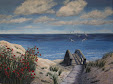
     One goal for this exhibit was to present a greater variety of sizes and prices than I had in the previous exhibit. The little pair of 5" x 7" marsh paintings seen on the chest near my artist's statement and business cards are the smallest, while the largest are two 18" x 24" paintings above that chest on the left. One shows a winter day at Big Talbot Island Park here in North Florida, where waves are gradually undermining a bluff causing trees, one by one over time, to fall into the water. The other represents a view of the St. Johns River by the National Historic Site at Kingsley Plantation. Whoops, there is one other in that size which the shop had kept from my previous exhibit--a view of the Atlantic Ocean at Jacksonville Beach, looking over the dunes and a foot bridge--seen on a side wall. 

     Thank you all for your good wishes as I recover from total hip replacement surgery. I am amazed and deeply grateful for the miracle of a new joint, for freedom from long-standing, constant pain, and for the wonder of growing strength and mobility the surgery and excellent physical therapy are making possible. I feel like a new woman!


Question of the day: Are you considering small, locally owned businesses like Paddiwhack and goods made in the USA in your holiday gift shopping?

Sunday, October 2, 2011

Painting of a Wooded Path

Here is the painting of a wooded path I showed you as a work-in-progress a couple of posts ago. Loosely based on a scene at our nearby Kingsley Plantation (which has appeared in a few previous posts and some other paintings), the piece is nearly finished. I have adjusted the light and shadow patterns on the path and have added some details in the upper right quadrant (the intended focal area). There will be a few more adjustments, but nothing that will be very noticeable in a snapshot. At least, that is my current thinking. Sometimes, I get a new insight after putting a nearly complete piece away for awhile.
However, I am wary of overworking a painting, a real temptation for a detail-oriented perfectionist like me. So, it's smart to stop before I feel that a piece is totally "there" and put it away for a time. I am much more likely to detract from a work by continuing to fiddle with it at this stage than to improve it much.
Given the sort of person I am, painting has been very good for me. Artistic pieces are never "perfect" or "correct" in the same sense that something like an algebra solution is. I am learning to enjoy the process above all and to let go of the need to keep trying to improve a painting that is "almost there". In art, there may be no "there" there--as someone said in another context. Looser work with some imperfection is often fresher, livelier, and easier for viewers to relate to. Stiff, overly fussy detailed work misses the mark in terms of communicating an artistic vision. Nature, after all, achieves its beauty in the variations, asymmetry, and yes, imperfections of living things and natural features of the landscape. So, for a representative landscape painter, letting go of perfectionism is the perfect approach.
Question of the day: What recent project or undertaking has proven to be a helpful corrective to your personal tendencies?

Monday, February 28, 2011

Exploring--Off the Beaten Track for Painting Subjects

Last post, I showed you a 2009 visit to Kingsley Plantation in the Timucuan Preserve, here in Jacksonville, Florida. Today's photos are from our visit to the plantation with out-of-town friends a couple of weeks ago on a pleasant, bright day. After viewing the ruins of the slave cabins, the buildings, and exhibits, we wandered the extensive property. I am always drawn to water, so took a trail by the river, where views of marsh grasses and small islands added charm to the view.
I took a number of photos, as I usually do in interesting coastal North Florida areas, hoping that some will provide inspiration for landscape paintings in the future. In addition to photos that might, with cropping and a few adjustments, become the basis for a painting, I take various photos to help me remember details. The bark or leaves of a particular tree, the mud at the edge of a river, a close-up of salt marsh grasses, a cloud formation, or any number of other details can provide the information I need back in the studio. Without good photo records, studio painting would be guesswork and would not result in the kind of expressive, yet representative, landscapes I like to paint. Of course, not every painter works this way, and many wonderful paintings evolve by other methods. But, for me, "making it up" does not produce the kinds of interpretations of actual locations in our beautiful area that I try to paint.
You may enjoy imagining how you would use these photos in a painting. The view of the path is intriguing, but lacks the variation in color and in lights and darks a painting needs. Guess I'd imagine more breaks in the trees on the left to add more sunny patches on the shadowed walk, then intensify the drama of the bright area where the trail curves out of sight with sunlit tree trunks and foliage. The river view has multiple possibilities; one would be to use a 6" x 12" canvas I have and paint a narrow panoramic view.
Question of the day: Do you, too, find yourself captured by a scene off the beaten path that other people might pass without noticing?

Saturday, February 4, 2012

Techniques for Painting Shadows in Landscapes

Today, let's consider shadows in landscape paintings once more, this time considering a few "how-to" techniques. (Scroll down a bit for earlier posts on this topic.) Of course, since painting is very individual and variable, I realize that my techniques and methods are only one way to approach this important element in a scene. I would love to hear from other artists who approach shadow painting differently--as well as from readers who might "see" them differently. I think shadows are fascinating to consider.
"Wooded Path" is adapted from some photos I took on the extensive grounds of the Kingsley Plantation, which I have written about in several earlier posts. This historic site is nestled in an immense preserve area just north of Jacksonville, Florida. The Timucuan preserve includes salt marshes, wooded areas, and Florida prairie, as well as other land and water habitats. The 16" x 20" acrylic painting on gallery-wrap canvas shows a bend in a path as it leads deeper into the woods. Unfortunately, I was not able to get a good, true photo of this piece (don't know why that happens sometimes). The photo of the final version, seen below an earlier view and a detail of the foreground, looks misty in the mid-ground, whereas the actual painting is clear. The work-in-progress took a better photo--hope you can see some value in the improvements in the final version in spite of the poor photo.
At first, the path was too uniformly dark and mid-dark in tone, so in the work-in-progress photo above, you see that I have lightened whole areas, especially just before the bend. Then I added some shadow areas gradually, being careful not to overdo either the amount of shadow area on the path or the darkness of the tones.
Linda Blondheim, in one of her excellent workshops, helped me see that the foreground shadow of the tree trunk was too dark as it moved away from the tree. Real life shadows tend to be darkest at their "source" (right next to the object casting the shadow) and then partially fade along the length of the shadow. Actually, I knew that, but had not been successful in my attempts to vary the shadow. It never looked right. Linda advised that I pull in other path tones and colors from the sides of the shadow edge as it moved away from the tree. To my eye, that worked like a charm, much better than my earlier tries at just gradually lightening the color I used for the shadow as it extended out.
One other change, made before Linda's workshop, was to revise the curve of the path in the foreground. Although not related to shadows, I thought you might like to see that revision, too. In the earlier version, it seemed like the perspective was off, like the path sort of spilled into the viewer's lap. The detail photo shows my sketched lines for revision, which led to an improvement in the composition, I think .
Question of the day: Do you look at shadows differently after hearing about the challenges involved in painting them?

Monday, May 4, 2009

Exploring--Paddling & Savoring Timucuan Preserve

I mentioned my new painting adventures in the last post and am working on getting decent photos of some other paintings to show you soon. It can be difficult to get them lighted well to avoid glare and to display close to true color in photos.
In the meantime, here are a couple of photos of a kayaking outing I took with my husband and adult son (the younger of two sons) one cloudy Memorial Day. Here in North Florida, cloudy can be a good thing, helping the temperature stay moderate. Thankfully, the threatened stormy weather held off until later in the day. 
At a well-run facility called Kayak Amelia, we were fitted for kayaks and gear and instructed in safety and technique before we set off with a knowledgeable guide whose colorful stories and descriptions of his beloved salt marshes informed us about this precious habitat. Yet, he wisely allowed plenty of quiet time for us to savor the beauty, the water birds, the fish jumping, and the calming rhythm of silent paddling. Although most of the areas we explored that day are not accessible except by water, we were not far from Kingsley Plantation and other public sites and parks in the remarkable, extensive cluster of wetlands, beaches, and forest in the Timucuan Preserve (which also includes Big and Little Talbot Islands). See my posts for April 23 and 26 for more Timucuan Preserve sites. I am humbled and awed by the varied natural beauty there and feel tremendous gratitude to all the groups and individuals responsible for its preservation.  
Some of my photos from that day inspired a quiet marsh painting I'll show you soon. 
Question of the day?: What outdoor exploring is on your "do sometime" mental list? When--set a date now!--will you stroll, pedal, hike, saddle-up, paddle, sail, skate, or hang-glide (!) in a precious natural setting near your home?
Thank you to all my kind readers who have emailed or phoned me to respond to the blog. I appreciate knowing that you are "out there" whether or not you post a comment. It's especially encouraging to hear the plans for exploring that a couple of you have made since reading earlier posts. Here's to our continuing creative conversation!