Sunday, May 20, 2012

A Rewarding Painting Workshop Taught by Roger Bansemer


This past weekend, I attended a two-day landscape painting workshop in historic St. Augustine, Florida, taught by the noted painter, Roger Bansemer. The paintings in this post are by Roger, one done as a demonstration each of the two days. (By the way, I am trying to set up this post on the new blogger format and having trouble setting up the post the way I want to. I'm not sure how it will turn out--sorry if it's a little strange.) 


Bansemer's instructional painting television program has recently begun showing on our public tv station, and I took a look at his website after viewing an episode. Lo and behold, he offered a painting workshop over Mother's Day weekend only about a 45 minute drive from our home. I liked his painting style and his easy-going, yet very informative, manner on the television program, so enrolled in the workshop, hoping he would be a compatible teacher for me.


The workshop exceeded my expectations. As regular readers know, I tend to paint slowly and cautiously and to get overly fussy with detail in a detrimental way. Roger Bansemer was the perfect teacher to push me to a bolder, more "painterly" approach and to quash the fussiness right from the start.


Each workshop morning began with a lovely breakfast buffet, provided by the staff and volunteers of the St. Augustine Art Association, where the workshop met. Then Roger began the demonstration painting of the day, based on a photograph. He used acrylic paints, as I do, but welcomed students who were working in oils as well. His instruction covered all aspects of landscape painting, beginning with choosing a scene, then establishing the overall composition, balancing values (lights, darks, and in-between values), using a limited palette of colors, and other basics. As he spoke, he illustrated the method in his demonstration painting and kindly tolerated and answered our wide-ranging questions. 


My photos show each of his two demo paintings in an early stage and then at the end of the day after he had gone beyond the initial demo stage, using his lunch period and other free moments during the day to flesh out the piece. To begin, he rubbed a burnt sienna tone into the board as a mid-tone base. Then, he established the major dark areas, some of the lightest lights, and continued to fill in, working all around the piece in a balanced way. Clicking on any photo will enable you to see it enlarged.


After showing us the basics and answering questions, he turned us loose to work on our own chosen paintings and circulated from one student to the next, guiding each person's work. The workshop was very helpful to me, providing new skills, inspiration, and tips focused on my individual needs as an artist.
Question of the day: Isn't learning and stretching ourselves one of the most enlivening activities we can pursue?

Friday, May 11, 2012

Castaway Island Preserve--Another Amazing Jacksonville, Florida Park

Looking for some new reference photos for landscape painting, I recently visited the Castaway Island Preserve and found it fascinating. My photos don't fully capture its charms, I fear, but have given me much raw material for paintings. Sometimes all I need is good background information (a unique tree, a winding channel in the salt marsh, a particular bird) to meld into a composition that represents the area without copying any particular spot exactly. Although I had neglected to check the tidal schedule for the day, I was in luck to be there when the high tide was just receding. Thus, the marsh was quite wet, and birds, crabs, and other critters were active.
This wonderful small preserve includes both woodland and salt marsh ecosystems with views out to the intracoastal waterway, which runs between our off-shore beach island and the North Florida mainland in this area. We are parched for rain, unfortunately, and have some wildfires in the area. The day I explored Castaway Island, smoke hung in the air--sad to see and smell. However, I did the photo documentation I could under these conditions and have a nice packet of about 4 dozen prints to carry along with other photos to a painting workshop I will be taking this weekend. I hope to start two 9" x 12" canvases at the workshop.
In one photo, you see the dock at the end of the park area, where a woman had put a something on a line into the water (crabbing perhaps?). The intracoastal waterway is in the smoky background with a sailboat and a powerboat passing each other, going in opposite directions. Another photo shows the beginning of the path to Castaway Island (a short bridge crossing a channel in the marsh is the only clue that one is has crossed to an island). On the island part of the preserve, there are about 12 informative big boards along the main path, each one describing the life of one of the preserve's "survivor" species--other than that, the area is quite untouched. Two other photos show the wetlands, grasses, etc.--one includes a great blue heron fishing (actually blue-grey in color) which will take sharp eyes to see, even if you click on the photos to enlarge them.
For this visit, I took the paths through the salt marsh; the park provides extensive boardwalks over the wettest areas, helping to protect the natural habitat as well as making exploration convenient for the visitor. Another time, I'll explore the wooded areas further from the intracoastal. We are fortunate indeed in the Jacksonville, Florida area to enjoy a rich variety of habitats and to have many thousands of acres in these areas protected in preserves and parks.
Question of the day: Isn't it amazing how deep the creative and spiritual renewal available to us when we explore natural areas?

Monday, April 30, 2012

An Excellent New Book About Introverts Called "Quiet"

I am reading an intriguing, empowering, beautifully written new book called Quiet,The Power of Introverts in a World that Can't Stop Talking. When I first heard about this book on a Public Radio interview with the author, Susan Cain, I immediately searched our public library web site and placed a hold on it. The fact that I was about 28th in the waiting line gives you a clue as to the demand for this powerful read. Once my turn finally came, and I began reading, the brief introduction thoroughly captured my interest. Quiet continues to fascinate me and also to affirm me, an introvert who likes being myself.
However, all readers, whatever their personality types, can enjoy and benefit from this superbly well-researched and readable book. As a Harvard Law School honors graduate, business consultant, and negotiation skills teacher, Susan Cain offers a compelling argument that businesses, communities, and American society at large lose valuable insights, innovative ideas, and leadership potential by falling in step with the prevailing undervaluing of the unique gifts of introverts.
Cain convincingly marshals the latest research from psychology and neuroscience combined with inspiring narratives about real people demonstrating the complementary viewpoints and range of skills characteristic of both introverts and extroverts. She tracks the history of the focus on the qualities of extroverts as being more desirable in both business and relationships--then documents the evidence that we all lose when 1/3 or more of our people are undervalued or even discounted because they are introverts. She charmingly debunks the myths that all introverts (or extroverts, for that matter) are alike and affirms the contributions all make.
I like this book because it upholds who I am, but it offers much more than that. Cain's insights into relationships (especially between different personality types), parenting, cooperation in groups, and business management are pure gold.
When I started this blog about creative everyday life, I expected to post about the books I read fairly often, as I am a voracious reader. However, for some reason, that has not happened. Perhaps if blog readers enjoy hearing about this book and respond to the post, I will discuss my reading--of a wide variety of books, both fiction and non-fiction--more often.
Question of the day: What have you read lately that has entertained or informed you and enriched your life?

Friday, April 20, 2012

New Orleans Visit, Part III--Riverboat Tour

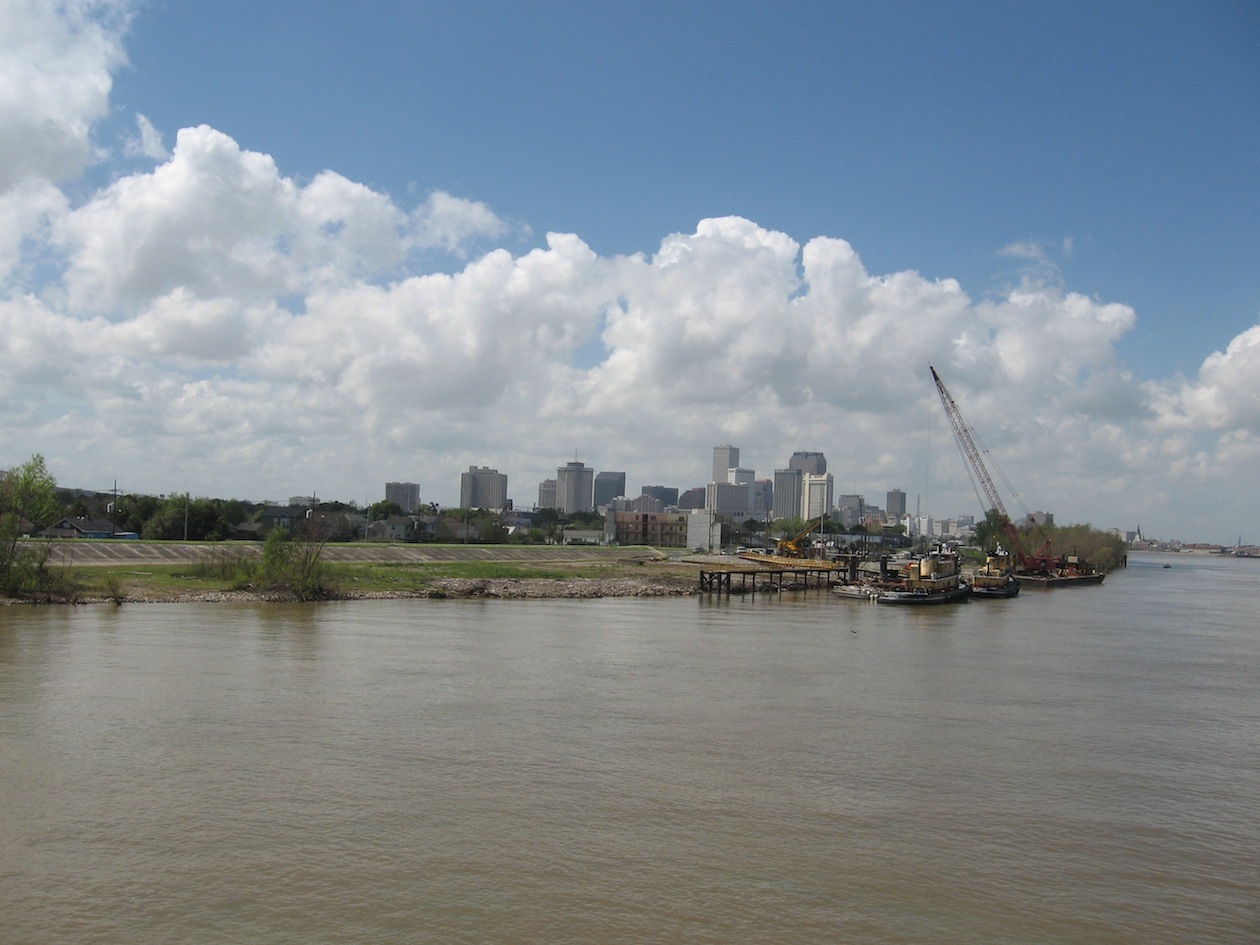
While we were in New Orleans last month, we took a Mississippi River tour on a stern-wheel driven steamboat (one of the last authentic steamboats on the Mississippi River). The informative commentary brought the busy harbor, various city parishes, and a stretch of the mighty river alive for us. Except for the photo of the paddle boat itself, you are seeing views from the boat.
You can see Jackson Square and the St. Louis Cathedral again (see recent post for more information) as we pull away from the French Quarter. The USS Cape Kennedy is a large naval cargo ship; one photo shows the stern hatch of its sister ship open with its ramp out for loading or unloading tanks and other heavy equipment. We also got a sense of what a busy shipping port New Orleans is, with commercial cargo ships from all over the world coming, going, docked, loading, and unloading. Returning from a fascinating 2-hour cruise, we enjoyed stunning views of the city.
Question of the day: Do you also gravitate to bodies of water, water tours, and water recreation when you travel or relax near home? We enjoy cities, mountains, desert vistas, and more--but have to admit that nothing beats rivers, oceans, lakes, etc. for beauty and enjoyment for us.

Thursday, April 12, 2012

The Art of Framing Paintings--New Look for Cypress Swamp Painting

In a few days I will share one more post from our visit to New Orleans. Today, I wanted to show you the frame I found for the 8" x10" Cypress Swamp painting. I do most of my work on gallery-wrapped canvas with the painting wrapping around to the sides, top, and bottom. These can be hung without a frame for a nice, contemporary look, or clients can frame them if they prefer.
However, for small studies, like this painting of a cypress swamp scene near Punta Gorda, Florida (more information, in earlier posts), I sometimes use canvas-covered boards. These are best framed (so that they don't warp, as well as for appearance), but I don't feel confident choosing frames on my own and seek advice, either from my husband, who has a great eye for the best frame or from a framing expert in a shop.
Our local art supply store, Reddi Arts, which is a treasure trove of lovely, unique gifts as well as a bonanza of well-priced supplies for all types of artists and crafters, has the best framers around. They also have an extensive supply of ready-made frames in all price ranges. When I frame a piece that will be for sale, like this one, I do not want to invest in an expensive custom framing job. This would add too much to the price of the piece--and may not even be to the client's taste (many art buyers replace the frame a work comes in to suit their taste and decor). On the other hand, I want the piece to look as nice as possible and not to cheapen it with a shabby or poorly chosen frame.
At Reddi Arts, the staff is as careful and helpful assisting a customer seeking a $20 - $25 frame as when someone brings in a large piece for expensive custom framing. This particular painting is a bit tricky because the prevailing cool tones don't look right with most wood finishes or metallics--yet a plain black frame didn't add much either. The framer there walked through the entire department with me and found this attractive frame, which looks terrific--better than I seem to be able to show you in a photo--sorry about that. The finish has both muted silvery and gold touches on a neutral wood tone that picked up the touches of brown in the cypress roots perfectly. The right side of the photo is not true to the color of the frame; it's less brown and cooler toned than it looks on that side. I was pleased--AND the frame was only $23, a very good price for the look of quality it has. So, the total price of the painting can stay reasonable (about $150). Unlike some artists, I do not try to make money on frames--just pass on the basic cost.
Question of the day: What guides you in choosing frames for art work?

Friday, March 30, 2012

New Orleans Visit, Part II -- Botanical Gardens and Metairie Cemetery

The one day in New Orleans that we took our car out of the hotel's parking lot, we drove to Metairie Cemetery, which is an interesting combination of old tombs and current burial areas. Some New Orleans cemeteries are even older, but they are crowded with a jumble of mausoleums that serve, unfortunately, as cover for muggers and others. Visitors are advised to go there at the busiest times, perhaps with a guided group. Since our purpose was to visit a "drivable" cemetery and see the above-ground burial which the high water table and frequent heavy soaking of the ground requires in this area, Metairie was just right. New Orleans' largest cemetery, it covers over 65 acres (web sites seem to differ on its exact size), and was established in 1873 on the site of a former racetrack. The grounds are beautifully kept, a peaceful "park" full of birds singing their hearts out. Mausoleums of many leading families, tombs of former governors and mayors, and towering military memorials share the grounds with lavish displays by less upstanding (though certainly no less wealthy) citizens, such as the elaborate tomb of Josie Arlington, once the leading madam of Storyville.
Not far from that cemetery, New Orleans boasts a 1,300 acre city park, which includes the Carousel Gardens Amusement Park, the New Orleans Museum of Art, and many other scenic features and recreation centers. We strolled through the botanical gardens there (a treat for my master gardener husband). One photo from the gardens shows the conservatory (in a style complementing the main Pavilion across the promenade) which houses a tropical rain forest exhibit and "living fossils", plants with a lineage going back to prehistoric times. The other garden photo shows a corner of the Japanese Garden section.
We were very fortunate with our weather while we were in New Orleans (mid-March)--quite warm each day (mid to upper 80s), but not oppressive or excessively humid and beautifully clear, as you can see. I had made plans for activities we could have done if we had heavy rain or too much heat for extended time outside, but will save those for another visit. As I mentioned in the previous post, New Orleans exceeded my expectations as a fascinating destination, with much to see and do for visitors with a variety of interests.
Question of the day: When and where have cemeteries been among the attractions you have visited in your travels?

Thursday, March 22, 2012

A New Orleans Vacation

We have returned from several days in New Orleans, a delightful vacation break! Today's photos are all from the French Quarter, which we visited a couple of times, riding the excellent street car system to various destinations from our hotel on a quiet, beautiful, tree-lined block in the architecturally rich Garden District. I think we enjoyed the best of both worlds by visiting the razz-ama-tazz in the daytime and staying in a quieter (though still urban) area. Historic mansions made exploring the Garden District fun, and Magazine Street, a few blocks from our hotel, is famous for antique shops, boutiques, and galleries as well as some lovely restaurants. We strolled down to the Lilette Restaurant there for an elegant, delicious French meal our last evening in town.
Our first afternoon, we hopped on the streetcar after settling into our room (a $3 day pass got us all the rides and transfers we wanted--a real bargain--and no parking headaches or expense), riding to a stop near Jackson Square in the heart of the French Quarter. A mule-pulled carriage with a friendly, lively driver provided us with an orientation tour of the Quarter--a fun, relaxing way to get a feel for directions and to learn about the area. The photo of the building corner gives a flavor of the lovely places and beautiful balconies there. Then we stood in a verrrrry long and slow line for the famous beignets and coffee at Cafe Du Monde nearby--quite tasty, but once was enough for us. Besides, they are so filling that a serving of 3 beignets each around 5 PM left us too full for any dinner that evening!
Jackson Square's main attraction is the St. Louis Cathedral, seen in two photos, outside and in. Historically fascinating, the basilica remains an active force in the life of the city today. The final photo shows a jazz group performing across from Jackson Square. The stairs on which the listeners sat lead up to the promenade along the mighty Mississippi. In a future post, I show you photos from our paddle-wheel boat ride the next day.
Although I love to travel, this particular trip was more my husband's desire than mine. However, I kept an open mind and was rewarded with a much richer, more interesting experience than I had expected. Of course, there is amazing food and the well-known nightlife in New Orleans, but there is so much more--in historical neighborhoods, natural beauty, and southern charm. We both thoroughly enjoyed our time there.
Question of the day: If you have visited New Orleans, what were your impressions of the city?

Saturday, March 10, 2012

For Health and Enjoyment--Fresh Ginger Root Tea

Is anyone else out there fighting a cold or some other respiratory ailment? Although my husband and I very seldom have colds anymore (at our age, we seem to have accumulated multiple immunities--a small comfort as other age-related troubles come around :>), we have each suffered a very bad cold in recent weeks. Hopefully, mine is beginning to wind down. One home remedy that is very soothing is ginger root tea. According to the nutrition expert Joy Bauer, ginger root is also a natural anti-inflammatory substance helpful for arthritis and other forms of inflammation. However, she cautions that it may also thin the blood a bit, so check with your doctor before using if you take blood thinning medications.
The first time I decided to try it, an internet search turned up all sorts of recipes and ideas, some fairly complicated. I tried instead simply slicing some ginger root and boiling it up to drink with lemon and honey--that worked fine for us. We like it quite strong, to the point that the tingle in the throat it causes could be termed a slight burn. With some experimentation, you can find the best strength for your taste.
To make simple ginger root tea,
- break off a length of the root and wash it as you would a baking potato (I leave the skin on for tea since we don't eat the pieces)
- cut slices, anywhere from quite thin to 1/4" thick at the most
- put the slices in a pot of water and bring it to a boil
- boil for 10 - 12 minutes
- strain into a mug
I add about 1 tsp. of lemon juice and honey to taste (probably a Tbsp. for me--I don't measure it) and drink up. It is both tingly and soothing for a sore throat and helps open up clogged sinuses. The photos show the amount of ginger root I used for about 3 cups of water, with a quarter coin for size comparison (after they posed for me, I cut the larger pieces into fourths for boiling).
Ginger root tea has become a favorite alternative to black tea for me, even when I feel fine. It is refreshing and restorative, as well as adding significant anti-oxidants to the day.
Question of the day: What is your favorite home remedy for a cold?

Wednesday, February 29, 2012

Work in Progress--Dune, Ocean, and Sea Oats Painting

This North Florida dune painting has been difficult for me to assess and complete. The reference photos were taken in dim conditions, so I am trying to recreate the brighter glow of some late afternoons at the beach just from my memory and from more recent walks on our Atlantic Ocean beaches. However, none of the days I have gone recently have had the atmospheric and light conditions I remember from a certain summer day. Late day photos I have taken in other locations along the shore have been some help, but haven't solved all the problems.
As many of us who make any sort of thing (art work, cake, cabinet, poem, garden, scrapbook, tin whistle, song, quilt, . . . ) know, some creations are more satisfying than others. I always struggle with each painting, but some really please me when they are finished. Others, less so. I have learned from experience that a piece I do not like as well as others may still appeal to someone else. In a previous post, I described how a painting delighted a client of the Trends Home Decor shop (although I did not mention that I had never liked that piece much and once considered painting something else over it!). She ignored all the other pieces I had in the shop and bought my least favorite. Viva la difference, n'est pas?
So, here's the thing. I have this particular work in progress (a 12" x 16" acrylic painting on gallery wrapped canvas) hanging on the wall and feel strongly that it needs further revision. I also know that it will probably never be a favorite among my creations, so have to resist overworking it and ruining any good qualities it might have. Interestingly, when I photographed it, looking at the photo gave me a bit of distance, and the piece didn't seem quite so bad.
The more distant beach line still needs work. It has been very hard to get the right perspective, to show how the dune slopes down onto the beach in the near right corner compared to the glimpse of the shoreline farther away, past the edge of the dune. I also may have made the sky too blue and bright for a late afternoon, although it sometimes looks this way, and I really don't want to grey it down much. Finally, this stretch of dune had a much thicker stand of sea oats, which would be an unattractive visual mess if exactly duplicated on canvas. I'd like to add a few more stalks, smaller and less prominent than those featured here, but don't want to overdo it.
Any suggestions you might have would be very welcome. Please don't just flatter the piece (you readers are all so sweet and kind); it does need some revision. What do you think?
Question of the day: How critical are you of your own creations and production? To what extent does your self-criticism work in your favor, and when does it hinder you?

Friday, February 17, 2012

Refreshing Day Trip to Crescent Beach, Florida

Several weeks ago, on a pleasant North Florida winter day, Mark and I took a day trip to Crescent Beach, Florida. This distinctive area is southeast of Jacksonville (where we live), an off-shore island south of St. Augustine and north of Daytona. Although North Florida beaches on the Atlantic Ocean share similarities, each has its own particular look as well as variations in vegetation, bird life, and animal population.
The Matanzas Inlet adds to the interest we had in the area; it is one of the few inlets around which is not protected by jetties and thus gradually moves with the currents and tides. The Matanzas Inlet leads from the Atlantic Ocean to the inland waterway, which runs on the inland side of a string of off-shore islands along North Florida. Of course, the inland waterway runs all the way along the Atlantic Coast, but varies from place to place in whether it follows rivers near the ocean or other available waterways. In one of the photos, you can see the large pond-like area into which the inlet flows and across the water, (if your eyes are sharp; it is by no means a close-up) the Fort Matanzas National Monument, built by the Spanish. More information about the Fort here. In the photo that shows the ocean on the left and dunes on the right (looking south), you may be able to discern the inlet by a narrow fog layer extending in toward land, with homes on the far side. Our friends who fish say that the inlet is prime fishing territory for many species of fish. One friend, who hand weaves casting nets in the tradition of her Cherokee ancestors, particularly likes casting for mullet here. She watches dolphins feeding near shore in the ocean for clues to the running of the mullet. Sometimes a group of dolphins actually cooperate in fishing, as some of them "herd" hundreds of mullet toward other dolphins so that they can surround them and feed.
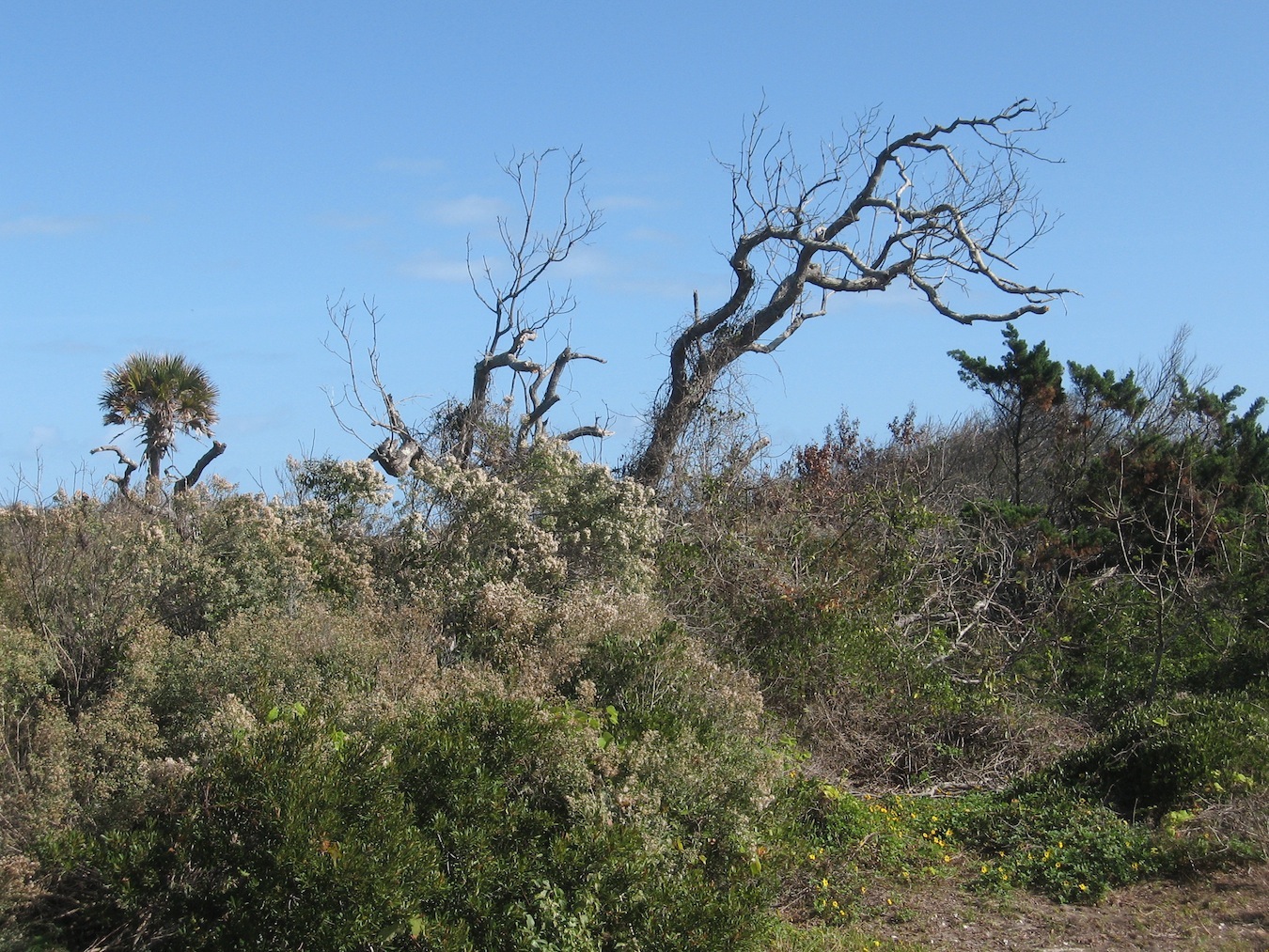
Our day was delightful. In the photos, you can see the beach and ocean, fairly heavy with haze that day, the boardwalk protecting the dunes and their vegetation, the inlet, and--a real treat for us--a gopher tortoise, one of several who had just come out of their underground den. (Correction: I can't believe I typed "turtle" and then didn't notice for a few days; this is a true, solely land-dwelling tortoise, not a turtle at all). We are indebted to a couple of tourists coming along the walkway as we were headed in from the beach who alerted us to their sighting of these shy, elusive animals. Sadly, their numbers are declining, a great loss due to their pivotal importance in a whole mini-ecosystem. As my Audubon Field Guide to Florida says, " [their] methodically constructed tunnels are . . . not only home to the declining Gopher Frog and Eastern race of Indigo Snake, but 300 other species of vertebrates use or rely on the burrows for shelter or food." If you look carefully in the photo with a dead-looking small tree at the top, you can see the large opening to the gopher turtle burrow at the lower right. As always, you can click on any photo to enlarge it.
One important aspect of our "creative everyday life" is exploring our rich and varied local area whenever we can. Those of you who are regular readers have seen other posts about our adventures in Coastal North Florida.
Question of the day: Do you agree with us that some of the best travel experiences can be found near home for curious, creative day trippers and explorers?

Trouble with Blogger

Have any of the rest of you been having trouble with the Blogger program? I have a post ready to go, but can't get the image posting program to come up. Last night, I was able to open "images" and to list the photos I had chosen there, but they would not upload to the post itself.
I hope to be back to you with that completed post sometime today.

Saturday, February 4, 2012

Techniques for Painting Shadows in Landscapes

Today, let's consider shadows in landscape paintings once more, this time considering a few "how-to" techniques. (Scroll down a bit for earlier posts on this topic.) Of course, since painting is very individual and variable, I realize that my techniques and methods are only one way to approach this important element in a scene. I would love to hear from other artists who approach shadow painting differently--as well as from readers who might "see" them differently. I think shadows are fascinating to consider.
"Wooded Path" is adapted from some photos I took on the extensive grounds of the Kingsley Plantation, which I have written about in several earlier posts. This historic site is nestled in an immense preserve area just north of Jacksonville, Florida. The Timucuan preserve includes salt marshes, wooded areas, and Florida prairie, as well as other land and water habitats. The 16" x 20" acrylic painting on gallery-wrap canvas shows a bend in a path as it leads deeper into the woods. Unfortunately, I was not able to get a good, true photo of this piece (don't know why that happens sometimes). The photo of the final version, seen below an earlier view and a detail of the foreground, looks misty in the mid-ground, whereas the actual painting is clear. The work-in-progress took a better photo--hope you can see some value in the improvements in the final version in spite of the poor photo.
At first, the path was too uniformly dark and mid-dark in tone, so in the work-in-progress photo above, you see that I have lightened whole areas, especially just before the bend. Then I added some shadow areas gradually, being careful not to overdo either the amount of shadow area on the path or the darkness of the tones.
Linda Blondheim, in one of her excellent workshops, helped me see that the foreground shadow of the tree trunk was too dark as it moved away from the tree. Real life shadows tend to be darkest at their "source" (right next to the object casting the shadow) and then partially fade along the length of the shadow. Actually, I knew that, but had not been successful in my attempts to vary the shadow. It never looked right. Linda advised that I pull in other path tones and colors from the sides of the shadow edge as it moved away from the tree. To my eye, that worked like a charm, much better than my earlier tries at just gradually lightening the color I used for the shadow as it extended out.
One other change, made before Linda's workshop, was to revise the curve of the path in the foreground. Although not related to shadows, I thought you might like to see that revision, too. In the earlier version, it seemed like the perspective was off, like the path sort of spilled into the viewer's lap. The detail photo shows my sketched lines for revision, which led to an improvement in the composition, I think .
Question of the day: Do you look at shadows differently after hearing about the challenges involved in painting them?