Wednesday, October 21, 2009

Learning and Growing--Landscape Painting, Part II

Part II of a pair of posts "back by popular demand" (see previous post for an explanation) appears today.
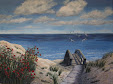
This painting, based on the photo in my previous post, emerged slowly. As I worked, my priorities for focus and scope changed in ways I would not have predicted. I will spare you a long description of all the twists and turns of the creative process, but will mention some of the insights and adjustments I made along the way.
First, I assembled all the reference photos taken at this bend in Little Pottsburg Creek--wider panoramas and close-up details as well as the main photo. I recalled the mild, still air, the musky, but not unpleasant, smell of the flat, muddy bank, and the colors that had danced in the sunlight and softened in shadow. I decided to incorporate some elements from other photos and to use a horizontal layout showing a greater expanse of water and some tall grasses in the foreground.
My first instinct was that the soft reddish grasses on the right would be my focal point. My husband viewed some of my thumbnail sketches along the way and was drawn instead to the taller grasses in the left foreground. Being torn among various interesting elements, I painted an adequate, but unfocused scene--too much competition for attention. My subsequent efforts to improve the composition and balance were unsuccessful, and I set the canvas aside for awhile to rest my mind by working on a small floral piece.
My painting mentor, Linda Blondheim (see her web site for beautiful paintings), suggested that she found the reddish grasses interesting as a texture contrast to the rocks I had indicated (but not featured) in the foreground. That was the trigger I needed to complete the painting--featuring an area of varied textures. Without fully realizing it, I had been captivated by the multiple textures in the scene as well, from the placid water to the jagged rocks and both soft and sharp-edged grasses. The texture contrasts on the right side of the painting, from foreground to mid-ground became the focal point, while other areas became less detailed in order to let them recede in importance. There's that matter of balance again, which keeps emerging as a theme in recent posts.
Another artist would have painted quite a different rendering. Your answer to the last post's question regarding what you would feature in this scene might be radically different as well--and wonderful in its own way. I have often heard that one must be able to truly see in order to paint. Along my creative journey, the opposite has more often been the case for me--that painting is a vehicle to enhanced seeing of what is around me. Every painting in process is a growing and learning experience to treasure.
Question of the day: What pursuit or activity is your growing edge?

Saturday, October 17, 2009

Learning and Growing--Landscape Painting, Part I

Occasionally, I will repeat a post or two that were well-received for the sake of my newer readers. I know that few of you will go back to read all previous postings. Also, frankly, this is a crazy busy time for me, and this helps me keep on my twice a week posting schedule. Today's entry is the first of two about this scene on Little Pottsburg Creek. Please excuse me, fellow bloggers if I am not able to visit and comment on all of your wonderful blogs as often as I would like for the next few weeks. I'll be back full-force before too long.

Landscape painting is a balancing act and requires priority setting and focus. I have written about balancing life goals and projects before, and have realized that a similar balancing process goes into the decisions involved in painting.
Few, if any, painters copy what they see in exact detail. We must discern what aspects of a particular scene drew us in and feature them. Other aspects need to recede in importance or even be left out. Sometimes an element needs to be moved or added for the sake of the composition. However, such changes require restraint. If a weathered barn is surrounded by purple wildflowers except for a trash pile in my sight line, filling that area with similar or compatible plants or a glimpse of bare earth is an acceptable adjustment to enhance the overall scene. However, it wouldn't make sense to paint a profusion of tropical passion flowers or cacti instead. The integrity of the location matters. Now I know that some lovely landscape paintings are completely "made up" by the painter from some combination of memories and a desire to create a scene that looks a particular way. I have done that myself, with fairly good results.
However, the "made up" places, at least when I paint them, do not resonate with the same depth as those based on an actual location. If I have truly been there, have seen, heard, tasted, smelled and touched the natural elements, I believe the truth of that experience shows in the art work. Yet, I do not paint simply what I see with my eyes or experience with my other physical senses. The painting arises out of my personal response to a natural place.
Holding the real and the "ideal" mental vision in tension to produce an interesting painting of an observed scene is infinitely rewarding. Sometimes this is quite difficult and requires extensive adjustment along the way--at other times, the process flows more easily. Wrestling with the balance of light and dark tones, with the way colors appear under variations in natural light, and with the arrangement of shapes and elements is a deeply moving, uniquely personal, creative experience.
The scene in the photo above is near our home. It's no place special--definitely not on anyone's sight-seeing itinerary--just a wide bend in Little Pottsburg Creek. Chunks of old concrete jostle the rocks and mussel beds in the muddy shallows, and trash lies half-submerged in the water. Still, something in the scene drew my attention. So I carefully recorded details mentally, snapped a few photos, and went home to figure out what the appeal was. If I tried to capture the feeling I had experienced in this everyday North Florida location, what would I paint? The result was an excellent learning exercise for me, which I will show you in my next post.
Question of the day: If you painted, drew, or more carefully photographed this creek bend, what would you feature?

Wednesday, October 14, 2009

Learning & Growing--Choosing Paintings to Show

As I prepare for the Open Studio Reception I mentioned in the last post, one task is to decide what paintings to show and offer for sale. Advice from other artists is proving very helpful, especially from those who will give me a clear, honest assessment of the pieces I am considering. We don't like all our own creations equally, of course, but cannot predict how other people might see them. Some that disappointed me in some way strike my "jury" as having merit and might prove to be another person's cup of tea. I find that I am ready (more so than even several months ago) to part with most of my "better" pieces, knowing that I will go on to create more. So, the timing is right for a show. UPDATE: I have now added an index to all blog posts about planning and holding an art reception. Access it here.

Today's painting, on an 14" X 18" canvas board, is a romanticized version of a scene near our home which I pass on one of my favorite walking routes. A broken-down, abandoned shed surrounded by rusted metal debris stands on the curve of a two-track dirt drive leading far back into a wooded area. Perhaps there was a house on this lot once although there is no evidence of a foundation, just half-ruined utility connections. It's on a back road shared by a mix of small "Old Florida" homes, newer construction replacing tear-downs, and older mobile homes, so might once have boasted a double-wide. Now natural vegetation and overgrown plantings are gradually taking over, but the place still somehow breathes with the spirit of people who once used tools stored in this shed. It invites the imagination to spin a story of those who called this spot home.
After studying, sketching and photographing the scene a couple of years ago, I came up with this painting, called Long Gone. It took on a life of its own, as creations often do, and I was led away from the initial subdued, realistic palette to make it sing with color. In spite of the air of abandonment, this has always struck me as a happy place, so that's what flowed from my brush. The result has a sort of storybook quality rather than realistically representing the actual location. This painting made the cut for the Open Studio Reception and hopefully will make an interesting contrast to other pieces with more limited palettes and greater realism.
Question of the day: In your own creative pursuits, how often does the process take on a life of its own? How comfortable are you with those experiences--do you like to maintain some control or do you enjoy being carried away and surprised?

Saturday, October 10, 2009

Growing--Exhibiting Paintings & Your Invitation to Join Us

My husband and I are delighted to invite all blog readers to join us for an Artist's Open Studio Reception on November 8. If the back of the postcard pictured here (which did not scan very well) is hard to read, click on the image to enlarge it. Or email me for information at lemmeneslandscape@bellsouth.net. UPDATE: I have now added an index of all blog posts about planning and holding an art reception. Access it here.

Many of the paintings I have been showing you on blog posts plus more will be available to purchase. However, we promise to allow guests to enjoy themselves--no hard sell here. You are welcome to stop in for snacks and a beverage, to enjoy live piano music, and to meet our friends and neighbors.
To enhance our Harvest Delights theme, our friends, the Lapinskis, will bring sustainably grown produce from their local farm, also available to purchase. They have warned me that our event is a week or two early for maximum harvest from their early winter crop, but they will bring whatever they have available. I know from experience that whatever they bring will be beautiful and yummy and that it will sell fast.
We hope that you will join us if you are in the area.
I have used the "Growing" heading for this post because it will be a first for me to show my paintings in our home. Although I am excited to be doing this, it is also surprisingly "nervous-making" and required a self-administered strong push to get me going on the planning.
Question of the day: Do you sometimes find that things you very much want to do are at the same time difficult to initiate?

Wednesday, October 7, 2009

Exploring--Croatia's Plitvice Lakes National Park, Part III and a Painting

This is my third and final post recalling our awe-inspiring day hike in Plitvice Lakes National Park in Croatia about a year ago. The photo on the right is one of my favorite views of one of the lakes. The breathtaking color is absolutely true to life; other than cropping, I never adjust the photos I show you or tinker with their colors. The actual tones and shades of the water in the park vary, but this clear aqua color is common there due to minerals dissolved from the limestone prevalent in the surrounding mountains and this beautiful valley. You can read further details about Croatia's magical national park in the previous two posts.
The painting at the top is a small (5" X 7") study created by simplifying the foreground in one photo (leaving out some tree trunks and the rushing water) and adapting a distant waterfall from another. Given the countless, varied waterfalls and rich virgin forest throughout the park, we saw other scenes like that portrayed in the painting, so my adjustments were not unrealistic. Mixing a color that worked for the water in the lake was difficult because I did not want a garish, swimming pool hue and yet wanted to be true to the startling reality. It seemed to work best to go greener because an exact duplication of the water color in the photo looked unreal when viewing the painting on its own.
For some reason, I have been slow to paint a larger landscape using this little study. I think that perhaps working on the study was enough for the sake of my memories. Beyond that, once we returned from that wonderful trip, North Florida's unique beauty recaptured my creative spirit with gratitude and joy for Home.
Question of the day: Isn't it a joy when travel stretches us and deepens our appreciation for other places and yet renews our love for our own nation and home?

Sunday, October 4, 2009

Exploring--Croatia's Plitvice Lakes National Park, Part II

I hope you will enjoy several more photos from this amazing park in Croatia (formerly part of Yugoslavia), which I described in the last post. My husband, Mark, is viewing a waterfall in one shot (notice the sturdy walkway, which is typical of wet area crossings in the park). In another, we are looking down from the highest point we reached on our day hike. I believe that the numerous fish swimming below ducks in another photo are chub, but species' common names are sometimes "lost in translation". As always, you can click on any photo to enlarge it and see the details.
The memory of our visit to Plitvice Lakes seems timely as PBS airs Ken Burns' beautiful, informative, and deeply inspiring film series about the magnificent national parks here in the USA. We can be very grateful for and proud of our extensive, varied national park system. His film series invokes a deep love for our land, a kind of patriotism that exceeds flag or government and rises from the very earth, where, I must say humbly, my own European ancestors arrived only a few generations ago.
Remembering Plitvice Lakes, however, as well as gorgeous environmental preserves I have visited in Belize and the Dominican Republic, I am thankful that a number of other nations also have founded national parks. I hope that all members of the global community who care about preserving unique natural ecosystems will be empowered to set aside parks and preserves.
Question of the day: What is your favorite national park or other natural preserve area in the USA?

Thursday, October 1, 2009

Exploring--Croatia's Plitvice Lakes National Park

Memories . . . In early autumn last year, we were privileged to travel in Eastern Europe for four weeks. Croatia's magical Plitvice Lakes National Park was a highlight of our time in that beautiful nation (formerly part of Yugoslavia). For the middle two weeks of our trip, we joined a guided tour of Slovenia, Croatia, and Bosnia-Herzegovina sponsored by the Rick Steves company (of public television fame). If you are interested in earlier posts about those destinations, simply enter "Eastern Europe" in the search box, above left. As I reminisce about that wonderful journey, I will post a time or two about our overnight visit and long trek in Plitvice Lakes National Park, one destination I had anticipated eagerly. This stunning park exceeded even my high expectations.
Photos cannot capture the full majesty of the lush, heavily forested park with 16 terraced lakes and countless waterfalls. The amazingly clear water shines in brilliant aqua or clear greenish tones due to the limestone-laden soils and rocks in the area. Bears, wolves, lynx, wild boar, and a rich variety of other animals, birds, and fish populate this protected area, one of the last remaining virgin forests in Europe.

We arrived late one afternoon, settled into a large, comfortable hotel in the park, and enjoyed a pre-planned "potluck" happy hour on the lake shore with our tour group, for which we had each purchased wine, sausage, cheese, chocolates, and other delights during the day. Dinner in the hotel was tasty, but hardly seemed necessary after that. Following an early, sumptuous breakfast buffet the next morning, we stowed our luggage on the tour bus, hoisted our day packs, and boarded a shuttle bus to a ferry dock. To avoid the crowds at this popular park, our excellent Rick Steves guide, Saso Golub, wisely guided us to begin at the furthest point of our trek, via a ferry across one of the larger lakes. His strategy worked beautifully--we saw the most dramatic falls before others crowded in, and we hiked in the opposite direction of the heaviest flow of visitors. The park offers a variety of hiking options on wide walking trails and sturdy plank walkways over rushing streams and gullies. The cold clear air of the early morning gave way to bracing, cool, delicious temperatures, perfect for hiking.

If you want to see more of the park and to learn about its dynamic ecosystem and shifting bodies of water and land formations, check your local public library for a DVD, which I think was originally a PBS program, Nature:Land of the Falling Lakes. In Plitvice, the water gradually wears down the land so that the lakes, streams, and waterfalls actually move over time. Then, the limestone deposits that erosion leaves in the water gradually build up again on fallen trees and branches underwater and on the lake bed itself so that over time, natural earth dams and eventually, new land areas are formed.

Next time, I will share a few more photos and memories from this magnificent park. Although we have grander individual waterfalls, vaster mountains, and deeper valleys in our beloved USA, the cumulative delights of the sheer numbers of waterfalls and rapids around every turn in Plitvice Lakes National Park in Croatia and the "forest primeval" atmosphere are unique and quite magical.
Question of the day: What natural preserve area has given you lasting memories?

Sunday, September 27, 2009

Exploring & Growing--The Refreshment of a Different Point of View

When our sons were Sesame Street age, I sometimes watched that wonderful show with them. One delightful piece I still remember featured video of a variety of creatures and a catchy song, each chorus ending with the claim, "It all depends on where you put your eyes." The camera gave us glimpses of the world as it may look to a giraffe, for example, contrasted with the way it may look to many other critters with eyes at radically different levels.
Strangely, that song has popped up in my mind several times in recent days. What's that about? Is my subconscious trying to tell me something about my perspectives, goals, or viewpoint? If it is, I will do my best to listen and learn from it.
I have posted in the past about our love for walks on the beach. We are grateful to live near the mighty Atlantic Ocean and enjoy the many moods of the waves and weather there. Somehow, our little Shih-tzu, Magnolia, who is too short to see much out the car windows, always knows when we are crossing the bridge over the intracoastal waterway. Her excitement builds as we drive on the offshore island side of the bridge where the pavement is wavy and gives us a mini-roller coaster ride. We both anticipate our beach time with joy.
However, I also love the distinctive and varied salt marshes in the Jacksonville area and enjoy contemplating the stretch of golden, green and/or brown (depending on the season) marsh grasses visible from the bridge. When the tide is low, more water birds are poking around among the mussel beds and crab holes; when it is high, more fishing boats congregate.
One fine day on our way home from the beach, I decided to explore the neighborhood closest to the marsh on the mainland side and made a sharp right turn just off the bridge. When I could see through to the marsh between yards, fences, and old trees, I had a whole new perspective on the bridge, marsh, and intracoastal waterway. The photo above is one view this lovely area provided.
So, as the Sesame Street song continues to invade my reflections, I recalled this experience, which struck me as a metaphor for the richness available in life--depending on where I put my eyes. Don't have anything profound to say about that just now, but I'll keep on looking and listening.
Question of the day: Where are your eyes these days? Have you recently found a new perspective, are you hopeful for a change in viewpoint, or is your outlook just right for this time in life?

Wednesday, September 23, 2009

Learning & Growing--Art Classes & Cypress Swamp Painting

I recently showed you a painting of an iris, adapted from a reference photo taken by someone else and wrote about some of the difficulties I encountered. Well, I have done it before. Today's painting, of a cypress swamp (or marsh), is also adapted from someone else's photo, this one from a nature magazine. I am sorry that I cannot credit the photographer (even though my rendering is quite different from the photo). Since this painting was mostly completed in a painting class using reference material the instructor provided, I no longer have information on the photo or the magazine. Given the strong dark tones and bright contrast in this painting, I hope that it looks something like the real thing on your monitor (it is a bit too yellow on mine).
My landscape painting mentor and friend, Linda Blondheim, is an excellent teacher, both tough and sensitive. She listens to her students' expression of what they would like to achieve in a painting and (if that vision is achievable) helps them get there--a rare teaching gift. Looking at this cypress swamp piece reminds me of the enriching day and growth as an artist I experienced in a design and composition workshop with her a few years ago. By the way, all the best artists I know are self-described learners and are continually pushing themselves to grow and to achieve new directions and goals.
I was privileged to study with Linda again recently at a full day workshop learning about using values well in the landscape ("values" in art refer to the whole range of darks to mid-tones to lights). I know that this is one area in which I need improvement--I get so taken up with the brilliance or the subtlety of colors in nature that it is difficult for me to judge values sometimes or to balance them in an interesting way in a composition. Among other topics, she introduced the Notan system for making values "sing" in our work. It was especially meaningful to work with her earlier this month because her schedule requires her to stop in-person teaching for a time, and I am thrilled I could be in her final workshop (for now--all her students hope that she will return to teaching in the future).
For anyone who would like painting instruction from Linda, she is continuing on-line teaching, both individual and class instruction, and her e-classes are excellent. In fact, her next class unit will be an expanded version of the one-day values workshop I experienced. For more information, go to HER WEBSITE and click on "artist resources" at the top.
Even if you are not looking for painting classes, her remarkable paintings and fascinating articles about her beloved North Florida, its history, farms, ranches, wetlands, and preserves are well worth a visit to that website (click on the link above). If you think all of Florida looks like Miami or the Gulf Coast, you will be amazed to see the paintings her lifetime of exploring has inspired.
Now, about the above painting, an acrylic on a 9" X 12" canvas panel from a workshop with Linda a few years ago. Like many of my accounts of the painting process, the story of this piece is a tale of mistakes along the way and hurdles overcome. The basic composition, under-painting, and some of the finishing were complete by the time I left the workshop. Under Linda's guidance, it was looking fairly good then. Linda had scanned a good quality copy of the magazine photo for me to bring home as i completed the scene, but I had difficulty getting it to look real. Finally, an insight struck as I studied the copy of the photo for the millionth time. The photographer either had used flash or had other additional lighting on the stumpy cypress knees in the foreground so that there was a combination of natural back lighting and dramatic light falling on the foreground. Although that made for a striking photograph, trying similar tones in my painting made the scene look phony. Softer, mid to dark tones in the foreground made a real improvement.
Question of the day: What is your current growing, learning edge?

Saturday, September 19, 2009

Exploring & Learning--Our Magical Public Libraries & Reference Books for Artists

For weeks, I have been meaning to write about the delights of exploring public libraries. From the time my mother first took me to Muskegon, Michigan's castle-like Victorian library as a small child, libraries have held a fairy tale magic for me. Since the last post featured books and since I recently found a terrific series of photo reference books for artists, now is the perfect time for this subject.
I am an absolute library junkie and did my best to raise our sons to share that obsession. It seems particularly timely in a difficult economy to remember the remarkable resources available free of charge in public libraries. As much as I love books, I purchase relatively few--in particular, very few novels. They are free at the library; I read each one only once--why would I buy them? The library is also my favorite source for current non-fiction (often works I have heard about on public radio) like the latest nutrition book, exercise DVD, financial advice, business trends, and other works that I want to look at, but don't need to purchase. Most libraries offer wonderful additional services, such as children's story hours, student and adult programs, free computer use, and a variety of media (beyond books) available to borrow.
Admittedly, we do purchase books, too. We have kept a number of worthwhile books from our years of study and from my adventures teaching philosophy and math. I also like having reference books handy, so our shelves hold atlases (up-dated periodically), travel books, books about words and writing, nature field guides and bird books, books about architecture, home repair, sewing, knitting, music, history, and many other topics. Other long-time friends include poetry, quality art reproduction collections, and thought-provoking, spiritually meaningful books.
Of course, I also own some books that inspire and assist my painting. For example, when my own reference photos don't provide quite enough detail for accurately painting birds in a landscape, my various bird books provide rich detail about that particular species--everything from characteristic textures of feathers and subtleties of coloring to unique patterns of flight and characteristic posture when standing or perching.
Still, the world is full of wonderful books we don't own that the library can provide. The pages above were scanned from a series of books by photographer Gary Greene, who generously and explicitly invites artists to photocopy or scan and then adapt images from his books (as long as they do not try to profit from an exact copy). As always, you can click on the images above to enlarge them in order to appreciate the remarkable detail in Greene's photos. His beautiful books spark my creative process even when I don't use any of the specific images for a painting. Our library system has a number of his works, and I am currently waiting for one to come in on a transfer from another branch. The above pages appear in Artist's Photo Reference, Reflections, Textures & Backgrounds. The volume I am waiting for showcases boats and marine scenes. When it comes in, you can bet that along with it, I'll carry home an armload of additional, irresistible finds from my magical library.
Question of the day: Are you a public library junkie? What are your favorite recent library discoveries?

Wednesday, September 16, 2009

Learning & Savoring--Inspiring Photo Books

I mentioned an accomplished photographer-friend, David Young, in my last post. Today, I'll show you some of the photos from one of his books, Prayer Photos, and say a few words about his books. If you would like to know more about them, you can email Dave at dsyoung@peoplepc.com. He has some copies of two of his books available for only $5, a substantial discount off the cover price. If you read my blog regularly, you know that I normally do not include anything even resembling advertising, but decided to make an exception for some exceptional books at a super price.
Prayer Photos is a high-quality, soft-cover book with a photo on each right-hand page and an appropriate free verse prayer poem by David Young on the left. The poems explore a variety of moods and human experiences, are non-sectarian, and would be meaningful to any spiritual person. The photos above are two examples of his sensitive, intriguing images.
I highly recommend this book as well as another he has available, called Coloring the Wind, with several one-page essays about peace, justice, and other topics, many short free verse poems, and more of David's beautiful photos, mostly of people, taken on his extensive travels to many cultures. He possesses an uncanny ability to capture a depth of character and meaning in a photo of an elderly Latina's face, of children at play around the world, of varied family groups, and more.
Question of the day: What powerful images have touched you recently?

Sunday, September 13, 2009

Learning & Growing--Purple Iris Floral Painting

About a month ago, I showed you a magnolia floral painting I had worked on as a change of pace from my usual landscapes (scroll down to August 11 or enter "magnolia" in the search box above to see it again). This purple iris painting is an older work, one of my first close-up florals. Among other things, I learned the value of perseverance from this project.
I can't remember anymore how long this painting was a "work in progress," or how many times I was tempted to scrap the project due to to the fact that some of the changes I tried made it worse instead of better. Works in progress are supposed to progress, aren't they? This one definitely gave me trouble.
Probably one issue with the painting was that I used someone else's photo. A friend (thank you, David Young) who is known for his breathtaking photos of people from around the world, sent me a packet of varied photos several years ago. I was inspired to try to paint this iris from one of his photos with a few adaptations to fit my own vision for the image.
Although I am quite pleased with the final result, I felt hampered along the way by the fact that I had not seen, touched, and smelled the flower myself. A wiser artist than I was would have at least sought out live purple irises somewhere to observe, sketch, and photograph. I will do that in the future. I know some artists can create excellent paintings strictly from photos of places, people, or natural things they have never seen in person. I am humbled by their skill. For me, I have learned that nothing can replace being there. In addition to various technical problems I had to iron out for this painting, it was difficult for me to bring the blossom alive on canvas--we had never actually met. The result--and sort of a solution--was to paint an image that is more stylized than natural.
Venturing outside my comfort zone can be a thrill. But when an effort to do or to learn something new seems too unpleasant or too hard, I try to remember this painting experience. Of course, some attempts fail. No shame there, I believe--the shame would be avoiding the new for fear of failure. But in the thick of any difficult struggle with a new venture, I recall the BATTLE OF THE IRIS and persevere. After all, I think this image turned out all right. In any case, I learned and grew as a person and as an artist from this project.
Question of the day: Have you battled any irises lately? What growth or learning resulted?