Friday, March 30, 2012

New Orleans Visit, Part II -- Botanical Gardens and Metairie Cemetery

The one day in New Orleans that we took our car out of the hotel's parking lot, we drove to Metairie Cemetery, which is an interesting combination of old tombs and current burial areas. Some New Orleans cemeteries are even older, but they are crowded with a jumble of mausoleums that serve, unfortunately, as cover for muggers and others. Visitors are advised to go there at the busiest times, perhaps with a guided group. Since our purpose was to visit a "drivable" cemetery and see the above-ground burial which the high water table and frequent heavy soaking of the ground requires in this area, Metairie was just right. New Orleans' largest cemetery, it covers over 65 acres (web sites seem to differ on its exact size), and was established in 1873 on the site of a former racetrack. The grounds are beautifully kept, a peaceful "park" full of birds singing their hearts out. Mausoleums of many leading families, tombs of former governors and mayors, and towering military memorials share the grounds with lavish displays by less upstanding (though certainly no less wealthy) citizens, such as the elaborate tomb of Josie Arlington, once the leading madam of Storyville.
Not far from that cemetery, New Orleans boasts a 1,300 acre city park, which includes the Carousel Gardens Amusement Park, the New Orleans Museum of Art, and many other scenic features and recreation centers. We strolled through the botanical gardens there (a treat for my master gardener husband). One photo from the gardens shows the conservatory (in a style complementing the main Pavilion across the promenade) which houses a tropical rain forest exhibit and "living fossils", plants with a lineage going back to prehistoric times. The other garden photo shows a corner of the Japanese Garden section.
We were very fortunate with our weather while we were in New Orleans (mid-March)--quite warm each day (mid to upper 80s), but not oppressive or excessively humid and beautifully clear, as you can see. I had made plans for activities we could have done if we had heavy rain or too much heat for extended time outside, but will save those for another visit. As I mentioned in the previous post, New Orleans exceeded my expectations as a fascinating destination, with much to see and do for visitors with a variety of interests.
Question of the day: When and where have cemeteries been among the attractions you have visited in your travels?

Thursday, March 22, 2012

A New Orleans Vacation

We have returned from several days in New Orleans, a delightful vacation break! Today's photos are all from the French Quarter, which we visited a couple of times, riding the excellent street car system to various destinations from our hotel on a quiet, beautiful, tree-lined block in the architecturally rich Garden District. I think we enjoyed the best of both worlds by visiting the razz-ama-tazz in the daytime and staying in a quieter (though still urban) area. Historic mansions made exploring the Garden District fun, and Magazine Street, a few blocks from our hotel, is famous for antique shops, boutiques, and galleries as well as some lovely restaurants. We strolled down to the Lilette Restaurant there for an elegant, delicious French meal our last evening in town.
Our first afternoon, we hopped on the streetcar after settling into our room (a $3 day pass got us all the rides and transfers we wanted--a real bargain--and no parking headaches or expense), riding to a stop near Jackson Square in the heart of the French Quarter. A mule-pulled carriage with a friendly, lively driver provided us with an orientation tour of the Quarter--a fun, relaxing way to get a feel for directions and to learn about the area. The photo of the building corner gives a flavor of the lovely places and beautiful balconies there. Then we stood in a verrrrry long and slow line for the famous beignets and coffee at Cafe Du Monde nearby--quite tasty, but once was enough for us. Besides, they are so filling that a serving of 3 beignets each around 5 PM left us too full for any dinner that evening!
Jackson Square's main attraction is the St. Louis Cathedral, seen in two photos, outside and in. Historically fascinating, the basilica remains an active force in the life of the city today. The final photo shows a jazz group performing across from Jackson Square. The stairs on which the listeners sat lead up to the promenade along the mighty Mississippi. In a future post, I show you photos from our paddle-wheel boat ride the next day.
Although I love to travel, this particular trip was more my husband's desire than mine. However, I kept an open mind and was rewarded with a much richer, more interesting experience than I had expected. Of course, there is amazing food and the well-known nightlife in New Orleans, but there is so much more--in historical neighborhoods, natural beauty, and southern charm. We both thoroughly enjoyed our time there.
Question of the day: If you have visited New Orleans, what were your impressions of the city?

Saturday, March 10, 2012

For Health and Enjoyment--Fresh Ginger Root Tea

Is anyone else out there fighting a cold or some other respiratory ailment? Although my husband and I very seldom have colds anymore (at our age, we seem to have accumulated multiple immunities--a small comfort as other age-related troubles come around :>), we have each suffered a very bad cold in recent weeks. Hopefully, mine is beginning to wind down. One home remedy that is very soothing is ginger root tea. According to the nutrition expert Joy Bauer, ginger root is also a natural anti-inflammatory substance helpful for arthritis and other forms of inflammation. However, she cautions that it may also thin the blood a bit, so check with your doctor before using if you take blood thinning medications.
The first time I decided to try it, an internet search turned up all sorts of recipes and ideas, some fairly complicated. I tried instead simply slicing some ginger root and boiling it up to drink with lemon and honey--that worked fine for us. We like it quite strong, to the point that the tingle in the throat it causes could be termed a slight burn. With some experimentation, you can find the best strength for your taste.
To make simple ginger root tea,
- break off a length of the root and wash it as you would a baking potato (I leave the skin on for tea since we don't eat the pieces)
- cut slices, anywhere from quite thin to 1/4" thick at the most
- put the slices in a pot of water and bring it to a boil
- boil for 10 - 12 minutes
- strain into a mug
I add about 1 tsp. of lemon juice and honey to taste (probably a Tbsp. for me--I don't measure it) and drink up. It is both tingly and soothing for a sore throat and helps open up clogged sinuses. The photos show the amount of ginger root I used for about 3 cups of water, with a quarter coin for size comparison (after they posed for me, I cut the larger pieces into fourths for boiling).
Ginger root tea has become a favorite alternative to black tea for me, even when I feel fine. It is refreshing and restorative, as well as adding significant anti-oxidants to the day.
Question of the day: What is your favorite home remedy for a cold?

Wednesday, February 29, 2012

Work in Progress--Dune, Ocean, and Sea Oats Painting

This North Florida dune painting has been difficult for me to assess and complete. The reference photos were taken in dim conditions, so I am trying to recreate the brighter glow of some late afternoons at the beach just from my memory and from more recent walks on our Atlantic Ocean beaches. However, none of the days I have gone recently have had the atmospheric and light conditions I remember from a certain summer day. Late day photos I have taken in other locations along the shore have been some help, but haven't solved all the problems.
As many of us who make any sort of thing (art work, cake, cabinet, poem, garden, scrapbook, tin whistle, song, quilt, . . . ) know, some creations are more satisfying than others. I always struggle with each painting, but some really please me when they are finished. Others, less so. I have learned from experience that a piece I do not like as well as others may still appeal to someone else. In a previous post, I described how a painting delighted a client of the Trends Home Decor shop (although I did not mention that I had never liked that piece much and once considered painting something else over it!). She ignored all the other pieces I had in the shop and bought my least favorite. Viva la difference, n'est pas?
So, here's the thing. I have this particular work in progress (a 12" x 16" acrylic painting on gallery wrapped canvas) hanging on the wall and feel strongly that it needs further revision. I also know that it will probably never be a favorite among my creations, so have to resist overworking it and ruining any good qualities it might have. Interestingly, when I photographed it, looking at the photo gave me a bit of distance, and the piece didn't seem quite so bad.
The more distant beach line still needs work. It has been very hard to get the right perspective, to show how the dune slopes down onto the beach in the near right corner compared to the glimpse of the shoreline farther away, past the edge of the dune. I also may have made the sky too blue and bright for a late afternoon, although it sometimes looks this way, and I really don't want to grey it down much. Finally, this stretch of dune had a much thicker stand of sea oats, which would be an unattractive visual mess if exactly duplicated on canvas. I'd like to add a few more stalks, smaller and less prominent than those featured here, but don't want to overdo it.
Any suggestions you might have would be very welcome. Please don't just flatter the piece (you readers are all so sweet and kind); it does need some revision. What do you think?
Question of the day: How critical are you of your own creations and production? To what extent does your self-criticism work in your favor, and when does it hinder you?

Friday, February 17, 2012

Refreshing Day Trip to Crescent Beach, Florida

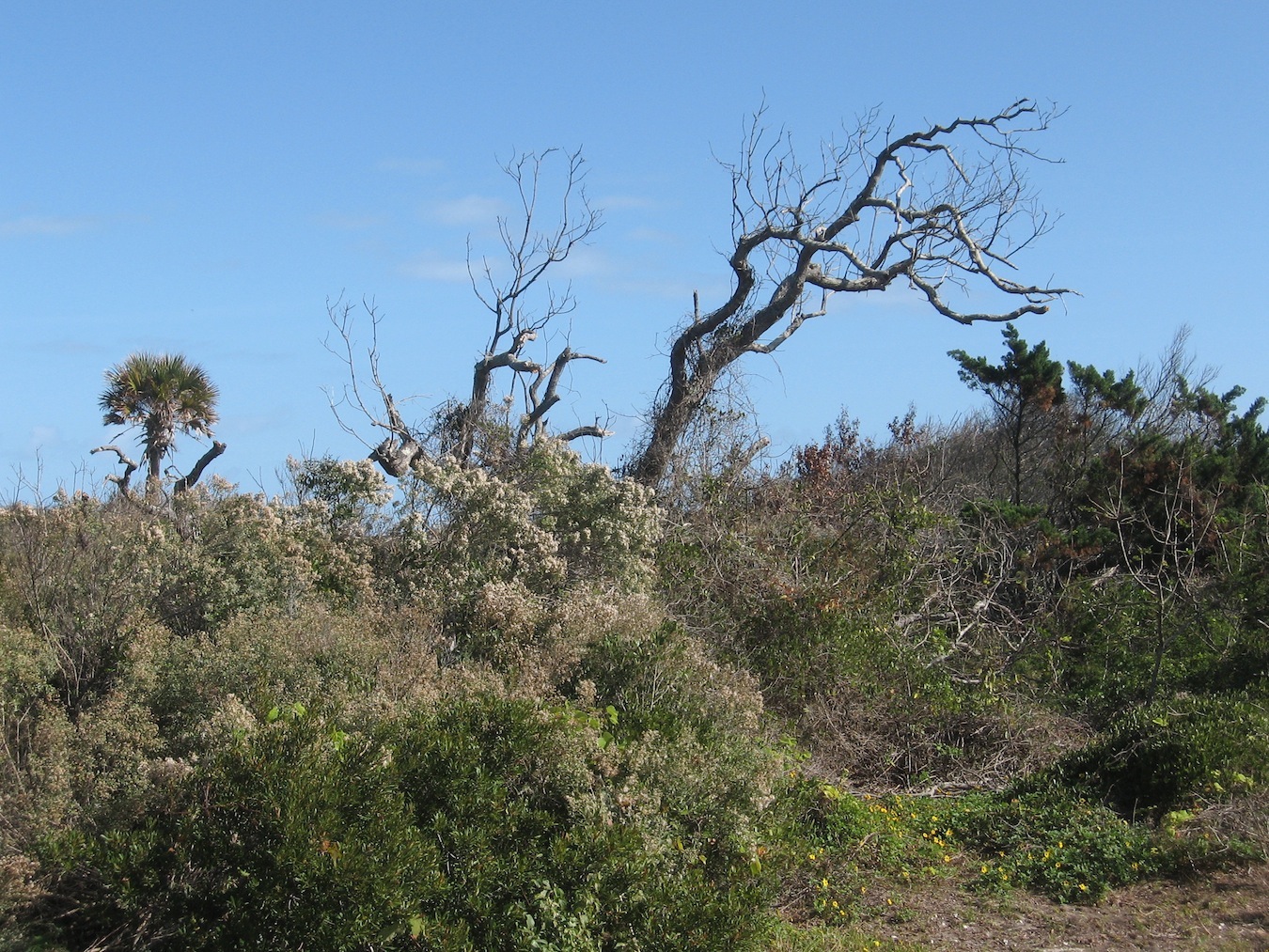
Several weeks ago, on a pleasant North Florida winter day, Mark and I took a day trip to Crescent Beach, Florida. This distinctive area is southeast of Jacksonville (where we live), an off-shore island south of St. Augustine and north of Daytona. Although North Florida beaches on the Atlantic Ocean share similarities, each has its own particular look as well as variations in vegetation, bird life, and animal population.
The Matanzas Inlet adds to the interest we had in the area; it is one of the few inlets around which is not protected by jetties and thus gradually moves with the currents and tides. The Matanzas Inlet leads from the Atlantic Ocean to the inland waterway, which runs on the inland side of a string of off-shore islands along North Florida. Of course, the inland waterway runs all the way along the Atlantic Coast, but varies from place to place in whether it follows rivers near the ocean or other available waterways. In one of the photos, you can see the large pond-like area into which the inlet flows and across the water, (if your eyes are sharp; it is by no means a close-up) the Fort Matanzas National Monument, built by the Spanish. More information about the Fort here. In the photo that shows the ocean on the left and dunes on the right (looking south), you may be able to discern the inlet by a narrow fog layer extending in toward land, with homes on the far side. Our friends who fish say that the inlet is prime fishing territory for many species of fish. One friend, who hand weaves casting nets in the tradition of her Cherokee ancestors, particularly likes casting for mullet here. She watches dolphins feeding near shore in the ocean for clues to the running of the mullet. Sometimes a group of dolphins actually cooperate in fishing, as some of them "herd" hundreds of mullet toward other dolphins so that they can surround them and feed.
Our day was delightful. In the photos, you can see the beach and ocean, fairly heavy with haze that day, the boardwalk protecting the dunes and their vegetation, the inlet, and--a real treat for us--a gopher tortoise, one of several who had just come out of their underground den. (Correction: I can't believe I typed "turtle" and then didn't notice for a few days; this is a true, solely land-dwelling tortoise, not a turtle at all). We are indebted to a couple of tourists coming along the walkway as we were headed in from the beach who alerted us to their sighting of these shy, elusive animals. Sadly, their numbers are declining, a great loss due to their pivotal importance in a whole mini-ecosystem. As my Audubon Field Guide to Florida says, " [their] methodically constructed tunnels are . . . not only home to the declining Gopher Frog and Eastern race of Indigo Snake, but 300 other species of vertebrates use or rely on the burrows for shelter or food." If you look carefully in the photo with a dead-looking small tree at the top, you can see the large opening to the gopher turtle burrow at the lower right. As always, you can click on any photo to enlarge it.
One important aspect of our "creative everyday life" is exploring our rich and varied local area whenever we can. Those of you who are regular readers have seen other posts about our adventures in Coastal North Florida.
Question of the day: Do you agree with us that some of the best travel experiences can be found near home for curious, creative day trippers and explorers?

Trouble with Blogger

Have any of the rest of you been having trouble with the Blogger program? I have a post ready to go, but can't get the image posting program to come up. Last night, I was able to open "images" and to list the photos I had chosen there, but they would not upload to the post itself.
I hope to be back to you with that completed post sometime today.

Saturday, February 4, 2012

Techniques for Painting Shadows in Landscapes

Today, let's consider shadows in landscape paintings once more, this time considering a few "how-to" techniques. (Scroll down a bit for earlier posts on this topic.) Of course, since painting is very individual and variable, I realize that my techniques and methods are only one way to approach this important element in a scene. I would love to hear from other artists who approach shadow painting differently--as well as from readers who might "see" them differently. I think shadows are fascinating to consider.
"Wooded Path" is adapted from some photos I took on the extensive grounds of the Kingsley Plantation, which I have written about in several earlier posts. This historic site is nestled in an immense preserve area just north of Jacksonville, Florida. The Timucuan preserve includes salt marshes, wooded areas, and Florida prairie, as well as other land and water habitats. The 16" x 20" acrylic painting on gallery-wrap canvas shows a bend in a path as it leads deeper into the woods. Unfortunately, I was not able to get a good, true photo of this piece (don't know why that happens sometimes). The photo of the final version, seen below an earlier view and a detail of the foreground, looks misty in the mid-ground, whereas the actual painting is clear. The work-in-progress took a better photo--hope you can see some value in the improvements in the final version in spite of the poor photo.
At first, the path was too uniformly dark and mid-dark in tone, so in the work-in-progress photo above, you see that I have lightened whole areas, especially just before the bend. Then I added some shadow areas gradually, being careful not to overdo either the amount of shadow area on the path or the darkness of the tones.
Linda Blondheim, in one of her excellent workshops, helped me see that the foreground shadow of the tree trunk was too dark as it moved away from the tree. Real life shadows tend to be darkest at their "source" (right next to the object casting the shadow) and then partially fade along the length of the shadow. Actually, I knew that, but had not been successful in my attempts to vary the shadow. It never looked right. Linda advised that I pull in other path tones and colors from the sides of the shadow edge as it moved away from the tree. To my eye, that worked like a charm, much better than my earlier tries at just gradually lightening the color I used for the shadow as it extended out.
One other change, made before Linda's workshop, was to revise the curve of the path in the foreground. Although not related to shadows, I thought you might like to see that revision, too. In the earlier version, it seemed like the perspective was off, like the path sort of spilled into the viewer's lap. The detail photo shows my sketched lines for revision, which led to an improvement in the composition, I think .
Question of the day: Do you look at shadows differently after hearing about the challenges involved in painting them?

Wednesday, January 18, 2012

Beach Scenes Are Enhanced by Shadows

Now that we have returned from a refreshing week away, I return to the shadow theme with a few examples of beach scenes.
Reflecting about the importance of shadows in painting (and in any visual experience or art form), I realized how crucial shadows have been in some of my recent beach scenes. Views of the ocean or other large bodies of water and expanses of shoreline can be fairly bare and lacking in obvious shadows. Although such scenes can serve as excellent subjects for serene, minimalist art works, including an object or objects, either natural or built on a beach or dune, creates opportunities for drama in contrast of the lights hitting the objects and the darks of shadow areas.
Particularly at the ocean here in Northeast coastal Florida, the sunlight can be very intense, casting strong, deep shadows. Here are three examples. Each of them has appeared in a previous post or two; clicking on the links will provide more information about them.
In the smallest, 6" x 12" painting, "Away from the Crowd", a bright red beach chair contrasts with the softer natural hues and draws the eye. But try to imagine the exact same scene on an overcast, misty day--or with the sun directly overhead so that the shadow would not extend out. The scene would still be nice, but some movement and interest would be lost. Further, notice the subtle dimensionality in the clouds due to the warmer, brighter light on the sunny side.
In the 12" x 16" vertical, "Dune Shadows", I was most interested in the patterns of the fence and its shadows on the rolling surface of the dune. Again, it seems that the scene would be more static and less interesting without the clear shadow design.
Finally, the 18" x 24" "Spring Breeze" demonstrates the extent to which a bright day at the ocean creates contrasting darks and lights. If the sun were straight overhead, the sand would be more monotonal; the foot bridge would be plainer, and the clouds would again be flatter-looking. Even the sky would have less color variation and less apparent depth.
Question of the day: Do you find yourself drawn to scenes with strong light and shadow contrasts or to quieter views with subtler contrast?

Sunday, January 8, 2012

The Importance of Shadows in Landscapes

Recently, I have been reflecting on how important shadows have been in some of my landscapes and seascapes. Although a few scenes, either for reasons of the weather or for the perspective involved have few or no obvious shadows, most landscape painting and photography relies on shadows for drama, contrast, indication of light source, and pattern.
This will be the first of several posts about shadows, and I invite artists and non-artist viewers of nature to contemplate the subject with me. Today, the photos show a painting that originated from my interest in shadow patterns one afternoon, as well as one reference photo from the actual location. The rest of the scene evolved gradually, but the foreground shadows were both the starting point and my primary interest in the project. This is an 18" x 24" acrylic painting on gallery wrapped canvas adapted from a location on a private school campus in Jacksonville, Florida.
In early work, I sketched, then rough-painted indications of some of the darker value areas, as shown in a post about a year ago about the painting process. As the painting progressed, I wanted to create liveliness and interest in the shadowed grass, so tried to vary both the patterns and the colors in the shadows. One of the tricks my essentially mathematical mind played on me involved the patterns. Knowing that a nice balance of variety and related rhythms is most attractive to viewers, I painted in much of the grass and shadow area very quickly, trying not to think overmuch about what I painted where. Oddly, what I produced was a very regular, boring, repetitive pattern. Whoops--good thing that acrylics dry quickly and can be painted over relatively easily. In addition to the shadow patterns and variations in lighter and darker regions, notice the variety of colors--not corresponding to nature, really, but added for vividness and glow. This painting has a fairly strong palette to begin with, including the intense (and sometimes difficult to use) phthalo blue and a strong purple. All the darker tones in my palette appear in the shadows--purples, blues, greens, browns, and greys.
I am thrilled to say that our local son and daughter-in-law particularly liked this piece and accepted it as a second anniversary gift recently. Since it is among my personal favorites as well, it will be wonderful to be able to see it often.
Question of the day: Do shadows fascinate anyone else out there? There is so much one could say, both about actual visible shadows and about shadow as metaphor in life.

Tuesday, January 3, 2012

Meaningful Giving--Thinking of the Homeless

Our weather has suddenly turned quite cold for Northeast Florida, with a few nights of hard freezes and days only into the low 40s, though bright and sunny. Last night, high winds just howled, adding to the chill. So, I am especially glad that I had completed a small gift to let just one homeless veteran know that people are thinking about him. Not wanting to seem to brag, I hesitated to write this post, then thought you might like to hear about this project. It's not much, but I know I am hardly alone and that many caring people are also doing for others this winter.
Since I had some soft, thick yarn left from another project and wanted to do some knitting, it seemed like a good idea to knit up a long, warm scarf for someone who needed it. The pastor knows a gentleman who comes to the weekly Second Harvest food distribution at the church who lives in a tent and cannot bring himself to use a city shelter (possibly a PTSD symptom). He said that he could pass an anonymous gift on to "Joe" (not his real name), so my knitting project was set. Of course, I wish I could do something larger and more lasting for "Joe" as well as for many other fine people who come to the food pantry. But, knitting a scarf provided some satisfaction, as I also volunteer in the pantry and give to the Second Harvest organization. The scarf is a simple four-row pattern that knit up thick and soft in this variegated, washable yarn. I was able to make it more than 60" long from my left-over yarn, so that it will wrap around the neck and again around to cover the face, if needed. I included a brief note with Christmas greetings and a reminder that people at the church care about you, Joe.
Question of the day: Our country has seen plenty and excess--as well as recent hard times. For those of us with more than enough, isn't even a small gift worth giving to raise some one's spirits as well as to help meet a need?

Thursday, December 8, 2011

Ideas for Hosting an Art Reception

As promised a few weeks ago, I will describe some of the planning and set-up details from the Open Studio Reception we held in early November (see photos in two earlier posts below). My studio is a small nook in (of all places) our master bathroom (this post shows the arrangement). People enjoy seeing such a novel and yet functional use of space. Also, it is surprising to me how many people are curious about how artists work and what our work space looks like. So, as we had two years ago, we invited a number of friends, neighbors, and acquaintances to join us on a Sunday afternoon from 2 - 5 to enjoy a party and see some paintings. UPDATE: I have now added an index to all blog posts about planning and holding an art reception. Access it here.

Our two receptions have been more elaborate than such events need to be. The main goal is to display artwork and, in a very casual and low-key way, to offer the pieces for sale. We wanted to make the occasion a fun party, too, so hired a piano player and offered beverages, appetizers, and small desserts each time. It's fun, but fairly expensive--and was a ton of work the first time before we acquired a catering daughter-in-law. In the future, I would like to try a reception with very simple food--maybe just cookies and punch, or cider with cheese and crackers.
I sent out postcard invitations to a wide list of people. The guest book information from the first reception was an invaluable source for the second. In order to encourage everyone to sign the guest book, I offer a prize drawing using the guest book signatures. Each entry is numbered, so late in the party, I simply put little numbered squares of cardboard (made in advance)--one for each actual guest book entry--into a bowl and draw the winners. A large poster board sign outside the front door read: "Please sign our guest book for a chance to win a prize." It listed prizes (this year, first prize was a $100 gift certificate toward any painting, second was a custom tote bag printed with an image of the same painting as on the postcard invitations). It gave the time of the drawing (4:15) and that you do not have to be present to win, which is an incentive to provide contact information in the guest book. This works very well; I am quite certain that every guest to both receptions not only signed the guest book, but provided an address and email and/or phone information.
Some of you might be interested in other details of the planning and set-up, but this post is long enough already. If you would like a description of my price and painting care information sheet and/or list of planning tasks essential to preparation for this kind of event, I will include that in a future post. Let me know. For now, I include photos of some recycled art bookmarks, an idea from Linda Blondheim, that guests enjoyed and purchased by the bunch. The process: After finishing the last couple paintings, I cleaned the palettes (always hate to waste paint) by stroking various leftover colors mixed with some white gesso in a sort of marbled pattern on the back of unneeded studies and a painting reject. Then, I cut them neatly into bookmark-sized strips, which creates interesting abstracts from the original paintings. These sold for $2 each, or 3 for $5. One photo shows the "fronts" and one the "backs" of the bookmarks.
Question of the day: In your area, do you see fewer people going to formal art galleries to purchase art? What are some other ways you see artists and craftspeople marketing their work?

Saturday, November 26, 2011

A Very Happy Thanksgiving!

I seldom show my family or post purely personal experiences, but felt like thanking God one more time with a few images from our holiday gathering. For both my husband and me, celebrating with a large extended family has not been possible for--well--for decades. Our siblings, nieces and nephews all live a distance away and are scattered in various eastern and Great Lakes states. Even our immediate family has not been able to gather very often, due to distance and other factors, until this past year. Our California son and his wife moved to the Atlanta, Georgia area a little over a year ago, and our other son and his wife live right here in Jacksonville, Florida.
We feel deeply grateful to have our four wonderful "kids" (have to count the amazing women the boys married as our own, too) fairly nearby. Last Thanksgiving the six of us celebrated in Jacksonville with a meal on Thanksgiving Friday so that one couple could gather with her side of the family on Thursday and to make travel simpler for the others. However, our Georgia daughter-in-law gave up considerable income to be with us on Friday and Saturday. So this year, we all met at their home south of Atlanta. None of us can stop talking about how terrific it was to be together again this year.
The photos show Sumry's beautiful table setting, the fantastic cooks (Ashley and Sumry--Husband, Mark did a lot of baking, too, and I made a dish, but had the easiest holiday ever), the expert clean-up crew (Dirk and Pete), and the guys watching the turkey deep fryer (until we moved south, I never would have believed that a fried turkey could be so juicy, non-greasy, and delicious--not to mention the under-an-hour cooking time). Extra points to readers who can untangle that ridiculous sentence! The pictures also show what gorgeous weather we enjoyed for the day.
This comes with prayers and hopes that all of you have enough of what really matters in life and that you live in thankfulness and peace.