Tuesday, August 21, 2012

Summer Means Butterflies--In Our Yard and in Mandarin Gardens


Now and then, I repeat a post from a couple of years ago. We have enjoyed a busy butterfly and hummingbird year again, and I thought you might enjoy seeing the lovely 
creatures from this September
2010 post. I have not rewritten it, so the description is of a "date" from back then. The Mandarin Gardens butterfly garden on the south side of Jacksonville, Florida is as lovely and as active as ever. If you live in the area, I encourage you to stop in for some quiet contemplation, surrounded by beauty.

A couple of weeks ago, my master gardener husband suggested a unique "date" to see butterflies at the Mandarin Gardens demonstration garden on Jacksonville's south side, his favorite place to volunteer. Because our weather continues to be fairly hot, we opted for a morning visit and then breakfast out afterwards. It was fantastic, just sitting quietly among the flowers and watching the butterflies and other pollinators work their magic. I resisted pulling out the camera for awhile in order to soak it in--then took on the challenge of capturing photos of very active butterflies. I'll keep the photos small, but you can always click on them to enlarge (sometimes a second click will give you an even closer view).

Master gardener that he is, Mark has also developed our yard into a haven for butterflies and hummingbirds, so I will share some photos from our yard as well as from Mandarin Gardens. According to my field guide, the photos taken at Mandarin Gardens show a Gulf Fritillary (orange with just a few black markings--seen on both yellow and lavender flowers) and a Long-tailed Skipper (brownish one on a bright orange flower).


   The monarchs are just beginning to grace our yard on their way to Mexico; I took the monarch photos this morning. This one looks like a male because of the black spot on a vein of each hind wing. Although I can't always tell a Monarch from a Viceroy as they fly by, I know the Monarchs have been up north for awhile because the milkweed Mark plants for their caterpillars to eat has grown very tall rather than being stripped down to nothing (the yellow flowering plants shown alone in a photo above--very different from what I called milkweed as a child in Michigan). The black Palamedes Swallowtail photos were also taken in our yard, earlier in the summer.

Question of the day: Aren't butterflies amazing--beautiful and captivating in a special way and also so helpful to plant life?

Saturday, August 4, 2012

A Second New Salt Marsh Painting--"Castaway Island Cedars"

     "Castaway Island Cedars" is the second of two paintings begun at a painting workshop with painter/teacher Roger Bansemer. I described the painting process for "Castaway Island Palms" a few posts ago when it was finished. Both are 9" x 12" acrylic works on gallery-wrapped canvas using reference photos and notes from my outing to Castaway Island Preserve on the intracoastal waterway here in Jacksonville, Florida. Each scene shows characteristic North Florida native trees and other vegetation growing in or near salt marsh areas, scenes like those that greeted the first Europeans to step on the shore of what is now Florida.


     With apologies for the slightly washed out look of the palms photo, here is the other painting. As always, you can click on the images to enlarge the view.


     I used the same limited palette for these two scenes so that they could hang harmoniously as companion pieces, but made certain each could also work alone. This palette includes: cerulean blue, ultramarine blue, Payne's grey, cadmium yellow light, Indian yellow, cadmium red light, white, and buff, with some burnt umber in a few of the mixes. As described in the "Castaway Island Palms" post, this is my first experience using Indian yellow, a warm, slightly orangey hue. It's very nice. I rubbed each canvas with an uneven burnt sienna mid-tone before painting, which provides a warm undertone unifying the entire work as well as a base from which it was easy to judge the tones (relative darks and lights) of the rest of the painting. Beginning with what I planned as the darkest darks, then moving to lights and mid-range tones, I laid in the rough shapes of the composition, then gradually worked in greater detail. "Castaway Island Cedars" came together more quickly (or in my case, less slowly :>) than the palms piece.


     For each of these paintings, I had excellent reference photos, including those that showed more detail of the red cedar branches and needle clusters, or other crucial detail areas. Several times in the workshop, Roger Bansemer stressed the importance of starting with well-composed reference photos with adequate tonal variation. Sounds obvious, maybe, but I have begun with so-so photos more than once in the past and then struggled to compensate for a poor composition or monotonal appearance. There is a point beyond which I am not good at "making it up"--especially in trying to add something to the given scene that is not actually there. Some aspects of a scene are fairly simple to adjust. Given the lush, varied vegetation here in coastal North Florida, I inevitably need to leave things out to make a pleasing composition, which is simpler than adding elements. The horizon (which is often near the horizontal center of photos) can be moved easily to avoid cutting the composition in half (much less pleasing to the eye than placing it a third of the way from the top or bottom--or at another less symmetrical level). Beyond that, the fact that these works both came from good, solid reference photos helped me complete them with less stress and difficulty than sometimes.
Question of the day: In visual art (including photography), how often do you think about or notice the placement of various features of the overall composition? Do you know why you are particularly drawn to certain compositions?  

Wednesday, July 25, 2012

Witnessing a Miracle of Nature

     Mark and I (and Magnolia the Magnificent, our Shih-tzu) were privileged to witness a miracle of nature this past weekend--newly hatched baby sea turtles scurrying to the ocean. Since I seldom go to the beach without a camera, usually for taking painting reference photos, I was able to snap a few pictures, including my size seven, medium foot in some to show how small these babies are. After a few photos, I was happier to simply watch in awe as the turtles scampered by.


     Sea turtles often hatch at night, when it is safer from most predators, but these emerged before 8 p.m. We are thankful they did, because being present was a once-in-a-lifetime thrill. Onlookers waved birds away as dozens--perhaps almost 100--little turtles headed straight for the ocean. They were quite fast, and overcame most obstacles. Even a footprint in the sand can create a mound more like a huge dune for these little ones, but they steadfastly kept on going--over, around, whatever it took. If they flipped over, they waved their legs awhile, but usually needed to extend their long necks and flip themselves right side up with their heads. Although we are not supposed to touch them, some onlookers couldn't resist "helping" the turtles who seemed to be in trouble. It is particularly amazing that they knew which way to go from their nest well above the high tide line because it was still light enough out that their usual guidance system of going toward to lightest area (at night, the glow of the water) would have been weak.

      If you would like to know more about these amazing animals, now a protected species given the steep drop in their numbers, here is one interesting web site. I am awed and thankful to have been present to see in person what we had only watched on TV before. That Saturday evening is now in my memory bank along with other remarkable scenes I can call to mind when I need a lift--or anytime I begin to recall the multitude of experiences of nature I am thankful for.
Question of the day: What unique, remarkable experiences of nature live in your thankfulness memory bank?

Thursday, July 19, 2012

The Encouragement of Past Achievements

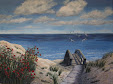
     In the previous post, I mentioned having hit a fallow time in my painting. Browsing images of some of my past paintings was helpful--especially the works that were most difficult to complete. The dune bridge piece pictured here was very stubborn and resisted my efforts to produce a harmonious composition for some time. Looking at it now and recalling the many wrong turns I took in painting "Spring Breeze" reminded me of the wisdom of the saying "this too shall pass". I have felt reluctant to paint, unproductive, and just plain unable before. So, feeling that way should not be scary now and certainly is no excuse for hopelessness. 


     Linda Blondheim's e-critique service helped me rescue this piece from what seemed like an impossible mess. Some of the fixes she suggested did not work; others were ideal. Some of the adjustments I tried on my own were helpful; others were disastrous. But, with persistence, the sort of painting I envisioned creating finally emerged. In the visual arts, some revisions can't be evaluated until you see them in relation to everything else in the composition. Fortunately,  acrylic paints permit painting out unsatisfactory areas and covering them with new shapes, colors, and forms. I would be lost without the possibility of "do-overs".


     The main problem with what you might call the "first draft" was a lack of balance, I think. Keeping the viewer returning to a central focal point gives a work its power, and the wildflowers competed with the foot bridge for awhile. Also, being too literal about the slope of the dunes I had photographed for reference left me with too little variation in the line of the dunes. Since the horizon is inescapably straight, I needed to exaggerate the height of the left side dune and add more undulations to the dune outline (without overdoing it) as a contrast to that straight line. One trick I used to "try on" various dune lines was to cut a paper outline and tape it over the piece--then a different outline, etc., until it looked about right. 


     So, looking back on creative challenges I have faced and coped with in the past helped me get past the funky time and get back to work. "Spring Breeze" and other works remind me of the inevitable ups and downs of the creative process. This is not the first time I have felt as though I have forgotten how to paint, nor will it be the last time. All I need to remember is that the frustration has always been a temporary speed bump and that with faith and patience, the joy of creating will return.
Question of the day: Can you recall a troublesome season you experienced that you were able to work through in time? Can you draw strength from those memories to help you face new challenges?

Tuesday, July 10, 2012

Handling A Fallow Time for Creativity

     A few weeks ago, I showed you this photo from our trip to Maryland and commented that the clouds to the north at this Chesapeake Bay park were a dramatic contrast to the clear sky to the south at the very same moment, shown in another photo on that post. Recently, my creative skies have been on the cloudy side. Not totally bleak, mind you; there had been plenty of beauty in life just as there is in this scene. However, the creative process--my painting in particular--had gone somewhat stale.


     During the last couple of weeks, I have not felt like painting, and when I forced myself to the easel, the results were not satisfying. In addition, instead of being relaxing and absorbing, the painting process felt tense and unproductive. I gained renewed admiration and respect for professional painters, writers, and many others who create for a living and do not have the option of taking a break from the process as I did. Their self-discipline is inspiring--and difficult to emulate.


     When farmers let fields lie fallow for a season, the soil can renew and the new crop planted afterwards is healthier and produces better. It is definitely too early to tell if my (relatively brief) fallow creative season will lead to anything remotely similar. The good news is that the lull is apparently past for now, and painting is fun again. I am working on several pieces that I will show Linda Blondheim soon via photo images for her illuminating e-critique response. Whatever blocked the creative painting process resulted in unsatisfactory efforts for a time, but now it feels as though I have pushed through those particular difficult areas and am moving forward. 


     Possible responses to fallow periods include spending time away from the activity, as I did, or trying an oblique approach to the work. I could have shifted to goal-free sketching or tried a series of brushwork or other basic exercises to loosen up and move on. That might have been better, but for some reason seemed too much "like work". I am fortunate and thankful that giving myself a break from painting helped me return with joy. It did require getting behind myself and pushing at first, but the fuzzy feeling has passed and the clouds are parting.
Question of the day: How have you coped with the inevitable enthusiasm gaps in your work or hobby activities?


Friday, June 22, 2012

New Salt Marsh Painting--"Castaway Island Palms"

     The first of two 9" x 12" paintings I am working on from my exploration of Castaway Island Preserve might be finished. At least, it is very near finished and is ready to show you. The small palm hammock in the mid-distance across the salt marsh drew me to the scene. Paintings always take on a life of their own, and this one somehow became a bit darker and softer than my original vision, which seems fine. It hangs in my studio where I'll contemplate it occasionally to decide whether or not to make any further adjustments.


     I have been fortunate to have had the advice of two excellent painters on this piece. I began the work in Roger Bansemer's helpful two-day workshop, described in a previous post, and brought it home maybe 2/3 finished. A companion piece, also from a Castaway Island scene, got a rough start there, too--at least in its basic layout--and is now on my easel to be re-engaged.


     Linda Blondheim, my dear friend and mentor--and best painting teacher I have ever studied with--has also advised me as I worked to complete this piece. Given that she lives and works in Gainesville, Florida, a good 75 miles away from Jacksonville, our time together is limited. However, she offers an e-critique service which is extremely well-done. Periodically, I send her images of works in progress and ask questions about them. Her responses are encouraging, insightful, and precise, guiding the process without imposing her own style. She is that rare art teacher whose guidance helps students achieve their own vision to the best of their ability.


     The palette for this painting and its eventual companion piece is: ultramarine blue, cerulean blue, Indian yellow, cadmium yellow light, cadmium red, Payne's grey, buff, and white. This is the first time I have used Indian yellow, an orangy, yet not overly bright blend and enjoyed learning something of its mixing potential. Following Roger Bansemer's practice, I toned the canvas with a rub of burnt sienna before beginning. Once that is rubbed partly off, the resulting background is a mid-tone, which can help the painter judge tonal relationships as she adds first the major dark areas and then the lightest lights, and builds from there. In a departure from my usual technique, I let some of this undertone show through rather than completely covering it with full-strength paint. Handling the light in the scene was tricky, given a day that had been partly cloudy with a somewhat directionless glow and very subtle shadowing. Our weather has been unusually dry here in North Florida until recently; the marsh is undoubtedly much greener and thicker than when I last visited Castaway Island Park. I am reasonably pleased with the way this painting captures the light and mood of the day I was there.
Question of the day: Wouldn't life be sadder and poorer without compatible teachers and mentors?


Saturday, June 9, 2012

Turtle Crossing--Our Neighbor the Florida Softshell Turtle


     Heading out for our afternoon walk yesterday, Magnolia (aka Maggie, the Magnificent) and I were surprised to see an extra-large turtle crossing the road. She (the turtle) seems as delighted with the recent, much-needed downpours as we are; the little creek that meanders behind our house, then goes under the road by the drain and continues in the yard Ms. Turtle has just left is wonderfully full of flowing water.


     Fortunately, turtles don't run away as fast as much of our neighborhood wildlife. Usually, by the time I run back outside with the camera, a fascinating bird or animal has moved on. The down side for less-speedy turtles is that they are not much good at ducking cars. However, passing neighbors were extremely careful and once the lovely lady had tired of our attention, she turned back to her creek.
     I say "she" because of her size. My trusty Field Guide to Florida confirmed that she is a Florida Softshell Turtle and added that the males of the species grow to about 8" long; the females to 16". Perhaps I'll resist the temptation to comment on that fact. As always, you can double click on a photo to enlarge it and see more detail.
     I'll have a painting to show you soon, but couldn't resist showing you our new friend first.
Question of the day: Do you also drop everything to watch the wildlife around you?

Turtle Crossing--Wildlife in Our Neighborhood

Grrr! Can't get the new Blogger program to accept the fourth photo in a new post. 


So, I'll make this a preview to a post to follow shortly.

Thursday, May 31, 2012

Natural Beauty on Maryland's Eastern Shore

     We just returned from a wonderful visit with family on Maryland's Eastern Shore, in an area just about equidistant from the Atlantic Ocean and the Chesapeake Bay. Fascinating day trips abound there. The marsh shown in the first photo is just one scene from a large preserve called Blackwater National Wildlife Preserve, near the Chesapeake Bay, where we observed numerous osprey, about 6 bald eagles, countless egrets, maybe a dozen great blue herons, and many other birds. I so enjoyed seeing the birds and soaking up the beauty of these wetlands that I mostly left the camera in my backpack rather than trying to capture a blurry image of each one. 
     The other three photos (including the nesting osprey--click to enlarge) are from an afternoon at a county park and beach on the Chesapeake Bay near a wee town called Nanticoke where the Nanticoke River flows into Tangier Sound. Notice the heavy cloud bank to the north contrasted with the nearly clear sky to the south; the changing clouds are a magnificent feature of the Eastern Shore--due to the influence of two major bodies of water and numerous inlets, rivers, and wetlands. My kind of place, in other words. 
     Given the laundry, errands, etc. awaiting my attention today, I will leave more description and photos for a future post. Loved being with family and seeing so much natural beauty, but it's great to be home--particularly since a major tropical storm came through Jacksonville in our absence, giving us a bit of worry. Fortunately, we suffered no serious damage to our home or our trees--although it is taking Mark quite awhile to clear up tree debris in the yard.


Question of the day: Do you actively seek out bird sightings, or mostly enjoy the experience when it presents itself?

Sunday, May 20, 2012

A Rewarding Painting Workshop Taught by Roger Bansemer


This past weekend, I attended a two-day landscape painting workshop in historic St. Augustine, Florida, taught by the noted painter, Roger Bansemer. The paintings in this post are by Roger, one done as a demonstration each of the two days. (By the way, I am trying to set up this post on the new blogger format and having trouble setting up the post the way I want to. I'm not sure how it will turn out--sorry if it's a little strange.) 


Bansemer's instructional painting television program has recently begun showing on our public tv station, and I took a look at his website after viewing an episode. Lo and behold, he offered a painting workshop over Mother's Day weekend only about a 45 minute drive from our home. I liked his painting style and his easy-going, yet very informative, manner on the television program, so enrolled in the workshop, hoping he would be a compatible teacher for me.


The workshop exceeded my expectations. As regular readers know, I tend to paint slowly and cautiously and to get overly fussy with detail in a detrimental way. Roger Bansemer was the perfect teacher to push me to a bolder, more "painterly" approach and to quash the fussiness right from the start.


Each workshop morning began with a lovely breakfast buffet, provided by the staff and volunteers of the St. Augustine Art Association, where the workshop met. Then Roger began the demonstration painting of the day, based on a photograph. He used acrylic paints, as I do, but welcomed students who were working in oils as well. His instruction covered all aspects of landscape painting, beginning with choosing a scene, then establishing the overall composition, balancing values (lights, darks, and in-between values), using a limited palette of colors, and other basics. As he spoke, he illustrated the method in his demonstration painting and kindly tolerated and answered our wide-ranging questions. 


My photos show each of his two demo paintings in an early stage and then at the end of the day after he had gone beyond the initial demo stage, using his lunch period and other free moments during the day to flesh out the piece. To begin, he rubbed a burnt sienna tone into the board as a mid-tone base. Then, he established the major dark areas, some of the lightest lights, and continued to fill in, working all around the piece in a balanced way. Clicking on any photo will enable you to see it enlarged.


After showing us the basics and answering questions, he turned us loose to work on our own chosen paintings and circulated from one student to the next, guiding each person's work. The workshop was very helpful to me, providing new skills, inspiration, and tips focused on my individual needs as an artist.
Question of the day: Isn't learning and stretching ourselves one of the most enlivening activities we can pursue?

Friday, May 11, 2012

Castaway Island Preserve--Another Amazing Jacksonville, Florida Park

Looking for some new reference photos for landscape painting, I recently visited the Castaway Island Preserve and found it fascinating. My photos don't fully capture its charms, I fear, but have given me much raw material for paintings. Sometimes all I need is good background information (a unique tree, a winding channel in the salt marsh, a particular bird) to meld into a composition that represents the area without copying any particular spot exactly. Although I had neglected to check the tidal schedule for the day, I was in luck to be there when the high tide was just receding. Thus, the marsh was quite wet, and birds, crabs, and other critters were active.
This wonderful small preserve includes both woodland and salt marsh ecosystems with views out to the intracoastal waterway, which runs between our off-shore beach island and the North Florida mainland in this area. We are parched for rain, unfortunately, and have some wildfires in the area. The day I explored Castaway Island, smoke hung in the air--sad to see and smell. However, I did the photo documentation I could under these conditions and have a nice packet of about 4 dozen prints to carry along with other photos to a painting workshop I will be taking this weekend. I hope to start two 9" x 12" canvases at the workshop.
In one photo, you see the dock at the end of the park area, where a woman had put a something on a line into the water (crabbing perhaps?). The intracoastal waterway is in the smoky background with a sailboat and a powerboat passing each other, going in opposite directions. Another photo shows the beginning of the path to Castaway Island (a short bridge crossing a channel in the marsh is the only clue that one is has crossed to an island). On the island part of the preserve, there are about 12 informative big boards along the main path, each one describing the life of one of the preserve's "survivor" species--other than that, the area is quite untouched. Two other photos show the wetlands, grasses, etc.--one includes a great blue heron fishing (actually blue-grey in color) which will take sharp eyes to see, even if you click on the photos to enlarge them.
For this visit, I took the paths through the salt marsh; the park provides extensive boardwalks over the wettest areas, helping to protect the natural habitat as well as making exploration convenient for the visitor. Another time, I'll explore the wooded areas further from the intracoastal. We are fortunate indeed in the Jacksonville, Florida area to enjoy a rich variety of habitats and to have many thousands of acres in these areas protected in preserves and parks.
Question of the day: Isn't it amazing how deep the creative and spiritual renewal available to us when we explore natural areas?

Monday, April 30, 2012

An Excellent New Book About Introverts Called "Quiet"

I am reading an intriguing, empowering, beautifully written new book called Quiet,The Power of Introverts in a World that Can't Stop Talking. When I first heard about this book on a Public Radio interview with the author, Susan Cain, I immediately searched our public library web site and placed a hold on it. The fact that I was about 28th in the waiting line gives you a clue as to the demand for this powerful read. Once my turn finally came, and I began reading, the brief introduction thoroughly captured my interest. Quiet continues to fascinate me and also to affirm me, an introvert who likes being myself.
However, all readers, whatever their personality types, can enjoy and benefit from this superbly well-researched and readable book. As a Harvard Law School honors graduate, business consultant, and negotiation skills teacher, Susan Cain offers a compelling argument that businesses, communities, and American society at large lose valuable insights, innovative ideas, and leadership potential by falling in step with the prevailing undervaluing of the unique gifts of introverts.
Cain convincingly marshals the latest research from psychology and neuroscience combined with inspiring narratives about real people demonstrating the complementary viewpoints and range of skills characteristic of both introverts and extroverts. She tracks the history of the focus on the qualities of extroverts as being more desirable in both business and relationships--then documents the evidence that we all lose when 1/3 or more of our people are undervalued or even discounted because they are introverts. She charmingly debunks the myths that all introverts (or extroverts, for that matter) are alike and affirms the contributions all make.
I like this book because it upholds who I am, but it offers much more than that. Cain's insights into relationships (especially between different personality types), parenting, cooperation in groups, and business management are pure gold.
When I started this blog about creative everyday life, I expected to post about the books I read fairly often, as I am a voracious reader. However, for some reason, that has not happened. Perhaps if blog readers enjoy hearing about this book and respond to the post, I will discuss my reading--of a wide variety of books, both fiction and non-fiction--more often.
Question of the day: What have you read lately that has entertained or informed you and enriched your life?