Showing posts with label wetlands. Show all posts

Saturday, August 4, 2012

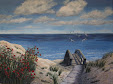
A Second New Salt Marsh Painting--"Castaway Island Cedars"

     "Castaway Island Cedars" is the second of two paintings begun at a painting workshop with painter/teacher Roger Bansemer. I described the painting process for "Castaway Island Palms" a few posts ago when it was finished. Both are 9" x 12" acrylic works on gallery-wrapped canvas using reference photos and notes from my outing to Castaway Island Preserve on the intracoastal waterway here in Jacksonville, Florida. Each scene shows characteristic North Florida native trees and other vegetation growing in or near salt marsh areas, scenes like those that greeted the first Europeans to step on the shore of what is now Florida.


     With apologies for the slightly washed out look of the palms photo, here is the other painting. As always, you can click on the images to enlarge the view.


     I used the same limited palette for these two scenes so that they could hang harmoniously as companion pieces, but made certain each could also work alone. This palette includes: cerulean blue, ultramarine blue, Payne's grey, cadmium yellow light, Indian yellow, cadmium red light, white, and buff, with some burnt umber in a few of the mixes. As described in the "Castaway Island Palms" post, this is my first experience using Indian yellow, a warm, slightly orangey hue. It's very nice. I rubbed each canvas with an uneven burnt sienna mid-tone before painting, which provides a warm undertone unifying the entire work as well as a base from which it was easy to judge the tones (relative darks and lights) of the rest of the painting. Beginning with what I planned as the darkest darks, then moving to lights and mid-range tones, I laid in the rough shapes of the composition, then gradually worked in greater detail. "Castaway Island Cedars" came together more quickly (or in my case, less slowly :>) than the palms piece.


     For each of these paintings, I had excellent reference photos, including those that showed more detail of the red cedar branches and needle clusters, or other crucial detail areas. Several times in the workshop, Roger Bansemer stressed the importance of starting with well-composed reference photos with adequate tonal variation. Sounds obvious, maybe, but I have begun with so-so photos more than once in the past and then struggled to compensate for a poor composition or monotonal appearance. There is a point beyond which I am not good at "making it up"--especially in trying to add something to the given scene that is not actually there. Some aspects of a scene are fairly simple to adjust. Given the lush, varied vegetation here in coastal North Florida, I inevitably need to leave things out to make a pleasing composition, which is simpler than adding elements. The horizon (which is often near the horizontal center of photos) can be moved easily to avoid cutting the composition in half (much less pleasing to the eye than placing it a third of the way from the top or bottom--or at another less symmetrical level). Beyond that, the fact that these works both came from good, solid reference photos helped me complete them with less stress and difficulty than sometimes.
Question of the day: In visual art (including photography), how often do you think about or notice the placement of various features of the overall composition? Do you know why you are particularly drawn to certain compositions?  

Thursday, May 31, 2012

Natural Beauty on Maryland's Eastern Shore

     We just returned from a wonderful visit with family on Maryland's Eastern Shore, in an area just about equidistant from the Atlantic Ocean and the Chesapeake Bay. Fascinating day trips abound there. The marsh shown in the first photo is just one scene from a large preserve called Blackwater National Wildlife Preserve, near the Chesapeake Bay, where we observed numerous osprey, about 6 bald eagles, countless egrets, maybe a dozen great blue herons, and many other birds. I so enjoyed seeing the birds and soaking up the beauty of these wetlands that I mostly left the camera in my backpack rather than trying to capture a blurry image of each one. 
     The other three photos (including the nesting osprey--click to enlarge) are from an afternoon at a county park and beach on the Chesapeake Bay near a wee town called Nanticoke where the Nanticoke River flows into Tangier Sound. Notice the heavy cloud bank to the north contrasted with the nearly clear sky to the south; the changing clouds are a magnificent feature of the Eastern Shore--due to the influence of two major bodies of water and numerous inlets, rivers, and wetlands. My kind of place, in other words. 
     Given the laundry, errands, etc. awaiting my attention today, I will leave more description and photos for a future post. Loved being with family and seeing so much natural beauty, but it's great to be home--particularly since a major tropical storm came through Jacksonville in our absence, giving us a bit of worry. Fortunately, we suffered no serious damage to our home or our trees--although it is taking Mark quite awhile to clear up tree debris in the yard.


Question of the day: Do you actively seek out bird sightings, or mostly enjoy the experience when it presents itself?

Wednesday, October 7, 2009

Exploring--Croatia's Plitvice Lakes National Park, Part III and a Painting

This is my third and final post recalling our awe-inspiring day hike in Plitvice Lakes National Park in Croatia about a year ago. The photo on the right is one of my favorite views of one of the lakes. The breathtaking color is absolutely true to life; other than cropping, I never adjust the photos I show you or tinker with their colors. The actual tones and shades of the water in the park vary, but this clear aqua color is common there due to minerals dissolved from the limestone prevalent in the surrounding mountains and this beautiful valley. You can read further details about Croatia's magical national park in the previous two posts.
The painting at the top is a small (5" X 7") study created by simplifying the foreground in one photo (leaving out some tree trunks and the rushing water) and adapting a distant waterfall from another. Given the countless, varied waterfalls and rich virgin forest throughout the park, we saw other scenes like that portrayed in the painting, so my adjustments were not unrealistic. Mixing a color that worked for the water in the lake was difficult because I did not want a garish, swimming pool hue and yet wanted to be true to the startling reality. It seemed to work best to go greener because an exact duplication of the water color in the photo looked unreal when viewing the painting on its own.
For some reason, I have been slow to paint a larger landscape using this little study. I think that perhaps working on the study was enough for the sake of my memories. Beyond that, once we returned from that wonderful trip, North Florida's unique beauty recaptured my creative spirit with gratitude and joy for Home.
Question of the day: Isn't it a joy when travel stretches us and deepens our appreciation for other places and yet renews our love for our own nation and home?

Sunday, October 4, 2009

Exploring--Croatia's Plitvice Lakes National Park, Part II

I hope you will enjoy several more photos from this amazing park in Croatia (formerly part of Yugoslavia), which I described in the last post. My husband, Mark, is viewing a waterfall in one shot (notice the sturdy walkway, which is typical of wet area crossings in the park). In another, we are looking down from the highest point we reached on our day hike. I believe that the numerous fish swimming below ducks in another photo are chub, but species' common names are sometimes "lost in translation". As always, you can click on any photo to enlarge it and see the details.
The memory of our visit to Plitvice Lakes seems timely as PBS airs Ken Burns' beautiful, informative, and deeply inspiring film series about the magnificent national parks here in the USA. We can be very grateful for and proud of our extensive, varied national park system. His film series invokes a deep love for our land, a kind of patriotism that exceeds flag or government and rises from the very earth, where, I must say humbly, my own European ancestors arrived only a few generations ago.
Remembering Plitvice Lakes, however, as well as gorgeous environmental preserves I have visited in Belize and the Dominican Republic, I am thankful that a number of other nations also have founded national parks. I hope that all members of the global community who care about preserving unique natural ecosystems will be empowered to set aside parks and preserves.
Question of the day: What is your favorite national park or other natural preserve area in the USA?

Monday, May 4, 2009

Exploring--Paddling & Savoring Timucuan Preserve

I mentioned my new painting adventures in the last post and am working on getting decent photos of some other paintings to show you soon. It can be difficult to get them lighted well to avoid glare and to display close to true color in photos.
In the meantime, here are a couple of photos of a kayaking outing I took with my husband and adult son (the younger of two sons) one cloudy Memorial Day. Here in North Florida, cloudy can be a good thing, helping the temperature stay moderate. Thankfully, the threatened stormy weather held off until later in the day. 
At a well-run facility called Kayak Amelia, we were fitted for kayaks and gear and instructed in safety and technique before we set off with a knowledgeable guide whose colorful stories and descriptions of his beloved salt marshes informed us about this precious habitat. Yet, he wisely allowed plenty of quiet time for us to savor the beauty, the water birds, the fish jumping, and the calming rhythm of silent paddling. Although most of the areas we explored that day are not accessible except by water, we were not far from Kingsley Plantation and other public sites and parks in the remarkable, extensive cluster of wetlands, beaches, and forest in the Timucuan Preserve (which also includes Big and Little Talbot Islands). See my posts for April 23 and 26 for more Timucuan Preserve sites. I am humbled and awed by the varied natural beauty there and feel tremendous gratitude to all the groups and individuals responsible for its preservation.  
Some of my photos from that day inspired a quiet marsh painting I'll show you soon. 
Question of the day?: What outdoor exploring is on your "do sometime" mental list? When--set a date now!--will you stroll, pedal, hike, saddle-up, paddle, sail, skate, or hang-glide (!) in a precious natural setting near your home?
Thank you to all my kind readers who have emailed or phoned me to respond to the blog. I appreciate knowing that you are "out there" whether or not you post a comment. It's especially encouraging to hear the plans for exploring that a couple of you have made since reading earlier posts. Here's to our continuing creative conversation!