skip to main |
skip to sidebar
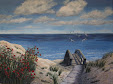
 "Castaway Island Cedars" is the second of two paintings begun at a painting workshop with painter/teacher Roger Bansemer. I described the painting process for "Castaway Island Palms" a few posts ago when it was finished. Both are 9" x 12" acrylic works on gallery-wrapped canvas using reference photos and notes from my outing to Castaway Island Preserve on the intracoastal waterway here in Jacksonville, Florida. Each scene shows characteristic North Florida native trees and other vegetation growing in or near salt marsh areas, scenes like those that greeted the first Europeans to step on the shore of what is now Florida.
With apologies for the slightly washed out look of the palms photo, here is the other painting. As always, you can click on the images to enlarge the view.

I used the same limited palette for these two scenes so that they could hang harmoniously as companion pieces, but made certain each could also work alone. This palette includes: cerulean blue, ultramarine blue, Payne's grey, cadmium yellow light, Indian yellow, cadmium red light, white, and buff, with some burnt umber in a few of the mixes. As described in the "Castaway Island Palms" post, this is my first experience using Indian yellow, a warm, slightly orangey hue. It's very nice. I rubbed each canvas with an uneven burnt sienna mid-tone before painting, which provides a warm undertone unifying the entire work as well as a base from which it was easy to judge the tones (relative darks and lights) of the rest of the painting. Beginning with what I planned as the darkest darks, then moving to lights and mid-range tones, I laid in the rough shapes of the composition, then gradually worked in greater detail. "Castaway Island Cedars" came together more quickly (or in my case, less slowly :>) than the palms piece.
For each of these paintings, I had excellent reference photos, including those that showed more detail of the red cedar branches and needle clusters, or other crucial detail areas. Several times in the workshop, Roger Bansemer stressed the importance of starting with well-composed reference photos with adequate tonal variation. Sounds obvious, maybe, but I have begun with so-so photos more than once in the past and then struggled to compensate for a poor composition or monotonal appearance. There is a point beyond which I am not good at "making it up"--especially in trying to add something to the given scene that is not actually there. Some aspects of a scene are fairly simple to adjust. Given the lush, varied vegetation here in coastal North Florida, I inevitably need to leave things out to make a pleasing composition, which is simpler than adding elements. The horizon (which is often near the horizontal center of photos) can be moved easily to avoid cutting the composition in half (much less pleasing to the eye than placing it a third of the way from the top or bottom--or at another less symmetrical level). Beyond that, the fact that these works both came from good, solid reference photos helped me complete them with less stress and difficulty than sometimes.
Question of the day: In visual art (including photography), how often do you think about or notice the placement of various features of the overall composition? Do you know why you are particularly drawn to certain compositions?
 The first of two 9" x 12" paintings I am working on from my exploration of Castaway Island Preserve might be finished. At least, it is very near finished and is ready to show you. The small palm hammock in the mid-distance across the salt marsh drew me to the scene. Paintings always take on a life of their own, and this one somehow became a bit darker and softer than my original vision, which seems fine. It hangs in my studio where I'll contemplate it occasionally to decide whether or not to make any further adjustments.
I have been fortunate to have had the advice of two excellent painters on this piece. I began the work in Roger Bansemer's helpful two-day workshop, described in a previous post, and brought it home maybe 2/3 finished. A companion piece, also from a Castaway Island scene, got a rough start there, too--at least in its basic layout--and is now on my easel to be re-engaged.
Linda Blondheim, my dear friend and mentor--and best painting teacher I have ever studied with--has also advised me as I worked to complete this piece. Given that she lives and works in Gainesville, Florida, a good 75 miles away from Jacksonville, our time together is limited. However, she offers an e-critique service which is extremely well-done. Periodically, I send her images of works in progress and ask questions about them. Her responses are encouraging, insightful, and precise, guiding the process without imposing her own style. She is that rare art teacher whose guidance helps students achieve their own vision to the best of their ability.
The palette for this painting and its eventual companion piece is: ultramarine blue, cerulean blue, Indian yellow, cadmium yellow light, cadmium red, Payne's grey, buff, and white. This is the first time I have used Indian yellow, an orangy, yet not overly bright blend and enjoyed learning something of its mixing potential. Following Roger Bansemer's practice, I toned the canvas with a rub of burnt sienna before beginning. Once that is rubbed partly off, the resulting background is a mid-tone, which can help the painter judge tonal relationships as she adds first the major dark areas and then the lightest lights, and builds from there. In a departure from my usual technique, I let some of this undertone show through rather than completely covering it with full-strength paint. Handling the light in the scene was tricky, given a day that had been partly cloudy with a somewhat directionless glow and very subtle shadowing. Our weather has been unusually dry here in North Florida until recently; the marsh is undoubtedly much greener and thicker than when I last visited Castaway Island Park. I am reasonably pleased with the way this painting captures the light and mood of the day I was there.
Question of the day: Wouldn't life be sadder and poorer without compatible teachers and mentors?
This past weekend, I attended a two-day landscape painting workshop in historic St. Augustine, Florida, taught by the noted painter, Roger Bansemer. The paintings in this post are by Roger, one done as a demonstration each of the two days. (By the way, I am trying to set up this post on the new blogger format and having trouble setting up the post the way I want to. I'm not sure how it will turn out--sorry if it's a little strange.)
 Bansemer's instructional painting television program has recently begun showing on our public tv station, and I took a look at his website after viewing an episode. Lo and behold, he offered a painting workshop over Mother's Day weekend only about a 45 minute drive from our home. I liked his painting style and his easy-going, yet very informative, manner on the television program, so enrolled in the workshop, hoping he would be a compatible teacher for me.
The workshop exceeded my expectations. As regular readers know, I tend to paint slowly and cautiously and to get overly fussy with detail in a detrimental way. Roger Bansemer was the perfect teacher to push me to a bolder, more "painterly" approach and to quash the fussiness right from the start.
 Each workshop morning began with a lovely breakfast buffet, provided by the staff and volunteers of the St. Augustine Art Association, where the workshop met. Then Roger began the demonstration painting of the day, based on a photograph. He used acrylic paints, as I do, but welcomed students who were working in oils as well. His instruction covered all aspects of landscape painting, beginning with choosing a scene, then establishing the overall composition, balancing values (lights, darks, and in-between values), using a limited palette of colors, and other basics. As he spoke, he illustrated the method in his demonstration painting and kindly tolerated and answered our wide-ranging questions.
 My photos show each of his two demo paintings in an early stage and then at the end of the day after he had gone beyond the initial demo stage, using his lunch period and other free moments during the day to flesh out the piece. To begin, he rubbed a burnt sienna tone into the board as a mid-tone base. Then, he established the major dark areas, some of the lightest lights, and continued to fill in, working all around the piece in a balanced way. Clicking on any photo will enable you to see it enlarged.
After showing us the basics and answering questions, he turned us loose to work on our own chosen paintings and circulated from one student to the next, guiding each person's work. The workshop was very helpful to me, providing new skills, inspiration, and tips focused on my individual needs as an artist.
Question of the day: Isn't learning and stretching ourselves one of the most enlivening activities we can pursue?
 "Castaway Island Cedars" is the second of two paintings begun at a painting workshop with painter/teacher Roger Bansemer. I described the painting process for "Castaway Island Palms" a few posts ago when it was finished. Both are 9" x 12" acrylic works on gallery-wrapped canvas using reference photos and notes from my outing to Castaway Island Preserve on the intracoastal waterway here in Jacksonville, Florida. Each scene shows characteristic North Florida native trees and other vegetation growing in or near salt marsh areas, scenes like those that greeted the first Europeans to step on the shore of what is now Florida.




 Posts
Posts

