Friday, November 30, 2012

Second Show of Paintings at Paddiwhack Gallery

     I am thrilled to have a second opportunity to show paintings in the featured "nook" at the front of the wonderful Paddiwhack Shop in Gainesville, Florida. It is an honor and privilege to have works hung together in this premier location in the store. It has been about a year and a half since I last exhibited there. This group of pieces (plus one called "Sanderling in the Surf", which is featured elsewhere in the shop) shared the coveted pre-holiday time period with Paddiwhack's unique selection of holiday-themed items. Of course, all the other delightful treasures Paddiwhack is known for are also available in their wonderful, large space. As always, you can click on a photo to enlarge it.


     All the pieces in this exhibit are new to Paddiwhack. Given my slow painting pace and the various life events that occurred and kept me from painting at times in recent months, it was a challenge to produce and mount the 12 works shown at the shop. Since I have at some time posted about the Coastal North Florida explorations that led to the subjects for these works and about the painting process for each piece, I won't discuss that today. 

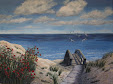
     One goal for this exhibit was to present a greater variety of sizes and prices than I had in the previous exhibit. The little pair of 5" x 7" marsh paintings seen on the chest near my artist's statement and business cards are the smallest, while the largest are two 18" x 24" paintings above that chest on the left. One shows a winter day at Big Talbot Island Park here in North Florida, where waves are gradually undermining a bluff causing trees, one by one over time, to fall into the water. The other represents a view of the St. Johns River by the National Historic Site at Kingsley Plantation. Whoops, there is one other in that size which the shop had kept from my previous exhibit--a view of the Atlantic Ocean at Jacksonville Beach, looking over the dunes and a foot bridge--seen on a side wall. 

     Thank you all for your good wishes as I recover from total hip replacement surgery. I am amazed and deeply grateful for the miracle of a new joint, for freedom from long-standing, constant pain, and for the wonder of growing strength and mobility the surgery and excellent physical therapy are making possible. I feel like a new woman!


Question of the day: Are you considering small, locally owned businesses like Paddiwhack and goods made in the USA in your holiday gift shopping?

Saturday, November 10, 2012

Homey, Heritage Comfort Food--Applesauce Spice Cake


It has been awhile since I have posted a recipe, so today will share my great-grandmother's applesauce spice cake recipe. In its original form, it called for "butter the size of an egg" and, interestingly, 1, 2, or 3 eggs. Apparently, our frugal ancestors used three eggs for a "company" meal, but fewer when baking for the family. Since their eggs were smaller than today's standard large eggs, we have settled on two eggs as the perfect number.
This homey cake, a favorite comfort food in my family, is a hit whenever I bake it. Individual pieces freeze well in a well-sealed container (handy for our household since it is a large cake and we try not to eat too many sweets). I will include the recipe for the cream cheese frosting, as pictured, although we also like it simply dusted with a bit of powdered sugar rather than frosted. The original recipe called for 1/2 cup chopped nuts; we like it better without them. And, yes, for readers with long memories, I have posted this recipe before, but it has been awhile, so thought new readers might like hearing about it. For some reason, it pulled the original comments along when I posted it again--I decided to leave them in.
Heritage Applesauce Spice Cake
1/2 cup butter or margarine
1 1/2 cups sugar
2 large eggs
1 1/2 cups applesauce (a 15 ounce jar works)
2 cups flour
2 tsp. baking soda
1/4 tsp. salt
1 tsp. cinnamon
1/4 tsp. ground nutmeg
1/8 tsp. ground cloves
1 cup raisins
Cream butter & sugar together. Add eggs and mix well, stirring vigorously until fluffy. Sift dry ingredients into a small bowl (I don't bother sifting). Add raisins to flour mixture and sir in to coat with flour (this keeps them from sinking to the bottom).
Add dry ingredients alternately with applesauce to the butter mixture in two or three batches, mixing thoroughly each time.
Turn into a greased 9” x 13” x 2” pan and bake 35 - 40 minutes at 325 degrees F until a toothpick comes out clean (or nearly clean--do not overbake). This recipe also makes nice cupcakes; bake them only about 25-30 minutes.
Cream Cheese Frosting
3 ounces cream cheese, softened (I use low fat neufchatel).
2 Tbsp. butter or margarine, softened
1 tsp. vanilla extract
dash salt
2 1/2 cups (or as much of this amount as needed for good frosting consistency) sifted confectioner's sugar (I whisk it in a bowl instead of sifting).
Cream butter and cream cheese together well. Beat in vanilla. Gradually add confectioner's sugar, blending well. If mixture becomes too thick, you can add a few drops of milk.
Question of the day: What recipes or foods connect you to your ancestors and to good family memories?

Friday, October 26, 2012

Newest Painting Is Complete--"River View at Kingsley Plantation"

     I felt a little rushed to complete this 18" x 24" acrylic on gallery-wrapped canvas in time to deliver it to Paddiwhack Gallery for a special exhibit. However, I am quite pleased with the result. "River View at Kingsley Plantation" utilized my cabbage palm painting photos and study, mentioned in the most recent previous post. It may not seem like a big deal to everyone, but creating the palm trunks and especially the palm canopy (and even the part of a canopy visible on the far right) required special study and careful work.

     Then, the first try after my studies produced a very nice canopy on the furthest palm away from the viewer (which appears in the middle of the three seen), but I painted much of it out and started again. That canopy had been very high on the canvas and was not seen in full (in other words, the viewer of the painting saw maybe the lower two-thirds of it at most). On e-critique advice from Linda Blondheim and on further reflection myself, I concluded that for good composition and better balance, that entire palm canopy needed to be lower so that it would be seen in full. Other changes from the main reference photo (seen below)--made to enhance the composition--included painting in a more interesting sky, adding a kite, which is one of Florida's gorgeous soaring shore birds, and simplifying the tall grasses.  My literal rendition of the bulkhead along the river at the Kingsley Plantation National Parks historic site bothered Linda. She would have preferred a softer, more organic, curving line, perhaps of the mud flats that line the river bank at low tide. I did consider her suggestion to replace the bulkhead, knowing that it would certainly work well. However, in the end, I stayed with the straight  bulkhead as it is, partly because viewers who have visited Kingsley Plantation have seen it there and partly because something about the sharper angles appealed to me as a change from some of the softer composition edges I have used in other pieces. 


     You can see other changes from the actual scene that I made in the painting. But, you can also see that this particular photo already represented a composition that appealed to me without major rearrangement. Compared to the times that I have used a reference photo that had appealing elements but was not composed well and required major revision in painting, beginning with a solid photo composition is much simpler and more satisfying.

Question of the day: Do you personally prefer fairly realistic--or even near photo-realistic paintings--or some other type such as impressionistic or abstract?

Thursday, October 18, 2012

Studying Cabbage Palms for Better Painting

In my newest painting, which I'll show you soon, three cabbage palms frame one side of the scene. They are seen fairly close up, so needed to be painted quite accurately. Painting a realistic cabbage palm tree proved more complicated than expected. After all, I thought, there were some decently rendered distant palms in some of my paintings, and I had good results with a tropical beach scene that had the island sort of palms near the viewer. Painting them close up was a whole new challenge, humbling, but very interesting.

Cabbage palms (technically the Sabal palmetto, Florida's state tree) are actually quite complex. The fronds in the canopy grow out on various levels as the tree grows taller. In nature, the lower fronds gradually brown, droop, and eventually drop off, sometimes cleanly and sometimes leaving spiky pieces of stem behind (as on the loosely trimmed palms in the photo above). At the national historic site scene I was working on, the browned lower fronds had been regularly trimmed away from the palms, leaving a mostly bright green "lollipop" shaped top. For visual interest, I had decided to add a few browned fronds hanging down, but did incorporate the fairly smooth trunk with no spikes sticking out, just as I saw it at the historic Kingsley Plantation. The plantation is one of our favorite places to visit or to bring out-of-town guests; if you wish, you can view previous Kingsley Plantation posts here.

As I worked to learn more about the cabbage palm, my mentor, Linda Blondheim, advised me and provided one of her own printed tutorials with detailed pointers on painting various species of palm trees. The tutorials may be available from Linda--here is a way to contact her. I also viewed dozens of palms on a perfectly timed weekend watching the dogs at our kids' beach town home while they were away. The yard of their home has gorgeous stands of palm trees, Then, just the shortest walk in their area provided many more palms to study and photograph--each with its own unique form and character. That weekend, I sketched a few palms and parts of palms to get a good feel for them and took dozens of photos, some showing a whole tree or stand of trees, others mid-range, and some intense close-ups for information about details. Back in the studio, the painting flowed much more successfully--will post the results soon.


By the way, please bear with me for a couple of months with less frequent posts. Mark is recovering well from recent rotator cuff repair surgery, and I go in next week for total right hip replacement. I plan to prepare a few posts the rest of this week (if all goes well) that can post automatically, but probably two posts a month will be my max for awhile.
Question of the day: Do you also find that one of the joys (and sometimes, frustrations) of creative pursuits is that each new project presents new challenges and opportunities to grow?

Saturday, September 29, 2012

"Sea Oats" Painting Revisions


     "Sea Oats", a 12" x 16" acrylic painting, is still a work in progress, but I think some current revisions have improved it. The newer version seen above now hangs on the studio wall for consideration. This piece will be part of a special exhibit I will have at Paddiwhack Gallery in Gainesville, Florida in less than a month. In spite of some on-going personal obstacles to getting maximum work done right now, I am determined to complete this painting and one larger piece in time to hang in Paddiwhack's honored front nook for a six week mini-show with other recent works. A previous post showed you the first exhibit I brought to this amazing store back in the spring of 2011.

     Some of you were very complimentary about the earlier version of "Sea Oats" I showed you awhile ago--seen below--but it wasn't quite satisfactory for me. It was too "pink" for my taste (others will differ on palette preferences, of course) and lacked punch. My mentor, Linda Blondheim, agreed, calling it a "pretty enough" picture, but also feeling that it was somewhat bland. 

     So, having added more tonal contrast, a more interesting sky, and more variation in the tones of the grasses and sea oats on the dune, I am happier with the piece. I have also reduced the power of the pink areas, substituting some quiet golden glow. Still am considering some minor adjustments, and may (or may not) change the placement of the birds (which will be sharpened a bit once their location is definite). Since I have signed up for one more week of Linda Blondheim's excellent e-critique, we will see what she thinks of this work once I have one other, larger piece ready for her assessment as well. She is a super teacher and guide and always understands that I may or may not include all her suggested revisions in the final form. As I have confessed to you before, I always have trouble knowing when a painting is finished (or finished enough, given that one could continue revising indefinitely--a process that eventually begins to detract from the vitality and impact of a work). So, Linda's assessment is also tremendously helpful in making that decision to sign a painting, give it a protective coat of medium, and consider it ready for prime time.
Question of the day: In any undertaking, do you agree that the assessment and revision process is almost as significant as the original concept for a good outcome?

Sunday, September 16, 2012

Favorite Paintings from 2007 and 2008

     Thinking back on the relatively few years I have been painting, I browsed the photo file, viewing earlier works, and spent some time feeling grateful for this rewarding pursuit. A few favorite early paintings stood out, although each and every piece has some interesting features, and each represents creative learning and growing experiences.

     About nine years ago, a week-long painting course at the John C. Campbell Folk School in North Carolina awakened a whole new pleasurable undertaking for me. I had expected to relax, stretch my mostly analytical mind beyond its comfort level, have fun making some messes, and come home refreshed. Well, with an excellent teacher, all my expectations were met--except one. The paintings were not total messes at all. Not that they were great art, but they were pleasing to me beyond anything I had ever thought possible.


     Since then, I have learned much more and refined my painting skills with occasional local classes, guidance from my painting mentor, Linda Blondheim, and lots of practice. Painting is a whole new, unexpected source of joy.

     So, as I looked back, I  found three photos to show you, each representing a particularly pleasing achievement for me. Each work has elements I would do differently today, but they were the best I could do at the time, and that's good enough. No need to be overly self-critical about them (or to whine to you about the short-comings I see in them now). 

     It's interesting how differently artists view their own earlier work. In one painting class, a very good teacher said that she sometimes cringed when she saw some of the paintings she had sold years ago. She was somewhat ashamed of those earlier works. That seems a pity; clearly they appealed to the buyers (and probably to others). Further, regardless of other peoples' opinions, they represent a stage in her creative journey which contributed to where she is now. Linda Blondheim's attitude strikes me as healthier and more self-affirming; she enjoys looking back and values every one of her paintings, convinced that each was the best she could do at the time.

     So, without apologies, here are three personal favorites from 2007 and 2008. For each, clicking on the link will pull up an earlier post describing their creation in more detail. "Look to the Hills", an 18" x 24" landscape, interprets a meaningful visit to a retreat center in Warwick, New York. The 12" x 16" marsh scene recalls a delightful day kayaking with my husband and one son (and later became an engagement gift for our son and his fiancee). The 9" x 12" "Magnolia on Purple" was based on photos of magnolia blossoms on some neighbors' trees. Each work brought frustration as I confronted its challenges, and each was a significant learning adventure. 

     Life's journey is always surprising--what if I had listened to my conviction that I had zero artistic ability?--what if I had never tried painting? By the way, I also value other less successful (or even totally bungled) ventures along my journey for the contribution they have made to the person I am today.
Question of the day: What surprising discovery have you made about your own abilities?

Monday, September 3, 2012

Wisconsin Family Reunion--Precious, Fun Time

     A couple of weeks ago, we returned home from a super time with my husband's extended family in Wisconsin. Among the many highlights of our family reunion (great food, a warm loving circle around the fire ring after sunset, spending extended time together), were the times on the water at one family's cottage on a lake in the Fox River chain of lakes. 

     The reunion planning began with a suggestion from one of our wonderful daughters-in-law. Although many of my husband's family members live in or near central Wisconsin, we and our two sons and their wives are the exception, living in Florida and Georgia. Thus, it has been difficult for the daughters-in-law to get to know our son's extended family. Ashley and Sumry treasured the time with my family in the Smoky Mountains last summer (my family is quite spread out over a number of states) and one suggested a family reunion with Mark's family. They were excited to have several days to grow closer to all their husbands' extended family members, one bunch each summer. 

     I intentionally chose photos that don't show faces clearly as the purpose of this blog has never been to reveal family details. I hope you can still see the family love and joy as we play. The sunset photos show our wonderful "kids". Both our sons were thrilled to get up on water skis (it's been many years since their last time) and to have successful runs, one on a slalom ski and one on two skis. Irma, the wonder dog (seen in the tubing photo of hubby, a brother, and a third, unseen reveler) served as primary spotter (backed up by a human assistant). She knows all the signals skiers and tubers use and barked the news to the skipper every time. 

     Mark and I have enjoyed many family times in Wisconsin, but this year was even richer and more precious because it was the first time in many years that our sons were able to join us and the first time ever for our sweet "daughters". Absolutely priceless!


Question of the day: Have recent gatherings added to your precious memories of family or friends?

Tuesday, August 21, 2012

Summer Means Butterflies--In Our Yard and in Mandarin Gardens


Now and then, I repeat a post from a couple of years ago. We have enjoyed a busy butterfly and hummingbird year again, and I thought you might enjoy seeing the lovely 
creatures from this September
2010 post. I have not rewritten it, so the description is of a "date" from back then. The Mandarin Gardens butterfly garden on the south side of Jacksonville, Florida is as lovely and as active as ever. If you live in the area, I encourage you to stop in for some quiet contemplation, surrounded by beauty.

A couple of weeks ago, my master gardener husband suggested a unique "date" to see butterflies at the Mandarin Gardens demonstration garden on Jacksonville's south side, his favorite place to volunteer. Because our weather continues to be fairly hot, we opted for a morning visit and then breakfast out afterwards. It was fantastic, just sitting quietly among the flowers and watching the butterflies and other pollinators work their magic. I resisted pulling out the camera for awhile in order to soak it in--then took on the challenge of capturing photos of very active butterflies. I'll keep the photos small, but you can always click on them to enlarge (sometimes a second click will give you an even closer view).

Master gardener that he is, Mark has also developed our yard into a haven for butterflies and hummingbirds, so I will share some photos from our yard as well as from Mandarin Gardens. According to my field guide, the photos taken at Mandarin Gardens show a Gulf Fritillary (orange with just a few black markings--seen on both yellow and lavender flowers) and a Long-tailed Skipper (brownish one on a bright orange flower).


   The monarchs are just beginning to grace our yard on their way to Mexico; I took the monarch photos this morning. This one looks like a male because of the black spot on a vein of each hind wing. Although I can't always tell a Monarch from a Viceroy as they fly by, I know the Monarchs have been up north for awhile because the milkweed Mark plants for their caterpillars to eat has grown very tall rather than being stripped down to nothing (the yellow flowering plants shown alone in a photo above--very different from what I called milkweed as a child in Michigan). The black Palamedes Swallowtail photos were also taken in our yard, earlier in the summer.

Question of the day: Aren't butterflies amazing--beautiful and captivating in a special way and also so helpful to plant life?

Saturday, August 4, 2012

A Second New Salt Marsh Painting--"Castaway Island Cedars"

     "Castaway Island Cedars" is the second of two paintings begun at a painting workshop with painter/teacher Roger Bansemer. I described the painting process for "Castaway Island Palms" a few posts ago when it was finished. Both are 9" x 12" acrylic works on gallery-wrapped canvas using reference photos and notes from my outing to Castaway Island Preserve on the intracoastal waterway here in Jacksonville, Florida. Each scene shows characteristic North Florida native trees and other vegetation growing in or near salt marsh areas, scenes like those that greeted the first Europeans to step on the shore of what is now Florida.


     With apologies for the slightly washed out look of the palms photo, here is the other painting. As always, you can click on the images to enlarge the view.


     I used the same limited palette for these two scenes so that they could hang harmoniously as companion pieces, but made certain each could also work alone. This palette includes: cerulean blue, ultramarine blue, Payne's grey, cadmium yellow light, Indian yellow, cadmium red light, white, and buff, with some burnt umber in a few of the mixes. As described in the "Castaway Island Palms" post, this is my first experience using Indian yellow, a warm, slightly orangey hue. It's very nice. I rubbed each canvas with an uneven burnt sienna mid-tone before painting, which provides a warm undertone unifying the entire work as well as a base from which it was easy to judge the tones (relative darks and lights) of the rest of the painting. Beginning with what I planned as the darkest darks, then moving to lights and mid-range tones, I laid in the rough shapes of the composition, then gradually worked in greater detail. "Castaway Island Cedars" came together more quickly (or in my case, less slowly :>) than the palms piece.


     For each of these paintings, I had excellent reference photos, including those that showed more detail of the red cedar branches and needle clusters, or other crucial detail areas. Several times in the workshop, Roger Bansemer stressed the importance of starting with well-composed reference photos with adequate tonal variation. Sounds obvious, maybe, but I have begun with so-so photos more than once in the past and then struggled to compensate for a poor composition or monotonal appearance. There is a point beyond which I am not good at "making it up"--especially in trying to add something to the given scene that is not actually there. Some aspects of a scene are fairly simple to adjust. Given the lush, varied vegetation here in coastal North Florida, I inevitably need to leave things out to make a pleasing composition, which is simpler than adding elements. The horizon (which is often near the horizontal center of photos) can be moved easily to avoid cutting the composition in half (much less pleasing to the eye than placing it a third of the way from the top or bottom--or at another less symmetrical level). Beyond that, the fact that these works both came from good, solid reference photos helped me complete them with less stress and difficulty than sometimes.
Question of the day: In visual art (including photography), how often do you think about or notice the placement of various features of the overall composition? Do you know why you are particularly drawn to certain compositions?  

Wednesday, July 25, 2012

Witnessing a Miracle of Nature

     Mark and I (and Magnolia the Magnificent, our Shih-tzu) were privileged to witness a miracle of nature this past weekend--newly hatched baby sea turtles scurrying to the ocean. Since I seldom go to the beach without a camera, usually for taking painting reference photos, I was able to snap a few pictures, including my size seven, medium foot in some to show how small these babies are. After a few photos, I was happier to simply watch in awe as the turtles scampered by.


     Sea turtles often hatch at night, when it is safer from most predators, but these emerged before 8 p.m. We are thankful they did, because being present was a once-in-a-lifetime thrill. Onlookers waved birds away as dozens--perhaps almost 100--little turtles headed straight for the ocean. They were quite fast, and overcame most obstacles. Even a footprint in the sand can create a mound more like a huge dune for these little ones, but they steadfastly kept on going--over, around, whatever it took. If they flipped over, they waved their legs awhile, but usually needed to extend their long necks and flip themselves right side up with their heads. Although we are not supposed to touch them, some onlookers couldn't resist "helping" the turtles who seemed to be in trouble. It is particularly amazing that they knew which way to go from their nest well above the high tide line because it was still light enough out that their usual guidance system of going toward to lightest area (at night, the glow of the water) would have been weak.

      If you would like to know more about these amazing animals, now a protected species given the steep drop in their numbers, here is one interesting web site. I am awed and thankful to have been present to see in person what we had only watched on TV before. That Saturday evening is now in my memory bank along with other remarkable scenes I can call to mind when I need a lift--or anytime I begin to recall the multitude of experiences of nature I am thankful for.
Question of the day: What unique, remarkable experiences of nature live in your thankfulness memory bank?

Thursday, July 19, 2012

The Encouragement of Past Achievements

     In the previous post, I mentioned having hit a fallow time in my painting. Browsing images of some of my past paintings was helpful--especially the works that were most difficult to complete. The dune bridge piece pictured here was very stubborn and resisted my efforts to produce a harmonious composition for some time. Looking at it now and recalling the many wrong turns I took in painting "Spring Breeze" reminded me of the wisdom of the saying "this too shall pass". I have felt reluctant to paint, unproductive, and just plain unable before. So, feeling that way should not be scary now and certainly is no excuse for hopelessness. 


     Linda Blondheim's e-critique service helped me rescue this piece from what seemed like an impossible mess. Some of the fixes she suggested did not work; others were ideal. Some of the adjustments I tried on my own were helpful; others were disastrous. But, with persistence, the sort of painting I envisioned creating finally emerged. In the visual arts, some revisions can't be evaluated until you see them in relation to everything else in the composition. Fortunately,  acrylic paints permit painting out unsatisfactory areas and covering them with new shapes, colors, and forms. I would be lost without the possibility of "do-overs".


     The main problem with what you might call the "first draft" was a lack of balance, I think. Keeping the viewer returning to a central focal point gives a work its power, and the wildflowers competed with the foot bridge for awhile. Also, being too literal about the slope of the dunes I had photographed for reference left me with too little variation in the line of the dunes. Since the horizon is inescapably straight, I needed to exaggerate the height of the left side dune and add more undulations to the dune outline (without overdoing it) as a contrast to that straight line. One trick I used to "try on" various dune lines was to cut a paper outline and tape it over the piece--then a different outline, etc., until it looked about right. 


     So, looking back on creative challenges I have faced and coped with in the past helped me get past the funky time and get back to work. "Spring Breeze" and other works remind me of the inevitable ups and downs of the creative process. This is not the first time I have felt as though I have forgotten how to paint, nor will it be the last time. All I need to remember is that the frustration has always been a temporary speed bump and that with faith and patience, the joy of creating will return.
Question of the day: Can you recall a troublesome season you experienced that you were able to work through in time? Can you draw strength from those memories to help you face new challenges?

Tuesday, July 10, 2012

Handling A Fallow Time for Creativity

     A few weeks ago, I showed you this photo from our trip to Maryland and commented that the clouds to the north at this Chesapeake Bay park were a dramatic contrast to the clear sky to the south at the very same moment, shown in another photo on that post. Recently, my creative skies have been on the cloudy side. Not totally bleak, mind you; there had been plenty of beauty in life just as there is in this scene. However, the creative process--my painting in particular--had gone somewhat stale.


     During the last couple of weeks, I have not felt like painting, and when I forced myself to the easel, the results were not satisfying. In addition, instead of being relaxing and absorbing, the painting process felt tense and unproductive. I gained renewed admiration and respect for professional painters, writers, and many others who create for a living and do not have the option of taking a break from the process as I did. Their self-discipline is inspiring--and difficult to emulate.


     When farmers let fields lie fallow for a season, the soil can renew and the new crop planted afterwards is healthier and produces better. It is definitely too early to tell if my (relatively brief) fallow creative season will lead to anything remotely similar. The good news is that the lull is apparently past for now, and painting is fun again. I am working on several pieces that I will show Linda Blondheim soon via photo images for her illuminating e-critique response. Whatever blocked the creative painting process resulted in unsatisfactory efforts for a time, but now it feels as though I have pushed through those particular difficult areas and am moving forward. 


     Possible responses to fallow periods include spending time away from the activity, as I did, or trying an oblique approach to the work. I could have shifted to goal-free sketching or tried a series of brushwork or other basic exercises to loosen up and move on. That might have been better, but for some reason seemed too much "like work". I am fortunate and thankful that giving myself a break from painting helped me return with joy. It did require getting behind myself and pushing at first, but the fuzzy feeling has passed and the clouds are parting.
Question of the day: How have you coped with the inevitable enthusiasm gaps in your work or hobby activities?