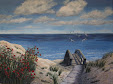
Showing posts with label salt marsh painting. Show all posts

Friday, May 31, 2019

How to Create Depth in Landscape Paintings, Part II--Tips and Techniques

"Summer Reflections"
     Our previous post discussed some principles of atmospheric perspective. This time, a few tips about achieving it in a landscape painting and other techniques for creating the appearance of depth. You may be surprised by the degree to which careful planning and analysis can be involved in painting.

     One technique I learned from my painting mentor Linda Blondheim is the use of glazes. I think glazes are particularly useful in acrylic painting because acrylic hues are usually quite sharp and clear. Distant elements in a scene should look hazy, a bit "fuzzy", and have a pale, cool hue. 

     Although I try to begin with appropriate soft tones in the background, they often need to be pushed further back visually. Acrylic glazing liquid is useful for this. Depending on the size of the area that needs to be modified, mix a puddle of acrylic glazing liquid with just a touch of blue, purple, or even soft aqua paint. After mixing it well, use a soft brush to stroke it across the area that needs softening, blending out the edges a bit so as to avoid an obvious line. Don't worry if it looks too muted or cloudy; it will usually be fine when dry. Let the area dry well (this will take somewhat longer than normal acrylic paint drying time). You can repeat the process with another layer or two until you are satisfied with the result. 

     The far background of the painting " Summer Reflections" was treated this way, and the tree just to the left of the center was also pushed back, but less dramatically (just one layer was enough to help that tree recede). The painting I showed you last time, "Look to the Hills" was painted before I knew about glazes. I remember finding it difficult to handle the distant hills, probably scrubbing on bluish purple mixed with lots of titanium white to produce that hazy appearance of distance. 
A study of a marsh scene

     The relative size of objects in a scene also helps define distance. Your eye may be better than mine, but I have discovered that I sometimes tend to make far away objects larger on canvas than they should be. Since I work from reference photos, I sometimes actually measure something on the photo, then use a proportion (oh no! math!) to translate that to my canvas. For example, if the photo is 4" vertically, and my canvas is 16" vertically, a far line of trees that is about 1/4" tall on the photo would only be about 1" tall on the canvas if I wanted to keep precisely the same proportions. 

     Of course, I do not duplicate the reference photo and am not bound by precise numbers and proportions. The exercise of measuring simply serves as an aid and a suggestion as I work, which is open to change if the result doesn't look right. A study of a marsh (pictured here) which I painted early in my art journey was a combination of a little measuring and lots of free-styling. Artistic license is alive and well in my studio--alongside some analytic thinking.

Question of the day: Do you think that planning, analyzing, and measuring are compatible with creativity?


Saturday, December 13, 2014

Blog Hop, Part II--My Creative Process

A great blue heron, seen at  Jacksonville's Hanna Park
Somewhere in Michigan (a scene from memories)

     Thanks again to Mary Paquet for the invitation to contribute to the blog hop project by responding to four questions. I continue here with the two last questions (see my previous post for Part I). And don't miss Jo Castillo's post on Monday, Dec. 15; I "tagged" her to be next in the blog hop and know that you will enjoy her lively creative sense and fine art works.

3) Why do I create what I do?

     I have always enjoyed sewing, knitting, and crocheting, but did not believe I had any talent for the visual arts I so admired. My love for color and for the beauty of the natural world kept tugging me toward giving landscape work a try.
Castaway Preserve Cedar
Castaway Preserve Palms

     Finally, about 11 years ago, I signed up for a week-long class in acrylic painting at the John C. Campbell Folk School in North Carolina--expecting to enjoy playing with color and making creative messes, then to toss them and return home renewed and relaxed. Well, with an excellent teacher and time to practice and learn, I painted pieces that I really liked. No tossing occurred, and I was hooked! Now, with more workshops and lots more practice behind me, some pieces even sell. More importantly, I find continued delight in creating acrylic landscapes and learning more all the time. Another Folk School class this year started me in silk painting as well--a fluid, often unpredictable medium that gives me additional pleasure. Creating art is a whole new world for me and a rewarding pursuit in semi-retirement.
Jacksonville Beach
Jacksonville Beach

4) How does my creative process work?

     While considering this question, I used the little search box at the top of my blog and entered "painting process". Oh, my--I have written many posts that include discussion of the creative process in general and of the particular processes involved in individual paintings or silk scarves.
An early work--A favorite retreat near Warwick, NY

Silk scarf (using resist)
Silk scarf (natural blending--no resist)
     So, what are the common threads in varying processes for individual pieces? For processes in making the silk scarves, please see recent posts on that topic.
     
     Nearly all landscape paintings begin with a photo or a cluster of reference photos. Since I am endlessly fascinated with coastal North Florida scenes and want to convey the beauty and serenity I find in exploring out-of-the-way places in this area, I study angles of light, color (how to capture the incredible range of greens?!), and take notes to accompany the photos I take from various angles and distances.

     In the studio, the next considerations are composition (including tonal balance--the lights and darks) and color palette. In our area, good composition almost always involves leaving out some of the lush growth and sometimes other elements. Sketching--very roughly--a few possible versions of a scene, sometimes moving the point of view or focal point, helps me decide on a final version. Here are some previous posts that discuss composition.

     Choosing a limited number of colors helps both in unifying a painting and still gives an incredible range of possible hues. I don't try to match the actual scene so much as try to capture a feeling while staying in a realistic color range. Sometimes I go for low contrast and cool serenity, sometimes warmer, lively vistas. Again, here are some previous posts with more about color and palette for interested readers.

      Revision is the other most crucial piece of my process. The beauty of acrylics (especially for a learner like me) is that they dry quickly and cover well. I can paint over an area that does not please me, take out a superfluous bush, or whatever. Sometimes before a major change, I try it out by cutting a shape out of construction paper that approximates the change, tape it to the canvas, and squint to judge the effect on the composition.

     When wrestling with a piece that is not cooperating, it helps to remind myself that any work is a valuable learning experience (taking myself too seriously is fatal). At times, I put a painting away for a time and work on something else. A fresh look later on often yields a solution.

Question of the day: Do you enjoy hearing about the creative process or watching artists work? Or would you rather simply experience the art for yourself with no background or explanation given?

Monday, December 8, 2014

Around the World Blog Hop Entry--My Creative Process

   
Outside a back yard at Jacksonville Beach, FL
I was invited to join an Around the World Blog Hop (google that and be amazed!) by fellow artist Mary Paquet, whose work and blog I always enjoy and admire. Please visit Mary Paquet's blog to see for yourselves and for her Blog Hop entry on December 1. In turn, I have invited Jo Castillo, a delightful, talented artist and prolific blogger to post on Monday, December 15. All the past blog hop entries I have visited are fascinating as a variety of artists each answer four questions about their work and creative process.

     The invitation is welcome both because 1) I am a relatively new artist and 2) my blog is a mix of posts about both acrylic landscape painting and silk scarf painting AND lots of other aspects of creative living, including travel, cooking, exploring coastal North Florida, and more. I am honored that more established artists with more art-focused blogs to include mine. Thank you, Mary Paquet. My thoughts on the questions appear below (and, to spare you a truly endless post this time, will continue in a second post in a few days). Here and there a link will take interested readers to related posts on this blog. 

1) What am I working on? After a break from art due to travel, time with family and, well, the rest of life, I have several projects going now:
Matanzas River Bend
  • finishing touches on a gift for a friend--a 12" x 6" piece picturing a Matanzas River scene, just off the Atlantic Ocean. My friend has always loved the Matanzas Inlet area, near St. Augustine, Florida.
  • deciding what's next on a half-finished silk scarf with a purple iris motif; it needs more tonal contrast and/or some other revision (not pictured--stay tuned).
  • designing and making a scarf for a friend who wants it as a Christmas gift for someone special to her. She has a color scheme idea, and is trusting me for the rest. How scary is that?
  • A favorite scarf, painted in March
  • Finally, something new for me, planning a couple of paintings based on photos and memories of a recent time in Tuscany. Normally, I interpret scenes here in coastal North Florida because I know this area in depth. Can I capture the essence of a place only visited? Perhaps not, but I am hoping to convey my own impressions and appreciation of its beauty.
2) How does my work differ from others of its genre? Most bloggers, including me, regard this question as a stumper--hard to answer for oneself. Even some relative strangers have said that once they see a landscape I've painted, they recognize others as being my style, so the work does have distinctive elements. However, defining those elements is difficult. I'll mention a few common threads in most of the landscapes. Making scarves is simply too new for me to have developed a personal style; "experimenting" is the current mode in silk painting. (See posts on the week-long "art camp" silk painting class I enjoyed).  My landscape paintings usually include:
Another silk scarf favorite

  • A realistic style--although I "edit" actual scenes for good composition; they are far from photographic.
  • Many portray out-of-the way places that most people would pass without noticing. Prowling back roads, urban pocket parks, and nature preserves with my camera, I find quiet charm and beauty--painting ideas abound.
  • Water appears in a fair number of works. Here in Jacksonville, Florida, we enjoy the Atlantic Ocean (from a surprising variety of beaches), the mighty St. Johns River and a number of other rivers, quirky creeks (some of which would be called rivers in other regions--they are wide!), still ponds, and our bewitching, ever-changing salt marshes. I love both being near natural bodies of water and the challenge of painting water.
  • Marsh in Fort Caroline Preserve
  • Finally, the works reflect an effort to establish a clear focal point and visual path for the viewer.
Clear focal point, "Summer Reflections" 
3) Why do I create what I do?

4) How does my creating process work?

This post is long enough, so--hoping the blog hop police won't mind--I will post again in a few days with consideration of the last two questions.

   Don't forget to visit the delightful blog of fine artist Jo Castillo, who has agreed to be "tagged" as the next Monday blogger in this creative chain. Don't miss her post on December 15! 

Again, I am truly thankful to Mary Paquet for providing this opportunity. Given the many incredible blogs I have discovered following the chain from one creator to another, it took real self-discipline to stop browsing and post on time :).


Question of the Day: What are some delightful discoveries of people/ideas/visuals/blogs you have encountered recently as you browse the web?    

Sunday, September 16, 2012

Favorite Paintings from 2007 and 2008

     Thinking back on the relatively few years I have been painting, I browsed the photo file, viewing earlier works, and spent some time feeling grateful for this rewarding pursuit. A few favorite early paintings stood out, although each and every piece has some interesting features, and each represents creative learning and growing experiences.

     About nine years ago, a week-long painting course at the John C. Campbell Folk School in North Carolina awakened a whole new pleasurable undertaking for me. I had expected to relax, stretch my mostly analytical mind beyond its comfort level, have fun making some messes, and come home refreshed. Well, with an excellent teacher, all my expectations were met--except one. The paintings were not total messes at all. Not that they were great art, but they were pleasing to me beyond anything I had ever thought possible.


     Since then, I have learned much more and refined my painting skills with occasional local classes, guidance from my painting mentor, Linda Blondheim, and lots of practice. Painting is a whole new, unexpected source of joy.

     So, as I looked back, I  found three photos to show you, each representing a particularly pleasing achievement for me. Each work has elements I would do differently today, but they were the best I could do at the time, and that's good enough. No need to be overly self-critical about them (or to whine to you about the short-comings I see in them now). 

     It's interesting how differently artists view their own earlier work. In one painting class, a very good teacher said that she sometimes cringed when she saw some of the paintings she had sold years ago. She was somewhat ashamed of those earlier works. That seems a pity; clearly they appealed to the buyers (and probably to others). Further, regardless of other peoples' opinions, they represent a stage in her creative journey which contributed to where she is now. Linda Blondheim's attitude strikes me as healthier and more self-affirming; she enjoys looking back and values every one of her paintings, convinced that each was the best she could do at the time.

     So, without apologies, here are three personal favorites from 2007 and 2008. For each, clicking on the link will pull up an earlier post describing their creation in more detail. "Look to the Hills", an 18" x 24" landscape, interprets a meaningful visit to a retreat center in Warwick, New York. The 12" x 16" marsh scene recalls a delightful day kayaking with my husband and one son (and later became an engagement gift for our son and his fiancee). The 9" x 12" "Magnolia on Purple" was based on photos of magnolia blossoms on some neighbors' trees. Each work brought frustration as I confronted its challenges, and each was a significant learning adventure. 

     Life's journey is always surprising--what if I had listened to my conviction that I had zero artistic ability?--what if I had never tried painting? By the way, I also value other less successful (or even totally bungled) ventures along my journey for the contribution they have made to the person I am today.
Question of the day: What surprising discovery have you made about your own abilities?