Tuesday, July 30, 2019

Hand-painted Tropical Leaf Silk Scarf with Varied Greens on Blue Background

Tropical Leaf Silk Scarf in Varied Greens on Blue Background
     The idea of painting a design of tropical leaves on a silk scarf has been in the back of my mind for awhile. Recently, I completed this 60" x 11" scarf in blue and varied green hues after a number of sketches finally resulted in a design I liked. I blended several shades and hues of green for the leaves, because I wanted to make the scarf more useful, more likely to look nice with different outfits. The leaf designs were inspired by photos of plants in some of my husband's botanical books and from direct observation of plants in our coastal north Florida neighborhoods.

One end of tropical leaf scarf
     I don't know why I draped the scarf on this old couch for its photos, but have decided it doesn't look too bad there. The final steps to finish the work-- steam-setting the dyes, removing the gutta outlines in a naphtha soak, washing and pressing--are not yet done. However, I thought you might like a look at it anyway.

Other end of tropical leaf scarf
     All the colors, including the blue background, are blends of liquid French silk dyes. I love experimenting with colors and color combinations and am rarely disappointed with the results of the blends I've planned--although it can take some "tinkering" to get the shade where I want it. 

     I painted a very light, watered-down blue on the entire white scarf blank first, then outlined all the leaves and stems with gutta resist (more information on using gutta in the third paragraph of this post). That way, the outlines have some color, rather than just being white. The lighter leaves are a pale green painted over with yellow (which tends to push other colors away and creates a nice variegation in hues). The large philodendron leaf is several layers of olive. The smaller vine leaves are a blend of greens, again layered until the depth of color seemed right. The heart-shaped larger vine leaves are a blend of green and blue. I gave each of the leaves one coat before "drawing" the veins with gutta resist; that way the veins would have more color, rather than just retaining the light blue of the first coat of the background. Last, I finished the final coat or two of the blue background, randomly stroking a true blue over aqua, then blending them for a watery, varied appearance. Now this will join a couple of other scarves in the studio closet until I have enough for a steamer batch to set the dyes.

Question of the Day: What sort of scarf design would you like me to try next?


Sunday, June 30, 2019

How to Create Depth in Landscape Paintings, Part III--Perspective in Skies

"Clouds Moving In", 14" x 11" acrylic painting
One of my worksheets for "Clouds Moving In"
     For Part III in this little series of posts about perspective, we will consider sky (especially clouds). Obviously, the painting of a large field with various trees both near and far, for example, will demand careful creation of depth in the ways we have discussed in Part I and Part II. But what about the sky in that painting? I do know that skies seldom appear just one monotone hue from the horizon on up and so often shade my painted sky from cobalt, ultramarine, or even slightly purplish blue at the top of the canvas to a slightly more aqua and lighter tone toward the horizon. This suggests distance in the sky.

     But I hadn't considered cloud perspective much until my painting mentor, Linda Blondheim, was providing feedback on a work in progress. She pointed out that clouds usually appear larger when they are closer and are smaller (and often flatter) in appearance toward the horizon. Linda encouraged me to make a grid with a vanishing point at the horizon to refer to as I painted a cloudy sky. Sounds obvious, I guess, but I was not observing the principle consistently in my work.


     I used that tip in the 14" x 11" acrylic piece, "Clouds Moving In", pictured above. I wanted to show clouds building over the Atlantic from the Northeast, as they often do here in coastal north Florida. So, the vanishing point is left of center (north) in the reference grid at the top of my worksheet (pictured above, left).


"Spring Breeze",  24" x 18" acrylic painting 
"Sea Oats", 16" x 12" acrylic painting
     Of course, real clouds are various sizes at various distances, but I have realized that my painted skies are most convincing looking when I follow some logical perspective rules for clouds. The 24" x 18" piece, "Spring Breeze" illustrates the principle as does the 16" x 12" painting, "Sea Oats".

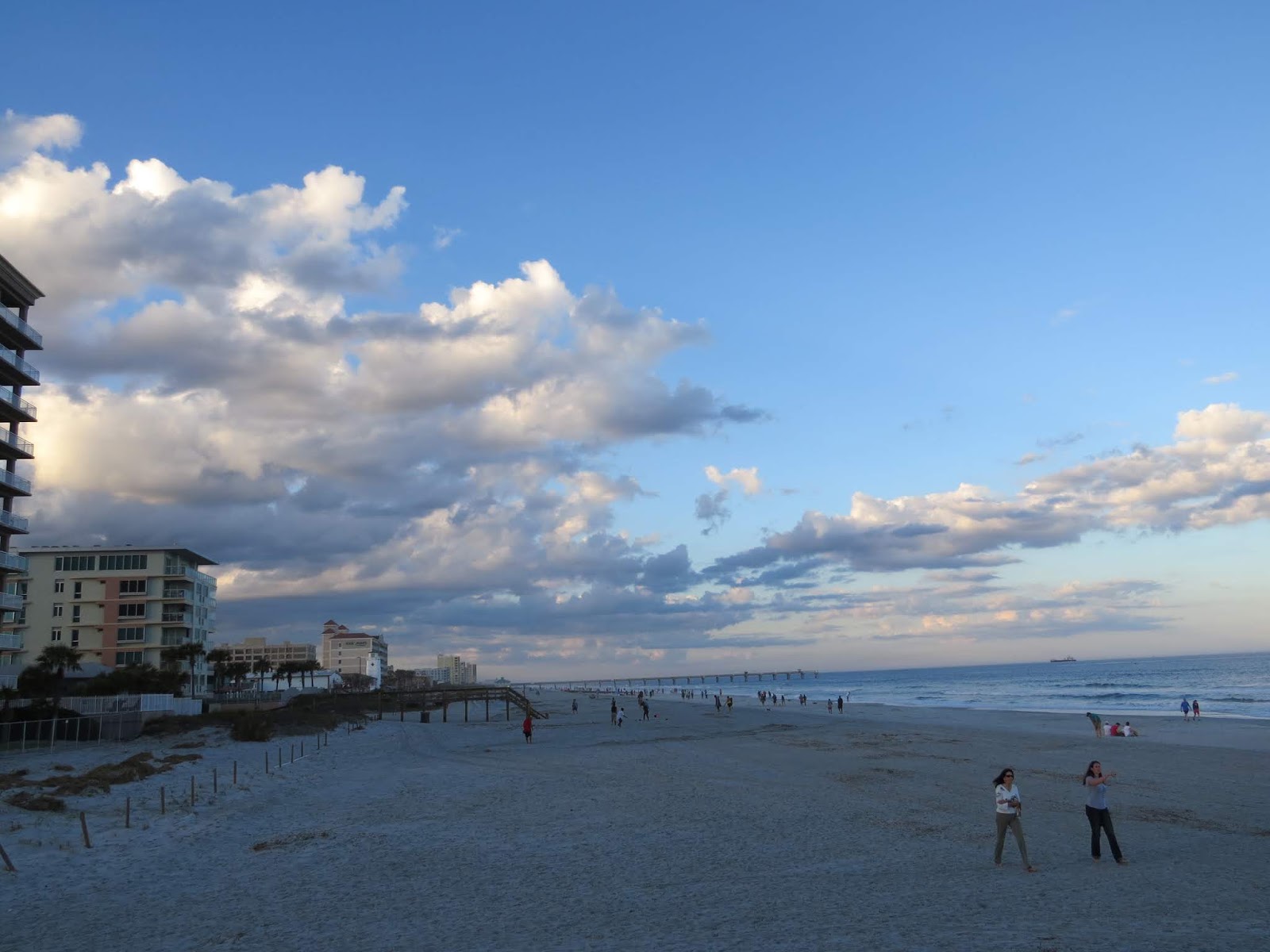
     Rather than more words today, I will simply share some of my photos that include clouds. Some are from my home area, some were taken for painting reference (not necessarily because they are stunning subjects in their own right), and some are from places we have traveled. Of course, you can click on any photo to enlarge it. You can draw your own conclusions about perspective in actual skies and how to create realistic depth in paintings that include clouds.
Jacksonville Beach, FL photo
Hanna Park, Jacksonville, FL photo


John C. Campbell Folk School, NC photo

Nova Scotia, Canada photo


Region of Tuscany, Italy photo
 Question of the Day: Have you ever thought about how clouds appear as they recede into the distance?

Friday, May 31, 2019

How to Create Depth in Landscape Paintings, Part II--Tips and Techniques

"Summer Reflections"
     Our previous post discussed some principles of atmospheric perspective. This time, a few tips about achieving it in a landscape painting and other techniques for creating the appearance of depth. You may be surprised by the degree to which careful planning and analysis can be involved in painting.

     One technique I learned from my painting mentor Linda Blondheim is the use of glazes. I think glazes are particularly useful in acrylic painting because acrylic hues are usually quite sharp and clear. Distant elements in a scene should look hazy, a bit "fuzzy", and have a pale, cool hue. 

     Although I try to begin with appropriate soft tones in the background, they often need to be pushed further back visually. Acrylic glazing liquid is useful for this. Depending on the size of the area that needs to be modified, mix a puddle of acrylic glazing liquid with just a touch of blue, purple, or even soft aqua paint. After mixing it well, use a soft brush to stroke it across the area that needs softening, blending out the edges a bit so as to avoid an obvious line. Don't worry if it looks too muted or cloudy; it will usually be fine when dry. Let the area dry well (this will take somewhat longer than normal acrylic paint drying time). You can repeat the process with another layer or two until you are satisfied with the result. 

     The far background of the painting " Summer Reflections" was treated this way, and the tree just to the left of the center was also pushed back, but less dramatically (just one layer was enough to help that tree recede). The painting I showed you last time, "Look to the Hills" was painted before I knew about glazes. I remember finding it difficult to handle the distant hills, probably scrubbing on bluish purple mixed with lots of titanium white to produce that hazy appearance of distance. 
A study of a marsh scene

     The relative size of objects in a scene also helps define distance. Your eye may be better than mine, but I have discovered that I sometimes tend to make far away objects larger on canvas than they should be. Since I work from reference photos, I sometimes actually measure something on the photo, then use a proportion (oh no! math!) to translate that to my canvas. For example, if the photo is 4" vertically, and my canvas is 16" vertically, a far line of trees that is about 1/4" tall on the photo would only be about 1" tall on the canvas if I wanted to keep precisely the same proportions. 

     Of course, I do not duplicate the reference photo and am not bound by precise numbers and proportions. The exercise of measuring simply serves as an aid and a suggestion as I work, which is open to change if the result doesn't look right. A study of a marsh (pictured here) which I painted early in my art journey was a combination of a little measuring and lots of free-styling. Artistic license is alive and well in my studio--alongside some analytic thinking.

Question of the day: Do you think that planning, analyzing, and measuring are compatible with creativity?


Monday, April 29, 2019

How to Create Depth in Landscape Painting, Part I--Atmospheric Perspective

"Look to the Hills",  demonstrating atmospheric perspective
     Atmospheric perspective in landscape painting is one tool artists have to create the illusion of depth on a flat surface. Using this tool well requires careful observation of subtle differences in color, contrast, and sharpness of objects as we see through the atmosphere from near to far. 

     No, it is not really complicated. Think about a time you could see a great distance into a scene with hills or mountains. The furthest ridges appeared bluer (or maybe a bluish purple) compared to near ridges as well as having softer edges (looking "fuzzier"). In general, colors become cooler as distance from the viewer increases, dark/light contrast lessens, and edges soften. A landscape artist needs to consider all these qualities carefully.

     I almost always paint from my own photos (as well as using field notes and sketches), but I have discovered that photos seldom show atmospheric perspective well. It is up to me to create that perspective as I paint. Merely copying a photo is unlikely to be effective in creating depth.
"On the Jones Creek Trail"

     Also called aerial perspective (although it has to do with looking through the air and whatever is in it, not at all with a bird's eye view), atmospheric perspective rendered well will make a stunning difference in your work. To create realistic looking depth, artists often exaggerate these effects.

     I am absolutely not an expert, but will show you a few paintings to illustrate my efforts at creating depth. "Look to the Hills", shown top right, pictures a favorite place near Warwick, New York with a long view into the distance. Notice that even though the distant foothills are heavily wooded, they don't look very green. Rather, they are a neutral sort of bluish shade with minimal appearance of contrast. Also, the far side of the valley is blurred and muted in color and tone, becoming a bit brighter and more defined nearer to the viewer. The trees, chair, and grasses closest to the viewer have sharper edges, more intense color, and greater light/dark contrast.

     "On the Jones Creek Trail" presents a different sort of challenge; the viewer cannot see very far because of heavy foliage. Here, you can see that I have definitely exaggerated the effects of atmospheric perspective to create several visual planes and to avoid a flat look. In my next post, I will describe some specific techniques I use with acrylics to paint landscapes with the appearance of depth.

Question of the day: Are you interested in descriptions of artists' techniques? What else would you like to hear about perspective?

Saturday, March 30, 2019

When Art Projects Go Wrong--Silk Scarf Mistake

     Recently, a silk scarf I was working on took a bad turn. All artists (I imagine) experience this on occasion with a project. Sometimes, there is a way to fix the situation and move on; sometimes it cannot be saved. In this case, I  could not fix the mistake, but was able to make the not-quite-ruined scarf reusable.
First stage--the background

Background from the other end
     The two photos of a scarf on a stretcher show the intended background for the piece. Painting wet-on-wet on a blank white scarf, I had made a shadowed pale aqua and blue ground on which I planned to paint large tropical leaves in various green hues. My original patterns--see photo of the design for one end of the scarf--were already sketched on heavy paper. The next step was to "draw" the design outlines on the scarf with gutta, a rubber-based resist. That's when it went wrong.

Design outline for one end of the scarf
The gutta and applicator 
     The gutta is applied with a small squeeze bottle through a metal tip with a small opening (see photo). The metal tips come in various sizes, and I think my mistake was using one with a medium opening at the top (it's still really tiny). The gutta flowed too fast and puddled, covering areas I intended to leave open. Every area covered with gutta would resist the French silk dyes and remain the background color. Using the metal tip with the smallest opening would have produced a thinner line of gutta and may have prevented the mess I ended up with. In some designs, this would not have mattered much; the design simply would have looked a bit different from what I'd intended. In this case, the leafy fronds on the left would have had undesirable aqua patches.

The gutta outlines, with messy overflow
     Even when the gutta is still wet, it cannot be wiped off, so I let the piece dry. What to do? I decided to start over and used the same dye blends in the same concentration as in the first scarf (glad I keep notes on my colors). Making no effort to duplicate the original background, I painted on the pale aqua and swirled in some blue. If all goes well this time, I hope to post the new, corrected version in the future.
Close-up of the messiest area

     Once all dye has been painted on, the finishing steps for a scarf (when using French silk dyes) are: steam setting the piece for an hour or more (I do several at once), soaking any scarves with gutta in naphtha to remove the resist (dry cleaning also works), then washing and pressing the scarves. 

     As an experiment, I soaked the original scarf in naphtha even though the dyes were not set. What's the worst that can happen?, I thought--the color will wash out or drastically fade, but the scarf might be reusable for another project. To my surprise, the color faded much less than expected. Now, I have two versions of an aqua/blue medley background to work with. Stay tuned.

Question of the day: Along with success stories, isn't it sometimes helpful to hear about a day that things went wrong for someone else?

Thursday, February 28, 2019

How I Prepared for the Holiday Pop Up Shop for Art and More

Hand-painted silk scarves on display
     Preparing for our Holiday Pop-up Shop was simpler than preparing for my own in-home studio open houses had been (index of those posts here), but it still required advance work and lots of lists. As I mentioned in my previous post, my neighbor initiated the pop-up shop and hosted it in her home this past November. We talked several times on the phone and in person a couple of months ahead and did some of the planning together, but she did the heavy lifting of clearing space in her spacious living/dining room and the attached office/studio, setting up tables for our displays, and purchasing nice cheeses, crackers, and fruit.
The paintings on the mantel

     My display space in her office/studio was well-lit and pleasant--as were the areas for her own art and the wares of other sellers participating in the larger living area. I brought my own tablecloth as a softer background for my hand-painted silk scarves and some smaller acrylic landscapes. There was room on a mantel behind me for a few larger paintings. So, how did I prepare for this event?


Smaller paintings on the display table
INVITATIONS:
Some of the supplies for the Pop-up Shop
     For my solo open studio receptions in the past, I had special invitation postcards printed and mailed them about 3 1/2 weeks before the event (one example; another example). For the Pop-up Shop, our host had requested us to limit our invitations to about 20 apiece so that her home was not overwhelmed--also so that she could post a general invitation at our neighborhood bulletin board and put up signs inviting passers-by to stop in. So, I purchased standard invitations to send, making sure that the information I wrote inside was complete and likely to attract interest in attending our event. The invitations were designed to arrive about 2 weeks before the event (Given the timing, I didn't want to go earlier and compete with Halloween for any one's attention).

     
OTHER PREPARATION DETAILS:
Close up of a painting's price tag
     Rather than plain price tags, I found pretty gift tags with room for the titles and sizes of paintings or the specifics of each scarf. It's surprising how much time it takes to do something as simple as to write out and attach price tags. The scarves were all freshly pressed, and the paintings wiped clean of any dust. I also had enough small bills to make change for cash customers and my receipt book ready. Small peach-colored gift bags with bright white tissue paper would hold purchased scarves and a roll of brown paper would wrap paintings to go home with customers. I used a pottery business card holder (visible in the photo of paintings on the table) and had flyers about my journey into making art ready to offer. 

     
SET-UP:
     Beginning set-up about an hour before our opening gave me plenty of time to take a few photos of my display and to meet the other sellers, who were each delightful and creative. Although I ended up wishing I had started a few of the prep tasks a day or two earlier (which seems to be typical for me :), my lists and the advance work I did paid off and all went smoothly. 

Question of the day: Are you typically well-prepared for things ahead of time, or are you a last-minute person? Or, like me, a bit of both that somehow works out?

Monday, January 21, 2019

In-home Holiday Pop-up Shop For Art and More

My display at the Holiday Pop-up Shop at a neighbor's home
     In early November, I participated in a Holiday Pop-up Shop at a neighbor's home. I offered landscape and seascape paintings and hand-painted silk scarves for sale. The event was my neighbor, Cheryl's, idea, and she had invited me some weeks before to join her and other sellers she knew for the one day event in her home. Although the price point of my paintings made selling them in that setting unlikely, I thought it would be a way to connect with some new people. Since my scarves are in the $60 - $70 range, I thought a sale was possible, but was quite ready to make the effort and to enjoy the experience--sales or no sales.

     Your response to previous posts about Open Studio Receptions I have held at our home (those posts are perennial favorites for visits) means I expect many readers to be interested in the planning, process, and set-up of the Pop-up Shop. Cheryl, our host, who has begun creating lovely watercolor/calligraphy greeting cards and other items recently, said that remembering those receptions at our house was one of the sparks for her pop-up shop idea. 

     With all the information I could cover, I'll write more than one post about our Holiday Pop-up Shop. Today, I'll begin at the event itself and back up to the details of preparation(that post here) at another time. Besides Cheryl and me with our art works, the sellers were a portrait and family photographer, a Younique makeup representative, and a woman who sells Paparazzi jewelry. The group provided a nice variety of offerings, and our guests/customers very much enjoyed the event. Many of them spent a fair amount of time circulating, chatting, and enjoying water or coffee with cheese, crackers, and grapes as well as shopping. 
A guest asking about my painting process

     The photo above shows my area, with a table provided by Cheryl, my own tablecloth and some paintings displayed on a mantel behind me. Oh, and by the way, I did sell a few scarves. More important, I think, is that I met wonderful people. Cheryl had encouraged us before we opened to focus on people and on our interactions with them more than on sales. She was right; we and our guests had a very enjoyable few hours, and sales did flow for each of us. Also, many people who spent time with me took my card and may contact me for paintings or scarves in the future.

Question of the day: Aside from on-line purchasing, what is one in-person holiday shopping experience that you especially enjoyed or gift purchase that felt extra satisfying?


Sunday, December 23, 2018

"Spring Breeze"--Ocean Beach Painting is a Christmas Gift

     "Spring Breeze", an 18" x 24" acrylic painting on gallery-wrapped canvas, has now been adopted. My sister and her husband had a spot in their new Maryland  home that they hoped I could fill with an Atlantic Ocean beach painting. I was thrilled to send them images of 5 available pieces in various sizes and palettes (some in shops and one still in our home). They chose "Spring Breeze", a scene at Jacksonville Beach, Florida about 14 miles from our home. The difficulties involved in satisfactorily completing this piece have made it more precious to me, and I'm thrilled that they will enjoy it and that it will stay in the family.

     I am delighted when family members or special friends accept the gift of a painting (or a hand-painted silk scarf--see earlier post about that). Although I would not take a chance on presenting someone with a painting they may not have chosen for themselves or which may not fit in their home, it is a true joy to give a painting away when I know the recipients like and want it.

     I hope you and yours have a meaningful and merry holiday season and that the joy of giving remains central in your lives. All of you who are faithful readers of this blog are a gift to me. Thank you for providing me the opportunity to share photos and thoughts with you, and a special shout-out to those of you who kindly share your own thoughts in response.

Question of the day: What is a gift you have received that seemed particularly precious or meaningful?

Friday, November 30, 2018

Deep Rose and Grey Hand-Painted Silk Scarf--Where Design Ideas Come From

Deep Rose and Grey Scarf before steam setting or removal of the gutta resist
     This 11" x 60" hand-painted silk scarf in deep rose and grey with white outline flower design sold so quickly after I completed the final finishing steps that I only have mid-stage photos. I think that's a happy reason for the lack of a better picture to show you! When the piece was completely finished, the colors were more intense, and the white outlines purer and brighter. 

     I'm often asked where I get ideas for my landscape paintings or hand-painted silk scarves. So, here is the story of the genesis of this scarf design. 

     Each of the scarves I make is a one-of-a-kind original. Although I sometimes adapt a previous design in a new color combination or use a motif from a previous scarf in a new way, there are never two scarves exactly alike. In fact, the nature of the hand-painting process makes creating duplicates impossible. The dye flows or blends differently each time; my free-hand sketching with the gutta resist turns out differently; etc.

     For scarf ideas, I keep a file of pages torn from magazines, catalogs, and other sources to page through to get my creative juices flowing. Sometimes, an unusual leaf or flower in nature or something in one of my own photos sparks a design element idea. I also have notebooks with rough sketches or descriptions of ideas that cross my mind. For this rose and grey scarf design, the initial source was a catalog picture of a black knit top with a large white abstract snowflake outlined on the front. Usually I outline motifs in gutta and fill in with a different color or colors than the background. This is the first time I have "drawn" with gutta resist on the blank white scarf but did not fill in the design to contrast with the background. Instead, the white outline stands out against a solid two-color scarf.

     The grey dye used had recently arrived from my supplier, Dharma Trading Company, with a couple of other new colors I'd ordered, and I was eager to try them. Rather than a single background color like the knit top in the catalog had, I thought I'd make a few bands of grey alternating with cranberry or burgundy. Another new color in my order was a darker burgundy with more of a brown undertone than I had expected. So, as I experimented on scrap white silk, I added enough light rose to the burgundy to make a color I liked with the grey.

     So, a new, one-of-a-kind scarf was born. I'll definitely use elements of this design again in other colors, with other motifs, or maybe similar motifs in different sizes or a different layout. Stay tuned. There are always more ideas in my inspiration file and design doodle and thoughts notebooks than there will ever be time to make.

Question of the day: Do you sometimes wonder how ideas for some of your favorite art pieces came about?


Wednesday, October 31, 2018

Two Beach Paintings--Two Different Palettes

"Early Spring Dune"
     Artist's choice of color, color temperature, and palette are significant factors in the mood and overall impression of a painting on the viewer. These two acrylic beach paintings are both based on observation and reference photos from Jacksonville Beach on the Atlantic in Northeast Florida. Yet, they evoke different feelings, at least partly because of different color palettes. My style, an interpretive realism, does not attempt to copy what I see, but to represent my feeling and impression of the natural scene, so I sometimes modify colors.

     When I first began painting, I tested colors and color combinations but did not restrict the palette for a given work. I chose tube colors and various blends of those colors according to the scene and my inclination. Later, when I learned to limit the palette for each work, the results were much more unified, cohesive, and pleasing (at least to me).

     The first painting, "Early Spring Dune" with a view outside the white wall of an oceanfront home and yard, has stronger, clearer, warmer hues, as well as sharper edges than the second. The palette included: Cerulean blue, Paynes grey (which is bluish), Sap green, cadmium red deep, burnt sienna, Naples yellow, buff, white, and a touch of black in a few shadow mixes.


"Sea Oats"
     In the second piece, "Sea Oats", a softer light glows from a partly cloudy sky later in the day. Considerable artistic license inspired this palette because the reference photo was taken on such a grey day that it almost looks like a black and white print. Memories of mature sea oats at different times of outdoor study informed my color choices. The palette for this work included: cobalt blue, Paynes grey, permanent rose, yellow ochre, burnt umber, buff, white, and a bit of black. The hues were softened by blending some with their complements or with gentle neutrals. You may notice that the blue and yellow chosen are cooler than those for "Early Spring Dune". Using permanent rose was a mistake for this piece, by the way; although a lovely shade, it is strong and can be difficult to handle. Regarding the choice as a learning opportunity, I blended the rose into submission, practicing on heavy art paper until the result worked.

     Same off-shore island, different paintings. You may prefer one or the other, but I enjoy exploring a range of palettes and always keep a record of each painting's palette in the file with my reference photos, sketches, and a photo of the completed painting. Those files have sparked many new adaptations of previously used palettes.

Question of the day: What differences do you notice in your response to the two paintings?      

Sunday, September 16, 2018

Brown, Rust, and Beige Hand-painted Silk Scarf Using Shibori Technique

     Using two new dye colors from a recent order as well as a deep brown already in my stock, I experimented with another Shibori technique somewhat similar to the flag fold technique I used for a coral toned scarf. I was delighted with the results--once again a complete surprise for me as a newbie to this style of silk dyeing. In fact, I couldn't wait to show this scarf to you. The dyes still need to be steam set, which will make the colors even richer. Then the scarf will be ready for its first thorough washing and careful pressing. Here, it still sports its Shibori folds.


center section detail
     The scarf's rich tones resulted from two factors. One is the inherent beauty of these French silk dye colors. The other was my concern that the dyes were not penetrating deeply enough into the folds, leading me to soak certain areas with additional dye. For this scarf, I was trying to color it all, not to leave any spots white.

     These techniques are wonderful and sort of magical. The dye flow follows the folds and settles more heavily on the edges of the folds as the silk dries. I do not think that even an experienced Shibori artist could control or predict the exact design results. With less color saturation, this particular folding pattern produces a simpler chevron design. Obviously, my heavier use of dye resulted in a more complex final pattern.


detail from one end
detail from the other end
     A few more details for those of you who are interested in my process: I folded this 11" x 60" silk scarf lengthwise just four times rather than the six times used on the coral scarf. Then, the diagonal folds were made in a back and forth triangular pattern rather than the flag fold used on the ends of the coral scarf. Each fold was pressed as I worked. The result was a long folded strip rather than the triangular packet of the flag fold technique. I folded the strip in half lengthwise, soaked it with water, and placed it in a large aluminum foil pan to dye. Soaking a brush (about 3/4" wide) in one color after another, I saturated various areas, some larger than others. The scarf air-dried for more than 24 hours. When I unfolded it, magic!

     There is a link to an earlier post about the flag folded coral scarf above. One other Shibori inspired scarf using a twisting method stars in another previous post. Both posts credit the author and book that guided my experimentation; this brown, rust, and beige scarf also followed directions from that wonderful book, adapted my own way.

Question of the day: My landscape painting and silk scarf dyeing and painting give me a variety of creative experiences, some mostly under my control and some free form and surprising like Shibori dyed scarves. Do you prefer one kind of creativity over the other--loose or controlled? I thrive on both.


Thursday, July 19, 2018

A Favorite Painting Technique Book


     The Simple Secret to Better Painting by Greg Albert inspires and teaches me something every time I pick it up. This book comes home from the public library every now and then so that I can find a new idea in it--or remind myself of helpful ideas that are easy to forget as I paint. 

     Today's post is rewritten from an entry I made in 2013. This super book came to mind today as I drove to the library, so I picked it up while I was there and decided to post about its wisdom again for new readers--and longtime readers as well.

     Greg Albert's "simple secret" is the wonderful lesson of variety within balance, which I consider a metaphor for a meaningful life as well as a basic principle for painting and other visual arts. His simple secret, which he calls the one central rule for design is: "Never make any two intervals the same." There is a wealth of valuable information contained in his applications of this rule. If you have any interest in the visual arts or in any facet of design, this book is worth reading and rereading.
"Sea Oats"

     Mr. Albert uses painting examples to expand his simple rule to intervals of distance, shape, tonal value, color, and more--no sort of interval should be the same, he maintains. This advice is helpful at all stages of a creative process. Here's an example. One of my recurring mistakes is to paint too much in mid-tone values--without fully realizing it along the way--rather than to include enough areas of more intense dark and very light values to balance the mid-tones. 


     In my more recent paintings, I started with a tonal value sketch, but sometimes still ended up with insufficient contrast. During my revision process, the value range often has needed to be extended. Mr. Albert's rule is a reminder to include a broader value range as well as to make sure that the areas (or "intervals") of dark, light, and mid-tone should not be the same in overall size. A previous post about a painting called "Sea Oats" shows one example of revision that included adding some very light clouds and brightening light areas on a dune as well as deepening just a few very dark highlights.
Hanna Park reference photo
"Hanna Park Heron"

     Another painting that required some added interval variety was "Hanna Park Heron"  (the colors in the photo of the painting are less intense than in the actual painting), shown here with the original reference photo (more about this painting was posted earlier also). Notice how the reference photo's background vegetation repeats types of plants, shapes, colors, and sizes equally--not ideal for artistic composition. Then, notice the additions of the two light grey dead trees to change that sameness and to provide strong verticals across from the large palm trunk. You will be able to spot other changes from the reference photo and to consider my possible reasons for them.

Question of the day: What does an idea like "variety in balance" bring to mind for you?