
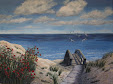
 On April 3rd, I showed you a photo of a sandpiper at the edge of foamy surf at Jacksonville Beach, a scene I wanted to try to paint. Here is that photo again and the current work-in-progress (looking a bit darker than it is "in person"), a study in acrylics on a 9" x 12" canvas board. Click on the photo to enlarge it if you wish. The painting was challenging because of the relative lack of color in the photo, but that was an advantage in using the scene to study balance in tonal values. For non-artist readers, by "values" we mean the tonal range of darks and lights (and all the in-betweens) regardless of color. The aim was for most of the painting to fall in a mid to mid-light range with a secondary emphasis on the brightest light tones in the foam and highlights on the sandpiper. That way, I reasoned, the darkest areas, on the bird, the shadow edge of the foam, and the weeds washed up by the surf, would stand out and draw the viewer's eye. On the whole, I am pleased with the way the tonal balance has worked out.
When I put this piece away for awhile a few weeks ago, I thought that it needed major work. However, a few added touches brought it to this point, and it seems (possibly) near completion. As I've mentioned before, knowing when to stop working on a painting, when further "fussing" might make it worse rather than better, is an art in itself. For now, it is perched on a small easel on a nightstand for contemplation :>).
You can see some changes from the photo, the main one being to reposition our feathered friend so that she did not run out of the composition. The line of foam is tweaked a little in shape. Originally, I had planned to change that line of foam somehow because it is so thick that it almost looks phony. However, at this point, it follows the look in the photo and seems pleasingly whimsical. To give a touch of perspective, I used warmer grey tones in the foreground, bluish greys in the mid-ground, and more or less straight greys mixed with white in the background. Almost none of the grey tones are simply mixes of black and white although some are variations of Paynes grey, a wonderful deep bluish grey. From the foreground to the foam line, most of the grey tones come from a mix of burnt sienna with either cerulean or ultramarine blue, lightened with white. Any grey or brownish neutral that results from mixing complementary (or near-complementary) colors is livelier and more interesting than a mix of black and white.
Some of you readers are avid bird watchers and may wonder precisely what variety of sandpiper this is. Answering that is well beyond my level of bird identification skills. Even our small guide to field identification of birds lists a couple dozen varieties of sandpiper, a daunting number of them found on Florida's coast. The dark legs narrow down the possibilities, and it seems most like a sanderling to me in size (about 6 or 7 inches long), beak shape, and coloring. The sanderling, like many Florida shorebirds, is brown and white speckled in summer, more black and white in winter. My photo, taken a few years ago in October, seems to show the winter plumage coming in.
Question of the day: Isn't it fun to tackle challenges--like painting a scene with little color?




 Posts
Posts

