


 Several weeks ago, on a pleasant North Florida winter day, Mark and I took a day trip to Crescent Beach, Florida. This distinctive area is southeast of Jacksonville (where we live), an off-shore island south of St. Augustine and north of Daytona. Although North Florida beaches on the Atlantic Ocean share similarities, each has its own particular look as well as variations in vegetation, bird life, and animal population.
 The Matanzas Inlet adds to the interest we had in the area; it is one of the few inlets around which is not protected by jetties and thus gradually moves with the currents and tides. The Matanzas Inlet leads from the Atlantic Ocean to the inland waterway, which runs on the inland side of a string of off-shore islands along North Florida. Of course, the inland waterway runs all the way along the Atlantic Coast, but varies from place to place in whether it follows rivers near the ocean or other available waterways. In one of the photos, you can see the large pond-like area into which the inlet flows and across the water, (if your eyes are sharp; it is by no means a close-up) the Fort Matanzas National Monument, built by the Spanish. More information about the Fort here. In the photo that shows the ocean on the left and dunes on the right (looking south), you may be able to discern the inlet by a narrow fog layer extending in toward land, with homes on the far side. Our friends who fish say that the inlet is prime fishing territory for many species of fish. One friend, who hand weaves casting nets in the tradition of her Cherokee ancestors, particularly likes casting for mullet here. She watches dolphins feeding near shore in the ocean for clues to the running of the mullet. Sometimes a group of dolphins actually cooperate in fishing, as some of them "herd" hundreds of mullet toward other dolphins so that they can surround them and feed.
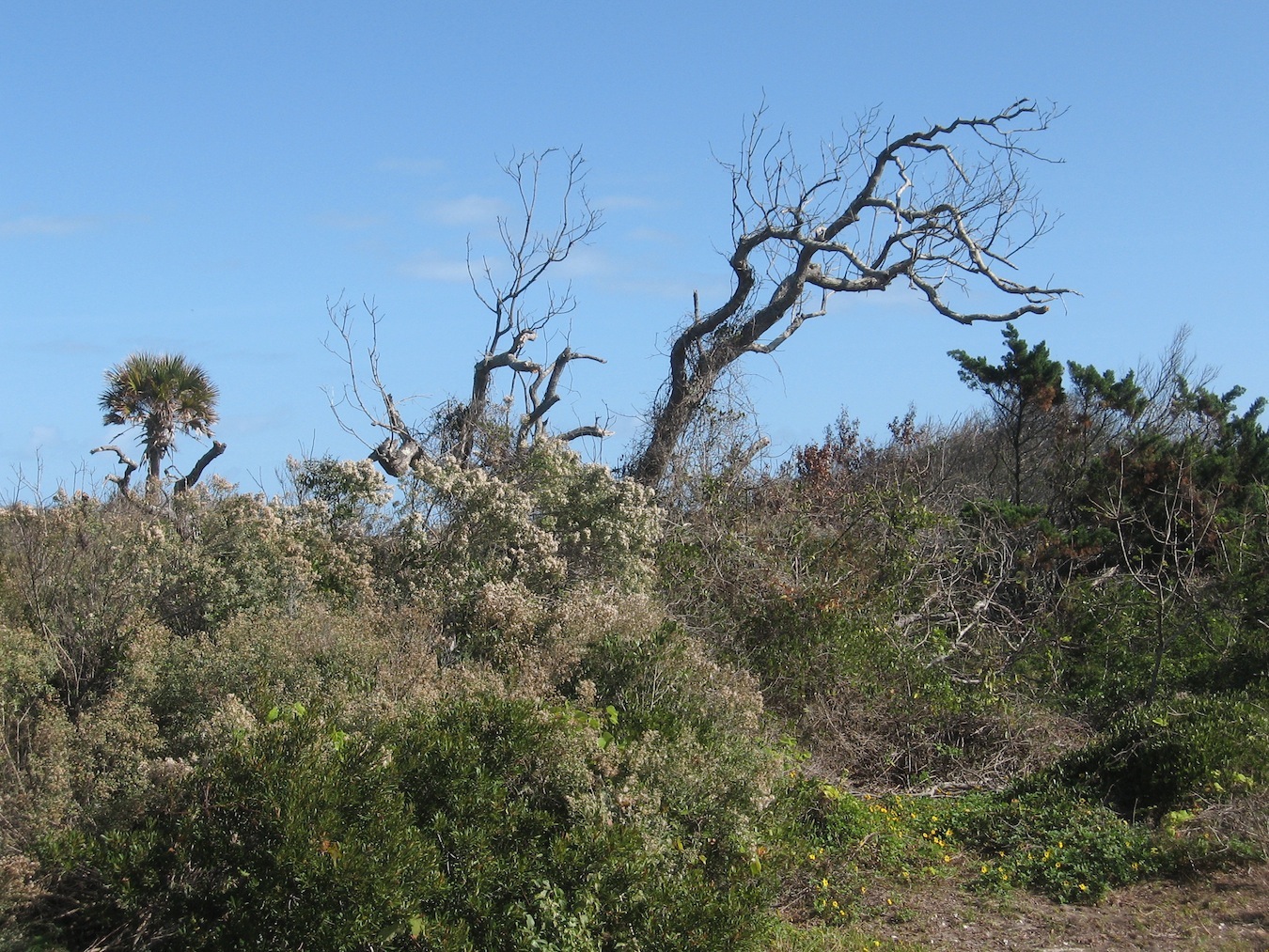
Our day was delightful. In the photos, you can see the beach and ocean, fairly heavy with haze that day, the boardwalk protecting the dunes and their vegetation, the inlet, and--a real treat for us--a gopher tortoise, one of several who had just come out of their underground den. (Correction: I can't believe I typed "turtle" and then didn't notice for a few days; this is a true, solely land-dwelling tortoise, not a turtle at all). We are indebted to a couple of tourists coming along the walkway as we were headed in from the beach who alerted us to their sighting of these shy, elusive animals. Sadly, their numbers are declining, a great loss due to their pivotal importance in a whole mini-ecosystem. As my Audubon Field Guide to Florida says, " [their] methodically constructed tunnels are . . . not only home to the declining Gopher Frog and Eastern race of Indigo Snake, but 300 other species of vertebrates use or rely on the burrows for shelter or food." If you look carefully in the photo with a dead-looking small tree at the top, you can see the large opening to the gopher turtle burrow at the lower right. As always, you can click on any photo to enlarge it.
One important aspect of our "creative everyday life" is exploring our rich and varied local area whenever we can. Those of you who are regular readers have seen other posts about our adventures in Coastal North Florida.
Question of the day: Do you agree with us that some of the best travel experiences can be found near home for curious, creative day trippers and explorers?




 Posts
Posts

